Breakfast · ALWAYS FREE
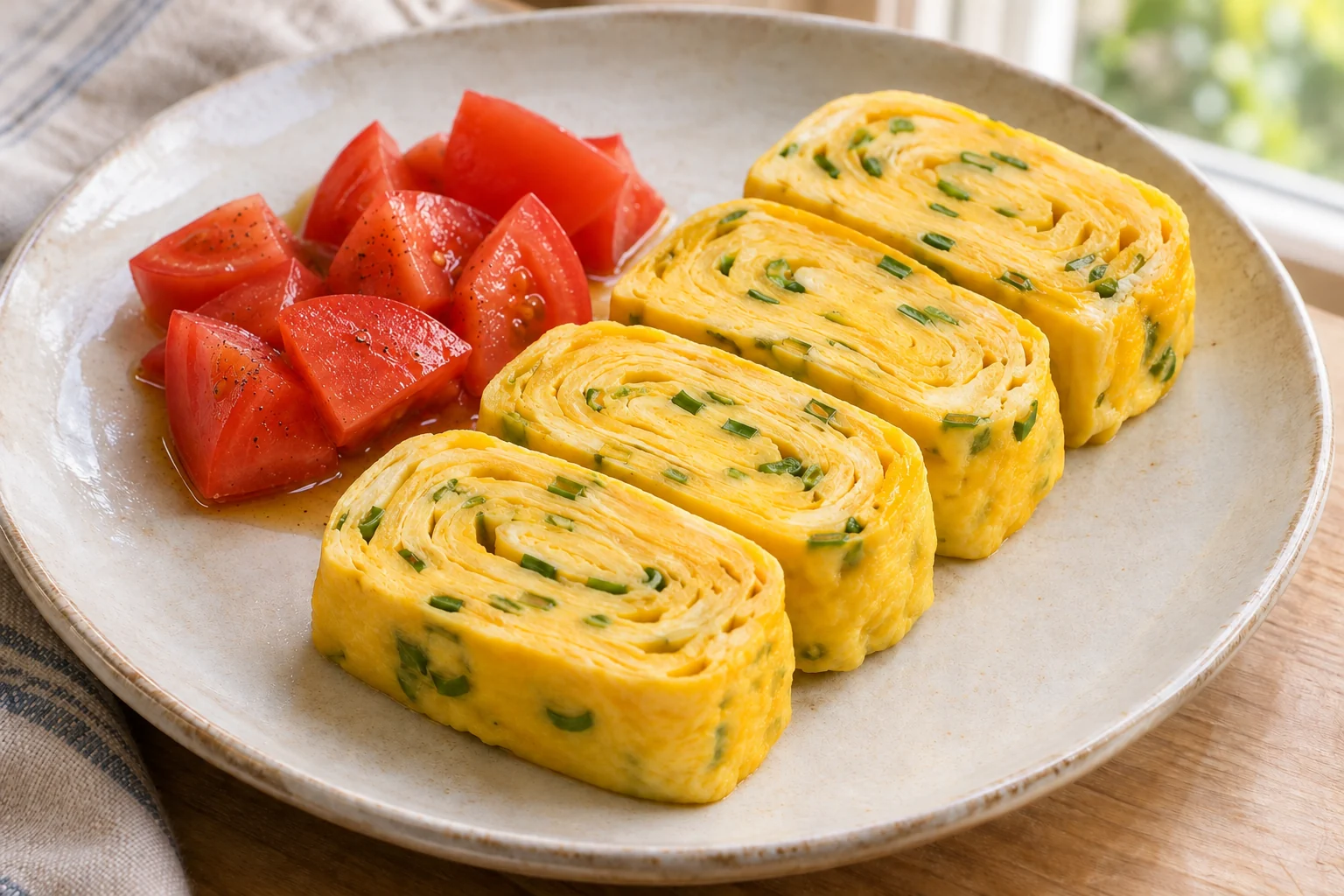
Scallion rolled omelet with tomato salad
Thin fully cooked egg layers rolled around scallions, served with a simple tomato salad.
Ingredients
Volumes are approximate. For baking, use a scale; Metric keeps the specified gram weights.
Let’s make it
- Beat eggs with water, soy sauce, sugar and scallions just until combined, avoiding excess foam. Divide into two equal batches. Mix tomatoes with all their juices, vinegar, sesame oil, salt and pepper; set aside while eggs cook.
- Warm an 8-inch (20 cm) nonstick skillet over medium-low heat. Reserve about 1 ½ tsp (6 g) canola oil for each omelet roll and brush a little of that allocation over the pan. Pour in one-quarter of the first egg batch and tilt into a thin layer. Cook until the surface is nearly set, about 1–2 minutes, then roll it from one side into a loose log with a flexible spatula.
- Move the log to one edge, brush exposed pan with a little more of its measured oil and pour in the next quarter, lifting the log briefly so egg flows beneath it. Let that layer nearly set, then roll the existing log back over it. Repeat with the remaining two quarters and all remaining oil allocated to that roll. Turn the finished roll gently over low heat for 1–2 minutes until the center reaches 160°F (71°C) and all layers are fully set. Repeat with the second egg batch and remaining 6 g oil.
- Rest rolls for 3 minutes on a board, then cut each into 6 pieces. Serve 4 pieces and one-third of all tomato salad per portion. Refrigerate leftovers within 2 hours; use within 3–4 days and reheat omelet to 165°F (74°C).
Estimated nutrition
Per serving · 1 of 3- Calories
- 223 kcal
- Protein
- 13.9 g
- Total carbohydrate
- 7.2 g
- Total fat
- 15.4 g
- Total sugars
- 4.9 g
Calculated from the listed ingredients and yield. Brands, draining, cooking and portioning can change the result. Not a laboratory analysis.
Calculation notes & sources
ESTIMATED per serving. Brand, crop, preparation, draining, pan residue and substitutions change actual nutrition. Not laboratory analysis. Each ingredient retains its primary food description and state. All listed ingredient masses are counted; cooking moisture changes do not change the stated portion count. No generic nutrient-retention factor is invented. Calories are kcal; protein, total carbohydrate, fat and total sugar are grams. Total carbohydrate includes fiber and is not net carbohydrate. Fiber and sodium are not displayed. Equal portions or explicitly counted items define the stated recipe yield. US/Metric display changes do not change these canonical inputs. Primary-source supplements are retained per ingredient where USDA lacks a field; missing values are never silently changed to zero. All tomato salad and dressing divided among three servings. Contains egg, soy, wheat and sesame; use plain sauce ingredients without dairy additives. Rolled egg is fully cooked, not served runny.
View the ingredient calculations · Source 1Why it’s in this collection
- Vegetarian: Complete ingredient review of Scallion rolled omelet with tomato salad: whole eggs without shells (about 6 large eggs); water; reduced-sodium soy sauce made with soy and wheat; granulated sugar; scallions; canola oil; raw tomatoes; distilled vinegar; sesame oil; salt; ground black pepper. No meat, fish, gelatin or animal-rennet cheese is listed; eggs or dairy may be present.
Required label checks: Review the complete listed ingredients and all product labels. Accompaniments and substitutions require a new screen. Processing aids and cross-contact have not been certified.
Supporting reference · Supporting reference - Dairy-Free: Complete ingredient review of Scallion rolled omelet with tomato salad: whole eggs without shells (about 6 large eggs); water; reduced-sodium soy sauce made with soy and wheat; granulated sugar; scallions; canola oil; raw tomatoes; distilled vinegar; sesame oil; salt; ground black pepper. No milk, butter, cream, cheese, yogurt, whey or casein is listed. Breadcrumbs, where used, must meet the explicit milk-free label condition.
Required label checks: Review the complete listed ingredients and all product labels. Accompaniments and substitutions require a new screen. Processing aids and cross-contact have not been certified. Check packaged products, especially breadcrumbs, for milk-derived additions and cross-contact.
Supporting reference
Calculations are estimates from the specified ingredients and portions. Brands, trimming, substitutions, and cooking losses change the result. This is recipe guidance, not individualized nutrition or medical advice.
Times are estimates. Images illustrate the dish; check ingredients and portions for your needs.
Use a food thermometer for meat, fish, and egg dishes. Refrigerate perishable food within 2 hours, or 1 hour above 90°F (32°C). Reheat leftovers to 165°F (74°C). Safe cooking temperatures · USDA leftover guidance