Pasta · ALWAYS FREE
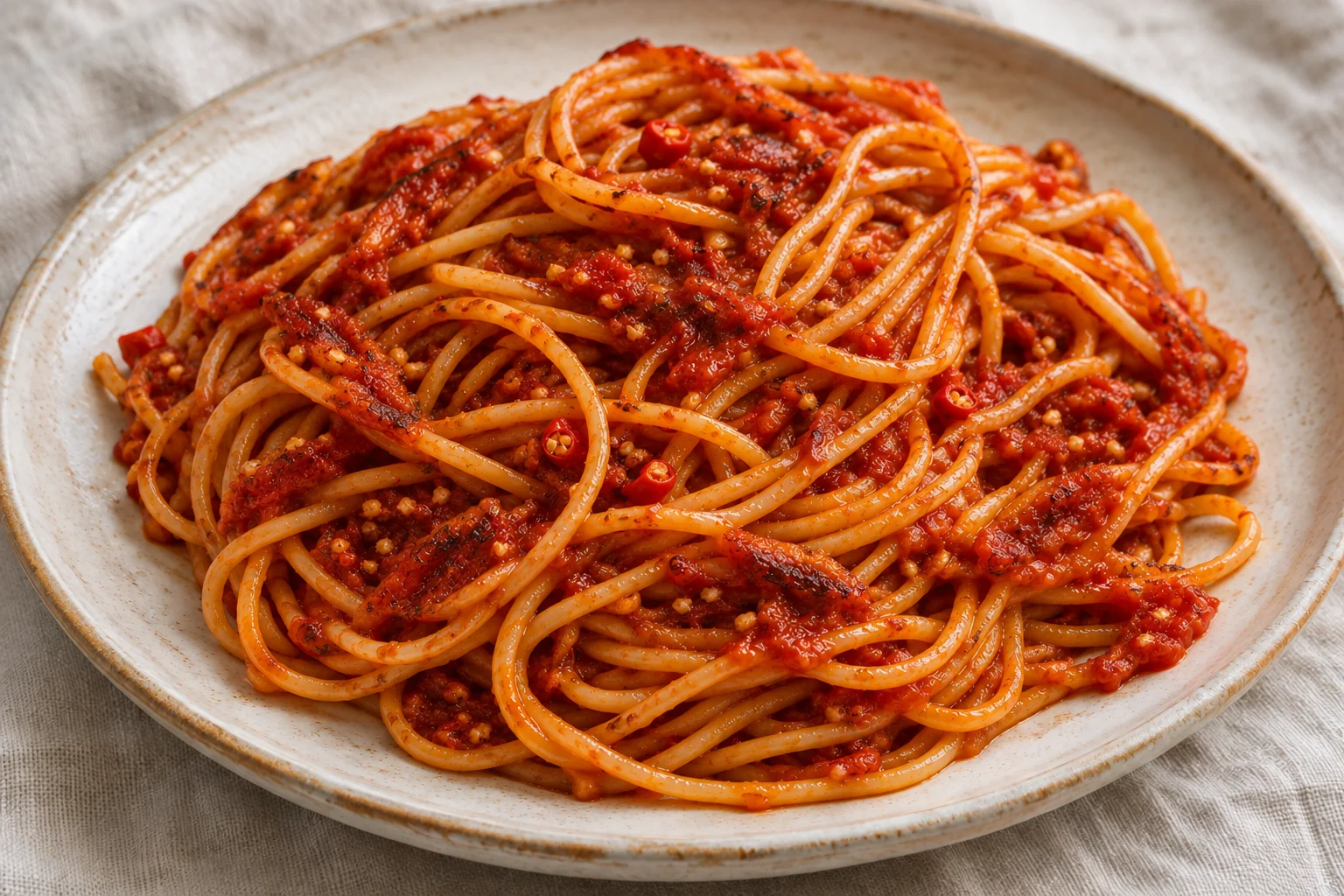
Skillet-charred tomato spaghetti
Dry spaghetti toasted in a wide skillet and cooked with gradual additions of hot tomato broth.
Ingredients
Volumes are approximate. For baking, use a scale; Metric keeps the specified gram weights.
Let’s make it
- Combine crushed tomatoes, tomato paste, measured water and salt in a saucepan. Bring to a gentle simmer and keep hot. Use a heavy 12-inch (30 cm) skillet wide enough for the spaghetti to lie flat; avoid an undersized pan.
- Warm oil over medium heat. Add garlic and chili for 30–45 seconds without letting the garlic blacken. Add dry spaghetti in a broad, shallow layer. Spoon about 5 ¼ oz (150 g) of the hot tomato broth over it and cook for 2–3 minutes until the underside begins to toast and the sauce sizzles.
- Turn the strands carefully with tongs. Add the remaining hot broth in roughly about 7 oz (200 g) additions, allowing each addition to mostly absorb before adding more. As the pasta softens, spread it back across the pan and leave short undisturbed intervals to develop deep red-brown patches. Continue for 25–35 minutes, using all broth, until spaghetti is tender with a slight bite and the sauce clings rather than pools. Reduce heat immediately if garlic or sauce smells acrid; aim for browned patches, not blackened food.
- Serve immediately, dividing all pasta and sauce into four portions. Refrigerate leftovers within 2 hours; use within 3–4 days and reheat to 165°F (74°C). The browned texture softens during storage; reheat gently with a little water to prevent scorching.
Estimated nutrition
Per serving · 1 of 4- Calories
- 430 kcal
- Protein
- 12.7 g
- Total carbohydrate
- 69.9 g
- Total fat
- 11.6 g
- Total sugars
- 7.6 g
Calculated from the listed ingredients and yield. Brands, draining, cooking and portioning can change the result. Not a laboratory analysis.
Calculation notes & sources
ESTIMATED per serving. Brand, crop, preparation, draining, pan residue and substitutions change actual nutrition. Not laboratory analysis. Each ingredient retains its primary food description and state. All listed ingredient masses are counted; cooking moisture changes do not change the stated portion count. No generic nutrient-retention factor is invented. Calories are kcal; protein, total carbohydrate, fat and total sugar are grams. Total carbohydrate includes fiber and is not net carbohydrate. Fiber and sodium are not displayed. Equal portions or explicitly counted items define the stated recipe yield. US/Metric display changes do not change these canonical inputs. Primary-source supplements are retained per ingredient where USDA lacks a field; missing values are never silently changed to zero. All tomato, pasta, oil and aromatics are served. Choose plain pasta without egg, dairy or animal ingredients for vegan/dairy-free tags. Contains wheat.
View the ingredient calculations · Source 1Why it’s in this collection
- Vegan: Complete ingredient review of Skillet-charred tomato spaghetti: dry enriched wheat spaghetti without meat ingredients; canned crushed tomatoes; plain tomato paste; water; olive oil; peeled garlic; fresh red chili; salt. No meat, fish, eggs, milk, honey, gelatin or other animal-derived ingredient is listed. Select vegan-labeled sugar or other processed ingredients when their processing source is uncertain.
Required label checks: Review the complete listed ingredients and all product labels. Accompaniments and substitutions require a new screen. Processing aids and cross-contact have not been certified. Check sugar, vinegar, olives, capers and packaged products for animal-derived processing aids or additions.
Supporting reference · Supporting reference - Vegetarian: Complete ingredient review of Skillet-charred tomato spaghetti: dry enriched wheat spaghetti without meat ingredients; canned crushed tomatoes; plain tomato paste; water; olive oil; peeled garlic; fresh red chili; salt. No meat, fish, gelatin or animal-rennet cheese is listed; eggs or dairy may be present.
Required label checks: Review the complete listed ingredients and all product labels. Accompaniments and substitutions require a new screen. Processing aids and cross-contact have not been certified.
Supporting reference · Supporting reference - Dairy-Free: Complete ingredient review of Skillet-charred tomato spaghetti: dry enriched wheat spaghetti without meat ingredients; canned crushed tomatoes; plain tomato paste; water; olive oil; peeled garlic; fresh red chili; salt. No milk, butter, cream, cheese, yogurt, whey or casein is listed. Breadcrumbs, where used, must meet the explicit milk-free label condition.
Required label checks: Review the complete listed ingredients and all product labels. Accompaniments and substitutions require a new screen. Processing aids and cross-contact have not been certified. Check packaged products, especially breadcrumbs, for milk-derived additions and cross-contact.
Supporting reference - Mediterranean: Complete ingredient review of Skillet-charred tomato spaghetti: dry enriched wheat spaghetti without meat ingredients; canned crushed tomatoes; plain tomato paste; water; olive oil; peeled garlic; fresh red chili; salt. Vegetables or legumes provide the principal bulk and olive oil is the added fat. This is an ingredient-pattern screen, not a clinical score or health-outcome promise.
Required label checks: Review the complete listed ingredients and all product labels. Accompaniments and substitutions require a new screen. Processing aids and cross-contact have not been certified.
Supporting reference
Calculations are estimates from the specified ingredients and portions. Brands, trimming, substitutions, and cooking losses change the result. This is recipe guidance, not individualized nutrition or medical advice.
Times are estimates. Images illustrate the dish; check ingredients and portions for your needs.
Use a food thermometer for meat, fish, and egg dishes. Refrigerate perishable food within 2 hours, or 1 hour above 90°F (32°C). Reheat leftovers to 165°F (74°C). Safe cooking temperatures · USDA leftover guidance