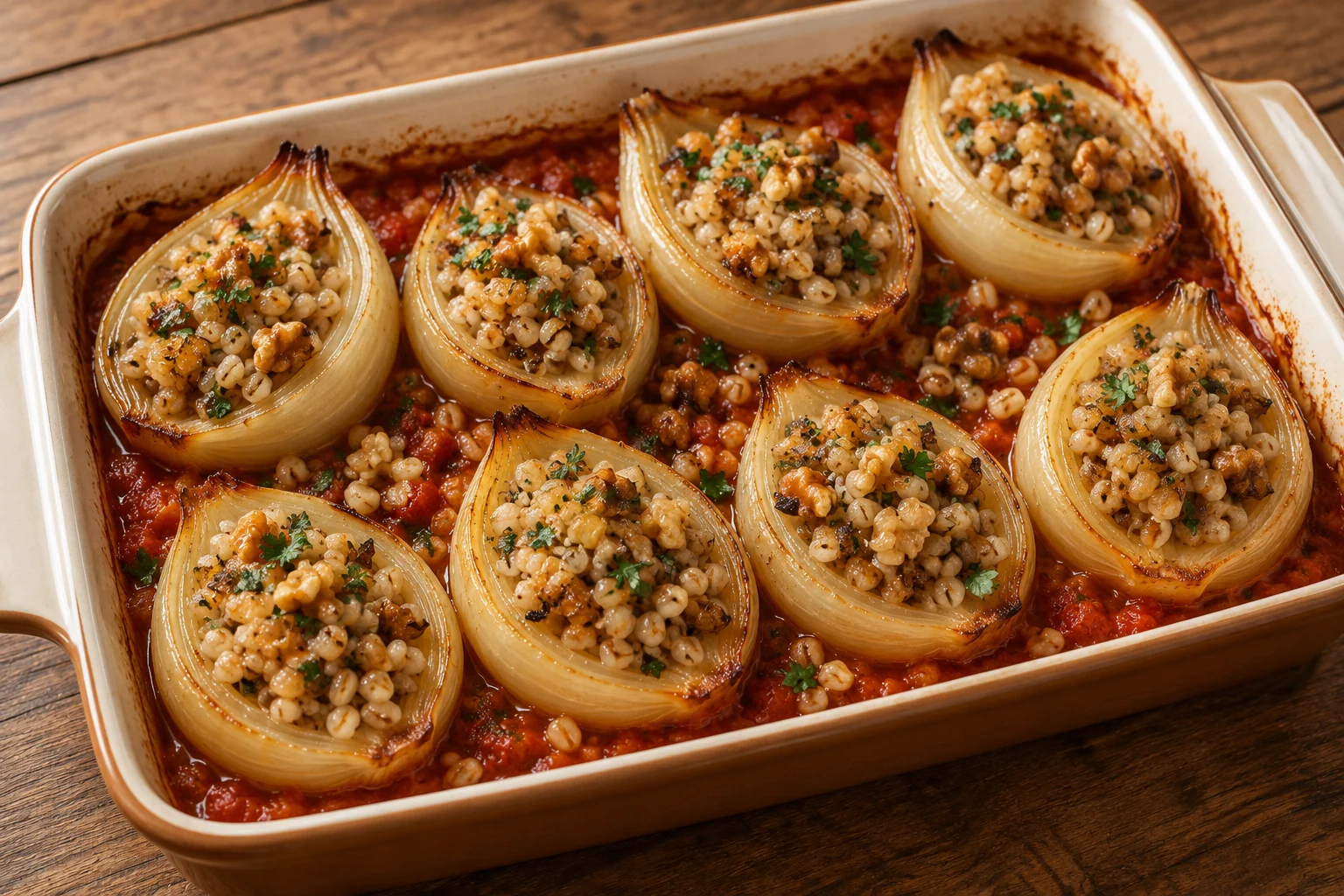
The onion performs two jobs in this recipe. Its outer layers hold the filling, while its chopped centers add sweetness and moisture to the barley. Nothing edible from the four peeled onions needs to be discarded. Walnuts provide texture, and fresh tomatoes form the baking base. This is a patient vegetable main: the 165-minute allowance includes cooking the grain, softening and hollowing the shells, baking and resting. Start the barley first and use its simmering time to prepare the onions.
Barley and walnut stuffed onions makes 4 servings, with 2 hr 45 min estimated total time. View the standalone recipe page.
Choose four evenly sized onions
Buy onions close enough in size that eight lengthwise halves will fit the same baking dish. The recipe calls for 800 g after papery skins are removed, rather than four onions of any weight. Halving through the root gives the layers a connection while they soften. Do not cut away a large plug from the base before scooping, because it can leave an open hole. Simmer the halves until their outer layers bend, then cool them before handling. A slippery hot onion is difficult to hollow safely and easy to tear.
Save the centers for the filling
Leave two or three layers around each shell, removing the middle gently with a small spoon. Keep all edible pieces, including loose layers that separate during handling. Chop these pieces together and cook them in the measured oil until soft and reduced. Their moisture needs time to evaporate; rushing this stage leaves a watery filling beneath a browned top. If one shell tears, overlap its layers in the dish and support it against a neighboring half. It can still hold filling without an elaborate repair or a discarded portion.
Cook the barley before stuffing
Use dry pearled barley, not a cup of already cooked grain. The listed water starts the absorption cooking, but individual packages can require different simmering times. Check tenderness before assembly: the grains should be chewy without a hard center. If water remains when they are tender, uncover and let it evaporate instead of pouring it away. Stir all the cooked barley into the reduced onion centers with walnuts and parsley. This keeps the calculation tied to the complete dry-grain input and avoids guessing a drained cooked weight.
Build a moist base and protect the shells
Spread the chopped tomatoes and their juices beneath the onions. The covered baking stage keeps moisture around the shells while they finish softening. Divide the filling among the eight cavities, putting any surplus between them; cavity sizes vary, and forcing every spoonful into a tiny shell can split it. Seal the foil around the dish rather than loosely balancing it on top. When you uncover for the final stage, look for gentle bubbling around the onions. The filling should reach 165°F and the shell should yield easily to a small knife.
Rest before portioning
Let the dish stand for ten minutes so the filling is less likely to scatter when lifted. A broad spoon works better than tongs, which squeeze the delicate layers. Serve two halves with one quarter of the tomato base and any extra filling from the dish. The estimate includes all walnuts and oil, not merely what sits inside each shell. Barley contains gluten, and walnuts remain a listed allergen even though the recipe is vegan. Refrigerate leftovers promptly in shallow containers, keeping the sauce with the onions so reheated portions remain moist.
Common questions
Why are the shells still firm?
Large onions or thick outer layers may need longer softening. Re-cover the baking dish and continue until a knife enters easily; browning alone does not show tenderness. Check that some moist tomato sauce remains around the shells rather than letting the base dry out.
Can I replace barley with another grain?
A different grain changes cooking water, cooking time and nutrient values. This formulation uses the entire measured batch of pearled barley. Keep that basis for the published estimate rather than exchanging an equal volume of cooked rice or couscous.
Technique & food-safety references
These primary references support the technique, safety and storage guidance. The recipe and cooking explanations are original Recipe Pinboard content.


