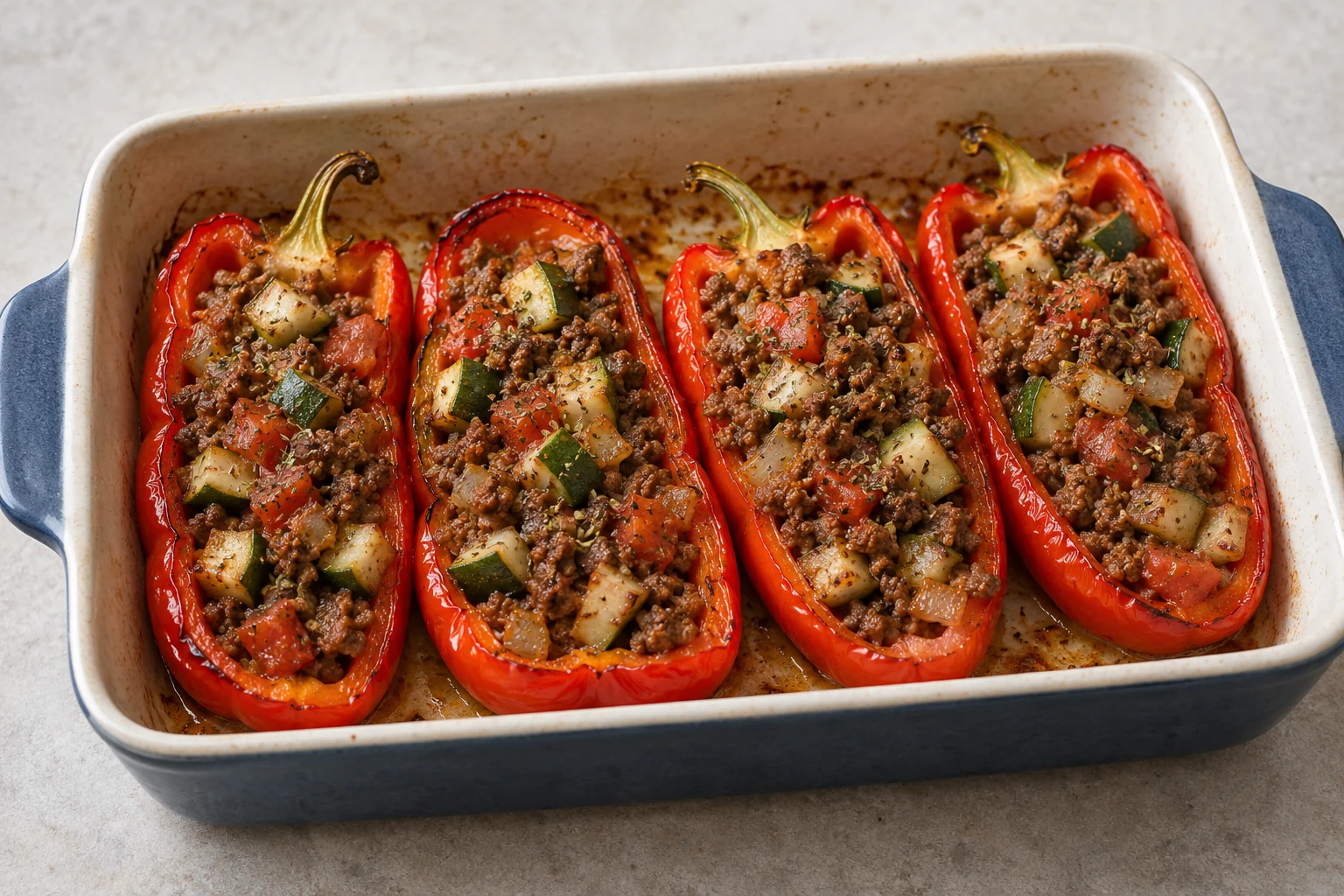
These stuffed peppers use beef, zucchini and tomato without a grain filler. Because both zucchini and peppers release water, the recipe controls moisture in two places: the filling is simmered until it mounds, and any watery liquid in the pre-roasted pepper halves is poured away before filling. That keeps the final portions moist without making them soupy.
Beef & zucchini stuffed peppers makes 4 servings, with 1 hr 5 min estimated total time. View the standalone recipe page.
Prepare eight stable pepper halves
Weigh 600 g red pepper after removing stems and seeds, arranged as eight lengthwise halves. Heat the oven to 400°F (200°C) and place them cut-side up in a roomy dish or on a rimmed sheet. Use two dishes if necessary rather than allowing the halves to overlap and block one another’s sides.
Brush with 8 g olive oil and sprinkle over 1 g salt, reserving the remaining oil and salt for the filling. Roast for eighteen to twenty minutes until the peppers begin softening. This preliminary stage gives the shells a head start so a thoroughly cooked filling does not have to wait inside raw, rigid peppers.
Cook the beef before introducing the diced vegetables
While the shells roast, heat the remaining 12 g oil in a wide skillet. Add the 600 g ground beef and cook for seven to nine minutes, breaking it into small crumbles. Check several areas for 160°F (71°C); ground meat does not use the lower whole-steak endpoint or a surface-color test.
Add the finely diced onion and 1 cm zucchini cubes. Cook for another seven to nine minutes, stirring as they soften and release liquid. A wide skillet gives that liquid room to evaporate. Do not cover this stage and then expect the same dry-down while moisture is being held inside the pan.
Build a thick tomato filling rather than a loose sauce
Stir in garlic, tomato paste and oregano for one minute, then add diced tomatoes with their juices, the remaining salt and pepper. Simmer uncovered for five to seven minutes. The mixture should stay moist but hold a mound on a spoon instead of immediately running into a thin puddle.
Keep the specified no-added-sugar tomato products and their stated ingredient limits when following the recipe’s dietary criteria. Similar red sauces can contain other ingredients. Do not add rice or breadcrumbs to absorb a watery mixture: those are not part of this formula. Let the stated uncovered cooking stage control its moisture instead.
Drain the shells and distribute all the filling
Remove the pepper dish from the oven with oven gloves. Carefully pour away watery liquid pooled inside the halves, supporting the hot dish securely rather than tipping it awkwardly over the worktop. The softened peppers can tear if squeezed, so use a spoon or wide utensil when repositioning them.
Divide the entire hot filling across all eight halves, gently mounding it. Work across the full set so the first few are not overfilled while the last ones receive mostly tomato. The recipe makes four servings of two filled halves, so the whole measured filling belongs in those portions rather than an uncounted extra pan.
Finish to temperature and rest before lifting
Bake the filled halves for twelve to eighteen minutes, continuing until the peppers are tender and the center of the filling reaches 165°F (74°C). Check a central, well-filled portion rather than the hottest exposed surface. The earlier 160°F beef check and this final filled-dish check are different stages of the same method.
Rest for five minutes before lifting two halves onto each plate. A broad spatula helps support the softened shells. Refrigerate leftovers in shallow containers within two hours, or one hour above 90°F (32°C), use within three to four days and reheat to 165°F (74°C). Do not judge safe reheating only by a hot pepper skin surrounding a cooler filling.
Common questions
Why is there liquid in the bottom of my peppers?
The shells and zucchini naturally release water. Pre-roast and drain the shells, then simmer the filling until it mounds before assembly. Adding an unlisted grain is not necessary to follow this recipe.
Why check 160°F first and 165°F later?
The first check establishes doneness of the ground beef in the skillet. The later check confirms the center of the assembled stuffed dish at the endpoint specified by the recipe; one does not replace the other.
Technique & food-safety references
These primary references support the technique, safety and storage guidance. The recipe and cooking explanations are original Recipe Pinboard content.