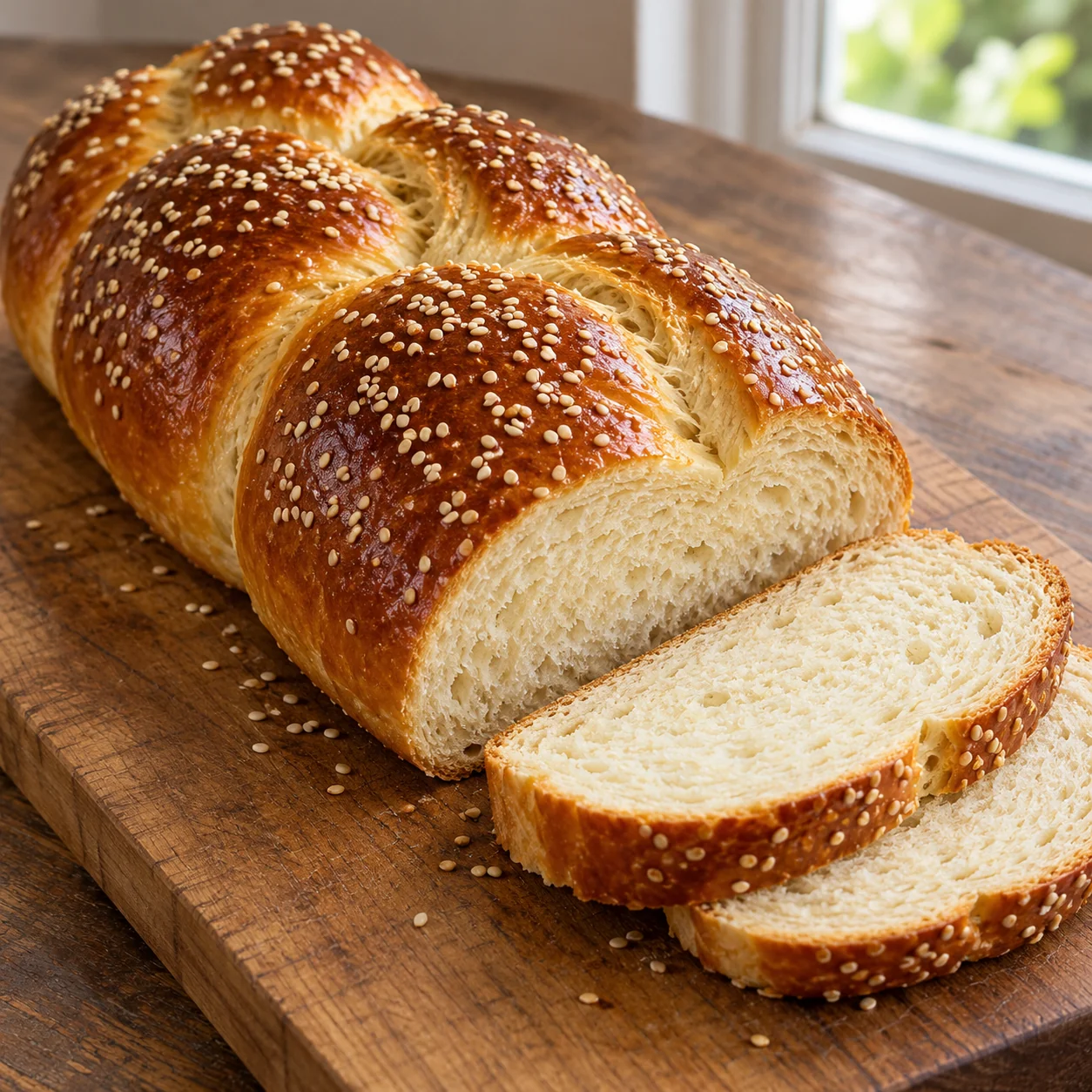
A three-strand braid gives this egg-and-oil loaf its shape without requiring complicated weaving. The full recipe makes one loaf cut into twelve equal slices. Its five-hour-twenty-minute planning window includes both rises, a possible shaping rest, baking and forty minutes of cooling. Most of that time is unattended, but the dough's expansion should decide when each stage ends rather than a rigid clock.
Braided sesame egg bread makes 12 servings, with 5 hr 20 min estimated total time. View the standalone recipe page.
Weigh the eggs before dividing them
Beat enough whole egg to weigh one hundred twenty grams without shells. Put one hundred grams into the dough and refrigerate the remaining twenty grams for the wash. This is more precise than assuming every egg has the same edible weight. Mix the yeast and sugar with lukewarm water and wait for foam before adding egg and oil. Incorporate flour and salt, then knead until the dough is smooth and elastic. It may feel slightly tacky at first. Avoid repeatedly dusting with flour, which changes the measured ratio and can make the loaf dense.
Give the enriched dough time to expand
Cover the bowl so the surface does not dry into a skin. Allow ninety to one hundred twenty minutes for the first rise, looking for substantial expansion to roughly twice the original volume. Egg, oil and sugar make this a different dough from a lean crusty loaf, so do not expect identical timing. A cool room may require extra time beyond the planning window. Choose a comfortably warm spot rather than direct heat from a hot oven or radiator. A transparent bowl or a simple mark at the starting dough level helps make the growth easier to assess.
Make three equal ropes before braiding
Gently press excess gas out, then divide the dough by weight into three pieces. Roll each on a silicone mat into a sixteen-inch rope. Begin near the center and move your hands outward, keeping the thickness reasonably even. If a rope repeatedly retracts, cover all three and pause for ten minutes. King Arthur's braided-loaf guidance uses a similar rest for dough that resists rolling. Forceful stretching can tear the surface and create thin weak sections. Once the lengths match, pinch one set of ends together and prepare a lined tray close by.
Braid loosely enough to leave expansion room
Bring one outside rope over the center, then the opposite outside rope over the new center, repeating down the loaf. Keep a steady rhythm without tugging the strands tight. Pinch the far ends and tuck both joins underneath. Transfer to the tray, cover loosely and proof for forty-five to sixty minutes until puffy. Brush with the reserved egg only after this rise, using a light touch so the dough is not deflated. Apply the full measured wash in a thin coating and scatter sesame evenly; avoid a deep puddle of egg collecting beneath the loaf.
Bake the center and let the crumb settle
Bake at 350°F / 175°C for thirty to thirty-five minutes. The egg wash colors readily, so a deeply golden crust alone does not prove the center is ready. Aim for about 190°F / 88°C at the center, inserting the probe where the loaf is thickest. Tent loosely with foil if the surface darkens too quickly. Transfer to a rack and wait at least forty minutes before slicing. Cutting much earlier can compress the warm crumb. Divide into twelve even slices, or use the finished loaf weight when equal nutrition portions are important. Never taste the raw dough.
Common questions
Why did the braid tear open on one side?
Unequal ropes, a tight braid or insufficient final proof can direct expansion into a weak spot. Roll evenly, braid without tension and wait for the shaped loaf to become visibly puffy before baking.
Is egg bread dairy-free?
This formulation uses oil and water rather than butter or milk, but it contains eggs, wheat and sesame. Dairy-free labeling still depends on the packaged ingredients and does not address shared-equipment cross-contact.
Technique & food-safety references
These primary references support the technique, safety and storage guidance. The recipe and cooking explanations are original Recipe Pinboard content.


