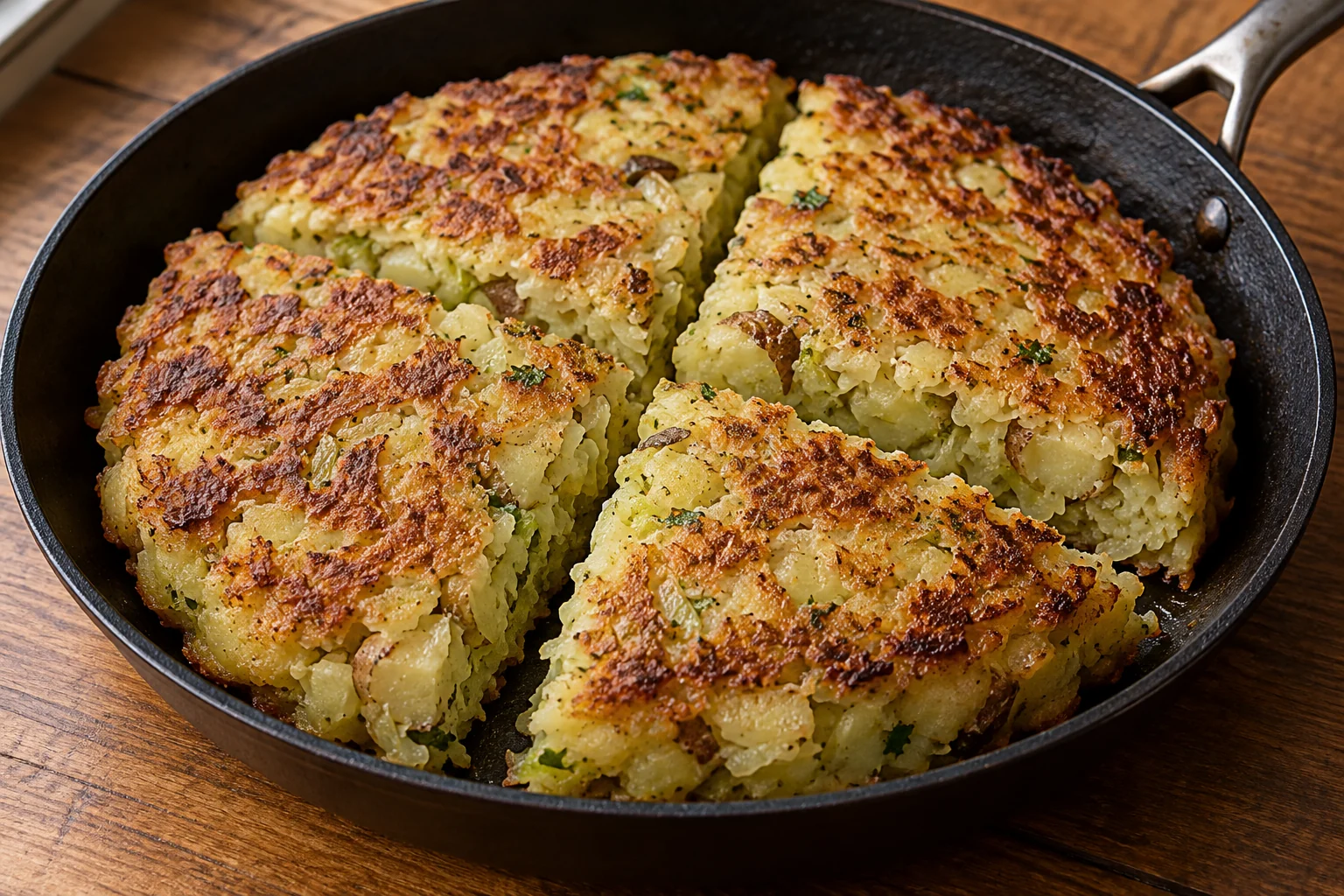
This skillet cake brings together rough potato mash and sautéed cabbage, then gives the mixture enough undisturbed contact with the pan to form a crust. It is cut into four wedges for turning, so there is no need to invert a heavy hot skillet over a plate. The 110-minute allowance starts with raw skin-on potatoes and includes their cooling time. Butter and olive oil are measured for the whole process, and parsley is incorporated into the mixture rather than added as an uncounted garnish.
Cabbage and potato skillet cake makes 4 servings, with 1 hr 50 min estimated total time. View the standalone recipe page.
Cook the potatoes fully before mashing
Cut the scrubbed potatoes into similar small chunks and simmer until a knife passes easily through the center. Undercooked pieces resist mashing and make the cake harder to press into an even layer. Drain, then let steam escape from the warm pan for five minutes before mashing. Keep the skins: large pieces can be lifted out, chopped finely and returned rather than discarded. Rough mash is appropriate, but large hard lumps are not. Spread the complete mash in a shallow bowl for the scheduled brief cooling period.
Remove loose cabbage moisture in the skillet
Finely shred cabbage and chop onion so both distribute through the mash. The onion gets a head start in the measured butter and oil. Once cabbage is added, stir it through the pan and allow its released moisture to evaporate. Tender cabbage with no watery puddle is the target. Do not drain it in a colander afterward; that would discard part of the preparation counted in the recipe. Fold all the vegetables into the potatoes with parsley and seasonings, including softened onion pieces clinging around the skillet's edges.
Press one level round
Add the remaining measured fats to the skillet before returning the mixture. A ten-inch pan gives the intended broad round without an overly deep center. Press gently into an even layer rather than packing one area into a thick hill. The top can look rustic, but the underside needs broad contact with the pan. Keep the heat moderate and allow the base to brown undisturbed. Repeated stirring at this stage turns the mixture into loose fried mash and prevents the coherent crust that lets a wedge lift.
Turn wedges with a broad spatula
After the first side has browned, cut through the cake into four sections. Slide a wide spatula beneath each wedge and turn it carefully, supporting as much of the base as possible. Press the sections gently back toward each other rather than trying to hide every seam. If a piece breaks, gather it back into its quarter and let the second side set; the dish does not require a flawless single-piece flip. Continue until browned underneath and the center reaches 165°F, reducing heat if the crust races ahead.
Rest briefly and keep the portions complete
Five minutes off the heat gives the cake a little time to settle before serving. Use the existing wedge cuts as the four-portion guide, collecting any loose browned pieces from the pan. The estimate counts all potato flesh and skins, cabbage, butter and oil. It does not claim a precise correction for nutrients lost into discarded potato-boiling water. This is a vegetarian main without bacon or a fried egg topping. Refrigerate leftovers promptly in shallow containers, use within three to four days and reheat thoroughly to the card's endpoint.
Common questions
Why does my cake fall apart?
Wet mash, watery cabbage or turning before a crust forms can all weaken it. Let potato steam escape, reduce cabbage juices and leave the first side alone long enough to brown. The wedge-turning method limits the amount you need to lift at once.
Can I use leftover mashed potatoes?
Only if their ingredients and storage are known. This card calculates raw skin-on potatoes without added milk or unknown butter. Previously enriched mash changes the quantities and nutrition, so an equal bowlful is not automatically an equivalent substitute.
Technique & food-safety references
These primary references support the technique, safety and storage guidance. The recipe and cooking explanations are original Recipe Pinboard content.


