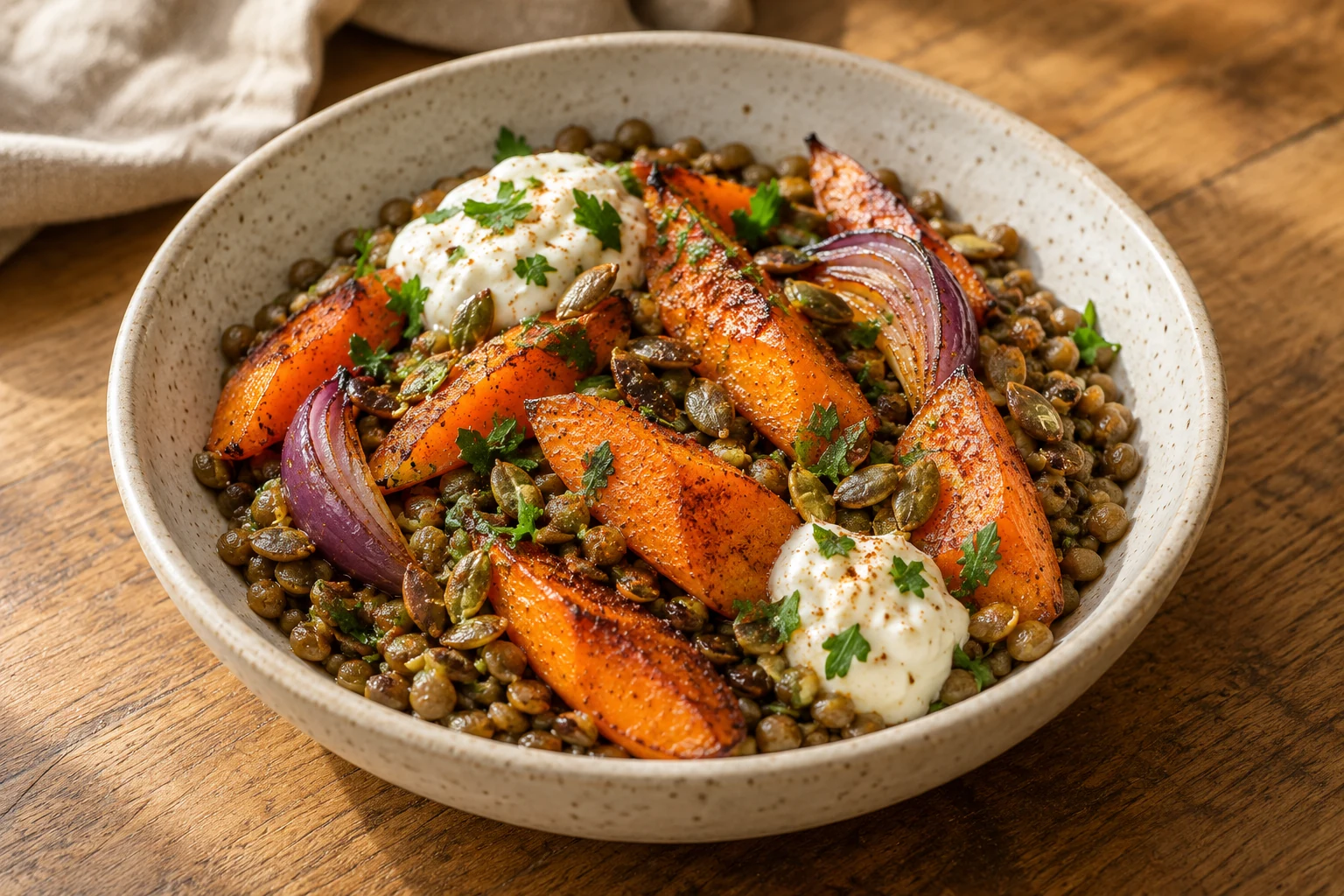
The carrots roast while whole lentils simmer, so the two main components can finish within the same fifty-minute window. Each needs its own texture check: tender carrots with browned edges, and lentils that are soft inside but retain their shape. This recipe makes four bowls with a cool lemon-yogurt finish and toasted pumpkin seeds. The lentil quantity is 240 g dried, not cooked.
Roasted carrot & lentil bowls with lemon yogurt makes 4 servings, with 50 min estimated total time. View the standalone recipe page.
Sort the lentils and start the oven first
Pick over the lentils for debris, rinse them and place them in a saucepan with one liter water. Use green or brown whole lentils as specified. Split red lentils break down differently and would change the distinct-textured base. Bring to a boil, then reduce to a gentle uncovered simmer for twenty-five to thirty-five minutes.
Heat the oven to 425°F/220°C while preparing the vegetables. Check the lentil water occasionally and add more if needed to keep them submerged. Avoid a forceful boil that knocks them around unnecessarily. Test several lentils toward the end of the range; a soft exterior with a hard center still needs cooking, even if the carrots are already ready.
Cut carrots for an even roast
Peel and cut the carrots diagonally into four-centimeter pieces. Halve pieces lengthwise if they are thicker than 1.5 cm, so the largest ones do not remain firm while narrow tips finish. Cut the red onion into 1.5 cm wedges. These dimensions help the two vegetables share a tray without requiring identical shapes.
Toss with 20 g oil, cumin, 1.5 g smoked paprika, 2 g salt and the pepper. Keep the remaining paprika and oil separate for later use. Spread the vegetables in one layer on a large rimmed sheet. If they are heaped on top of each other, the edges have less opportunity to brown and the middle pieces receive different heat exposure.
Judge carrots and lentils separately
Roast for twenty-five to thirty minutes, turning halfway through so more than one surface meets the hot tray. Test a thick carrot piece with a knife; it should be tender through the middle. An onion edge may brown before a carrot center softens, so do not use the darkest small onion fragment as the only readiness cue.
Drain the cooked lentils well once they are tender and still intact. They should not carry a pool of plain cooking water into the serving bowl. Toss them gently with the remaining 10 g oil, 10 ml lemon juice and 1 g salt. This seasoning belongs to the lentil base and is separate from both the roast coating and the yogurt sauce.
Keep the yogurt chilled and the seeds moving
Mix the Greek yogurt with 20 ml lemon juice, finely grated garlic and 1 g salt. Stir until the garlic is evenly dispersed, then keep the sauce chilled until assembly. Fine grating matters here because the garlic is not subsequently cooked. Large raw pieces would create sharp, uneven bites inside an otherwise smooth dollop.
Toast the pumpkin seeds in a small dry skillet over medium-low heat for two to three minutes, stirring frequently. Transfer them to a plate once fragrant. Thin seeds can move quickly from toasted to scorched, especially if left in a hot pan after the burner is turned off. Keep them dry and separate until the bowls are assembled.
Build four bowls with balanced finishing portions
Divide the warm lentils first and arrange roasted carrot and onion over each portion. Add two small yogurt dollops to every bowl rather than stirring the sauce completely through the base. The separation preserves cool, creamy bites alongside the warm vegetables and keeps the roasted surfaces visible instead of coating everything in yogurt.
Distribute the seeds, parsley and reserved 0.5 g paprika across all four bowls. Sprinkle lightly so the paprika does not land as a dry concentrated patch. Serve while the lentils and vegetables are warm. If components finish a few minutes apart, use that time for plating preparation rather than continuing to roast tender carrots or simmer already-cooked lentils.
Common questions
Can I use split red lentils instead?
Not with the same texture goal and timing. The recipe uses whole green or brown lentils that remain distinct after simmering. Split red lentils tend to soften and break down more readily.
Why are some carrots still hard?
Thickness is often the issue. Halve pieces thicker than 1.5 cm lengthwise, spread them in one layer and test a thick piece for tenderness rather than judging only its browned edges.
Technique & food-safety references
These primary references support the technique, safety and storage guidance. The recipe and cooking explanations are original Recipe Pinboard content.