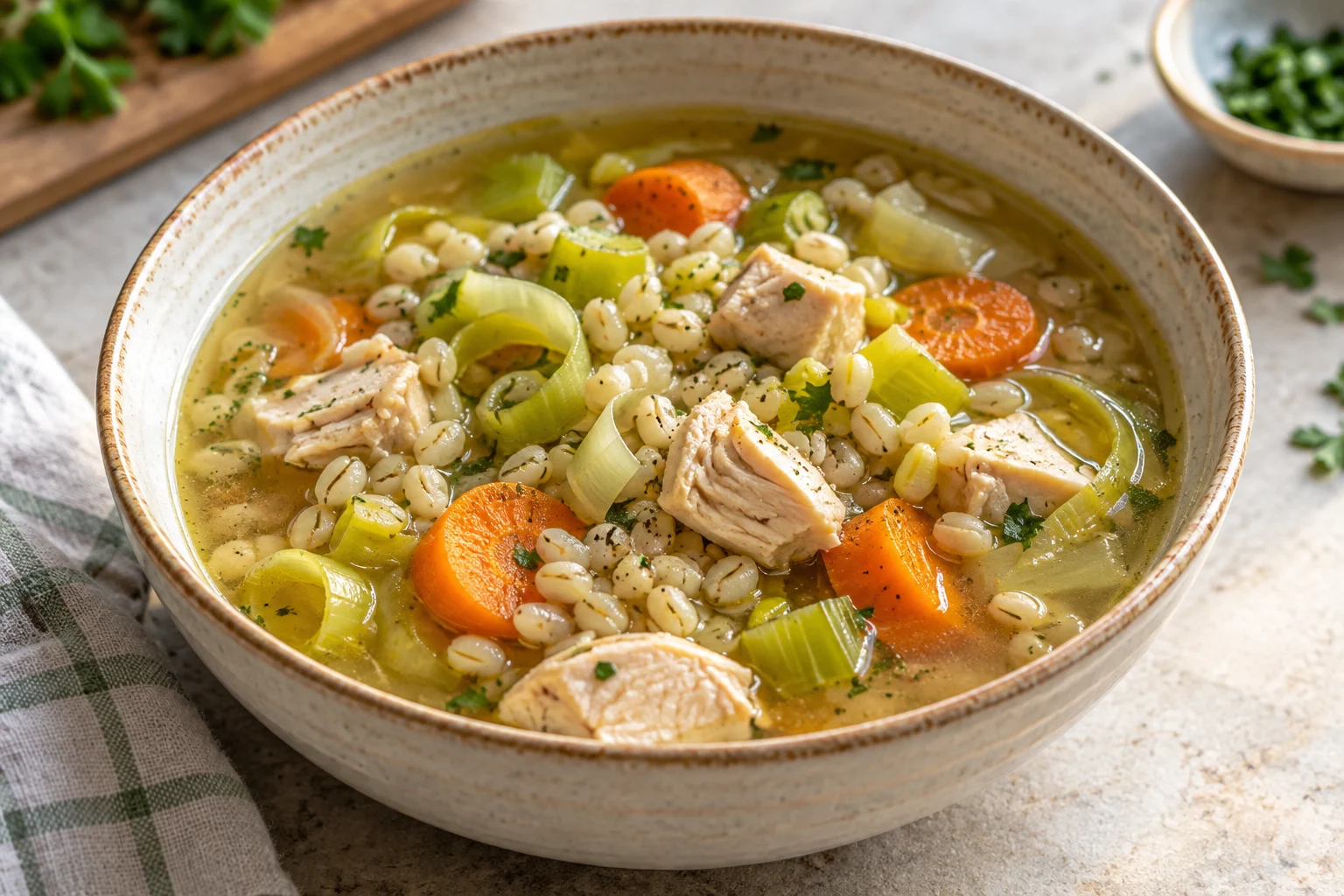
This soup makes its broth in the pot from leeks, carrots, celery, herbs and chicken. Pearled barley supplies body, but it needs more simmering time than small pieces of chicken breast. Starting the grain first and adding the chicken later is the central timing decision. The six-portion batch is planned for 75 minutes, including preparation and the return to a simmer after the cold chicken enters.
Chicken, leek & barley soup makes 6 servings, with 1 hr 15 min estimated total time. View the standalone recipe page.
Clean the leeks before weighing them
Trim away the roots and tough dark-green tops, split the remaining leeks lengthwise, and rinse between the layers. Soil can hide inside apparently clean outer leaves. Drain well, then weigh 250 g of white and pale-green leek and slice it. That is a prepared weight, so buying exactly 250 g whole leeks will not provide enough after trimming.
Prepare the carrots, celery and parsley before handling raw chicken. Keep the chicken cold until needed, and wash hands and equipment after cutting it. Use clean tools for parsley that will be added at the end. This order keeps the ready-to-eat garnish away from raw poultry juices.
Soften the vegetables without scorching the leeks
Use a pot with about five litres of capacity. The leeks, carrots and celery need seven to eight minutes over medium heat in the measured oil. Stir regularly because thin leek pieces catch sooner than the thicker carrot rounds. The goal is a softened aromatic base, not a deeply darkened vegetable mixture.
Add the garlic and dried thyme for just thirty seconds before the water. Having the 1800 g water ready makes that transition easy. This recipe uses water rather than boxed broth, so all of its listed flavor comes from the ingredients in the pot. Substituting a salted broth changes the seasoning and the nutrition calculation.
Give pearled barley a head start
Rinse the dry pearled barley, add it with the water and seasonings, then bring the pot to a boil. Reduce to a gentle simmer and leave the lid partly open. Stir occasionally so grains do not settle into a stubborn layer on the base. The initial twenty-five minutes happen before any chicken is added.
Use pearled barley rather than quick-cooking barley or intact hulled barley. They do not share one reliable cooking schedule. At the point where the chicken goes in, the barley can still have a firm center because it has another fifteen to twenty minutes ahead. Grain age and simmer intensity affect the final timing, so a taste test matters more than a clock alone.
Check both grain texture and chicken temperature
Add chicken cut into even 2 cm pieces, then allow the soup to return to a gentle simmer. A rolling boil is unnecessary and can roughen the chicken’s texture. Check the thickest pieces with a thermometer; chicken needs to reach 165°F (74°C). Clean the thermometer after any check on undercooked poultry.
The finished barley should be tender with some chew. If the chicken reaches temperature before the barley is ready, lift the chicken onto a clean plate, finish the barley, and return the chicken until hot. This avoids repeatedly cooking lean breast pieces simply to accommodate slower grain. Stir in lemon juice and parsley only at the end.
Expect the broth to thicken after chilling
Divide the whole batch into six portions rather than promising a precise finished weight, since evaporation varies. Barley continues taking up liquid as it stands, so yesterday’s soup may look closer to a stew. When reheating, a little water restores a soup-like consistency without adding salt.
Do not leave the full pot on the counter to cool. Portion promptly into shallow covered containers and refrigerate at 40°F (4°C) or colder within two hours, or one hour above 90°F (32°C). Use within three to four days. Bring reheated soup to a rolling boil and check that chicken pieces reach 165°F (74°C).
Common questions
Can I use quick-cooking barley?
Not with this exact staggered schedule. Quick-cooking barley may become overly soft before the chicken is ready; use dry pearled barley for the written method.
Why is the soup gritty?
Grit can remain between leek layers even when the outside looks clean. Split and rinse the leeks before slicing and weighing them, rather than briefly rinsing a pile of intact rings.
Technique & food-safety references
These primary references support the technique, safety and storage guidance. The recipe and cooking explanations are original Recipe Pinboard content.