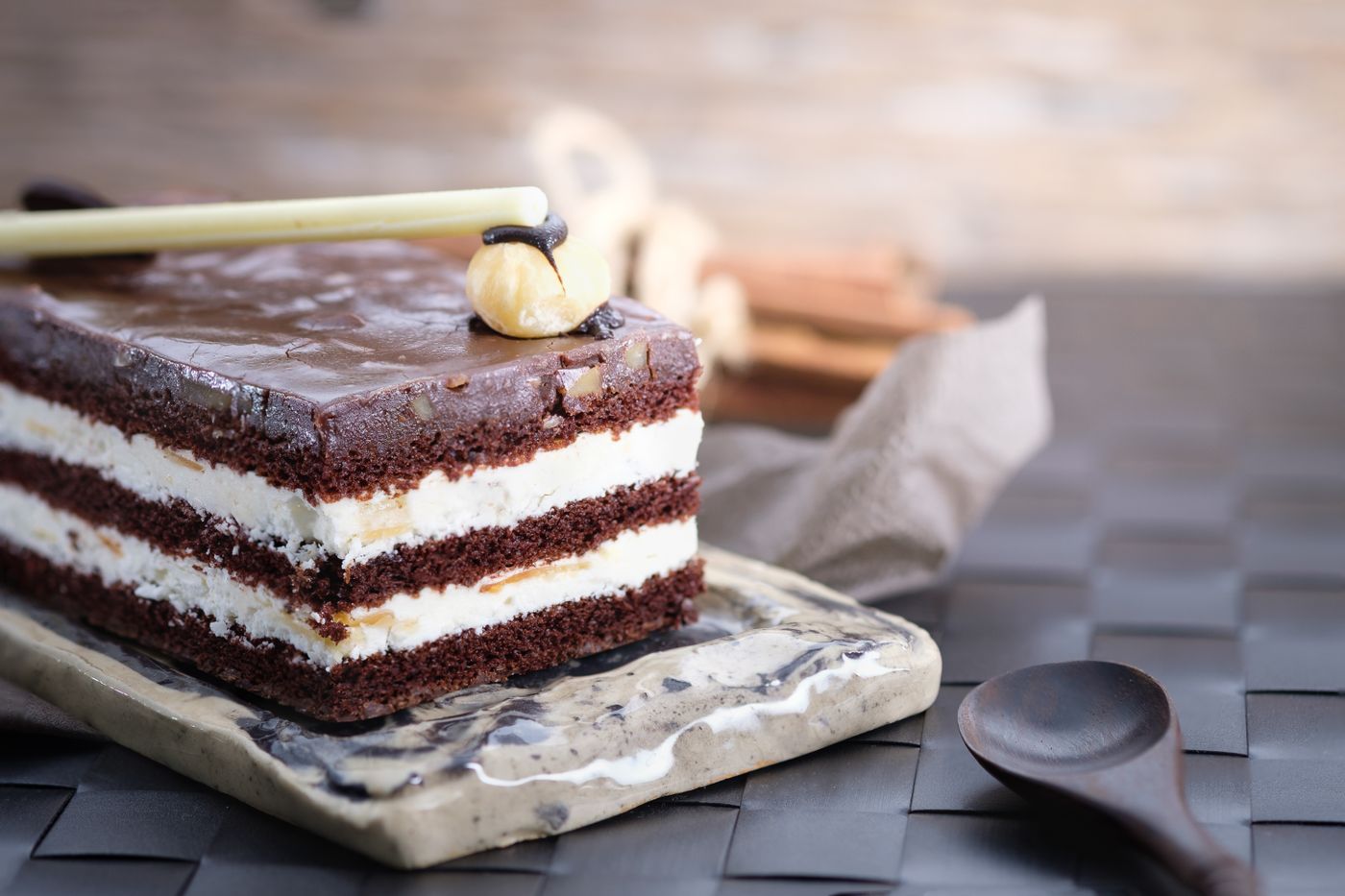
This chocolate and cream cake has three cake layers, two vanilla-cream fillings and a dark-chocolate top. It serves twelve and is planned for roughly two hours, including cooling. The structural challenge is temperature: warm cake softens whipped cream, while hot ganache can run down the sides before it thickens. Follow the sequence carefully, but allow extra cooling time if your kitchen or cake layers remain warm.
Chocolate & cream layer cake makes 12 servings, with 2 hr estimated total time. View the standalone recipe page.
Prepare three matching pans before mixing
Heat the oven to 350°F (175°C). Divide the 15 g greasing butter among three 8-inch round pans, using 5 g in each, and line their bases with parchment. Equal pan sizes keep the layers similar in depth and baking time. Prepare all three before mixing so the finished batter can be divided and baked without an avoidable delay.
Keep the dairy portions separate: 240 ml milk goes into the batter, 500 ml cold heavy cream becomes the filling and another 150 ml heavy cream makes ganache. The 2 tsp vanilla is also divided, with 1 tsp for the cake and 1 tsp for the filling. The optional white-chocolate curls are a finish, not part of the melted topping.
Combine the batter and divide it evenly
Whisk 250 g flour, 70 g unsweetened cocoa, 300 g granulated sugar, the baking powder, baking soda and salt. Break up cocoa lumps before adding wet ingredients. Beat in the two eggs, milk, 120 ml neutral oil and the cake’s vanilla, then stir in 180 ml hot water until smooth. Add that water carefully to avoid splashing hot liquid.
Divide the batter evenly among the prepared pans and bake for twenty to twenty-five minutes. Check each layer with a tester; it should have no wet batter attached. Different oven positions can bake at different rates, so one finished pan does not prove all three are ready. Raw cake batter should not be tasted because its flour and eggs are uncooked.
Cool completely before whipping the filling
Leave the baked layers in their pans for ten minutes, then turn onto racks and let cool completely, approximately forty-five minutes. Remove the parchment carefully. A layer that feels cool around the edge may still be warm in its center, so check before assembling. Stacking warm cakes traps heat and makes the cooling stage less effective.
Whip the 500 ml cold cream with 60 g powdered sugar and the remaining vanilla until it forms firm peaks. Stop when lifted peaks hold their shape but the cream is still smooth. Continuing until it looks grainy makes a poorer filling. Keep the finished cream cold while you organize the serving plate and inspect the cake layers.
Stack two cream layers without squeezing them
Place the first completely cooled cake on the serving plate and spread half the whipped cream evenly across it. Add the second layer carefully and repeat with the remaining cream, then position the third cake on top. You should have three chocolate layers separated by two white fillings, not a third cream layer under the ganache.
Use light pressure to align the stack. Pressing firmly forces the filling outward and can make the upper layers slide. If the cream softens while you work, refrigerate the cake before continuing. The recipe contains no gelatin or other stabilizer in the filling, so cool handling is important; adding one would be a separate formulation rather than a missing instruction.
Cool the ganache to a spreading consistency
Heat the remaining 150 ml cream just until steaming and pour it over 150 g chopped dark chocolate. Leave for two minutes, then stir until smooth. Let it cool until spreadable, around fifteen minutes. A ribbon that immediately floods flat is still too fluid for a controlled top; a thick, smoothly moving mixture is easier to keep in place.
Spread ganache over the top and add the optional 20 g white-chocolate curls. Refrigerate until serving and keep the finished cake at 40°F (4°C) or below. Limit unrefrigerated time to two hours, or one hour above 90°F. For quality, plan to serve it within a day or two, using fresh dairy and following any shorter package limit.
Common questions
Can I bake the batter in two pans instead of three?
Not on the same schedule. Two pans would hold deeper layers, changing baking time and the cake’s structure. Use the three 8-inch pans specified here to retain the intended three-cake, two-cream arrangement.
Why is ganache sliding off the top?
It may still be too warm and thin, or the cake and filling may not be cold enough. Pause and let the ganache thicken while the assembled cake chills. Do not add more chocolate automatically, because that changes the stated topping ratio.
Technique & food-safety references
These primary references support the technique, safety and storage guidance. The recipe and cooking explanations are original Recipe Pinboard content.