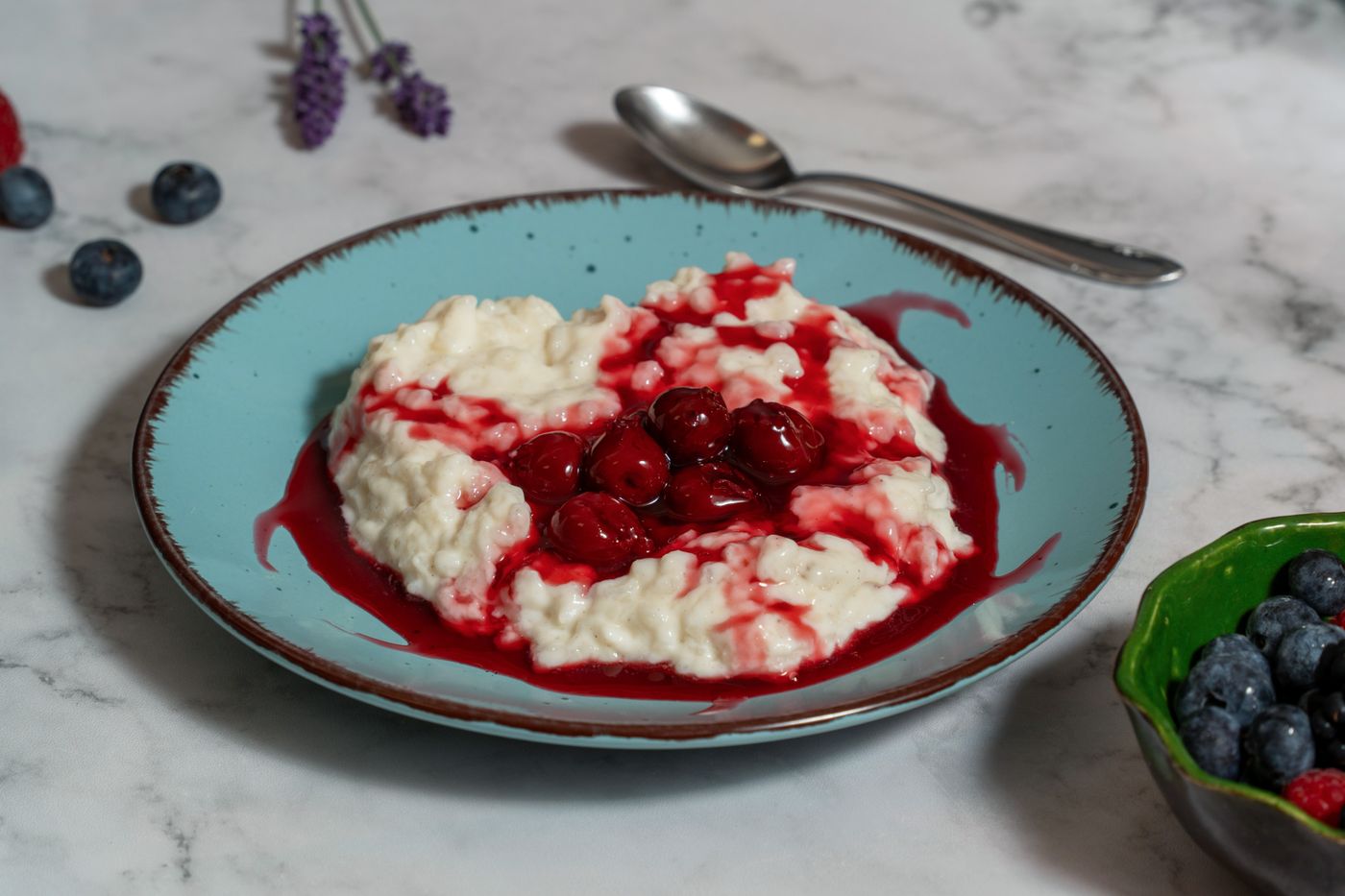
Creamy rice pudding with cherries starts with uncooked short-grain white rice, not leftover cooked rice. Its fifty-minute schedule makes six portions, combining a vanilla milk pudding with a separate cherry compote. The main judgment is the grain itself: thick liquid does not necessarily mean tender rice. Gentle heat, regular stirring and checking a cooled spoonful help you avoid a thick pudding with a hard center.
Creamy rice pudding with cherries makes 6 servings, with 50 min estimated total time. View the standalone recipe page.
Choose the specified rice and organize two pans
Measure 150 g short-grain white rice, 750 ml whole milk and 250 ml water for the pudding. Short-grain rice is useful for creamy desserts because of its starch and texture, a distinction noted by USA Rice. Long-grain, brown or quick-cooking rice would change the cooking behavior and should not be treated as an equivalent timed substitution.
Keep the sugar portions separate: 75 g belongs to the pudding and 40 g belongs to the cherries. Set the 1 tsp vanilla aside for the pudding’s finishing stage. The compote also uses its own 2 tbsp water, in addition to the measured water in the rice pan. A heavy saucepan helps you control the milk-based mixture over low heat.
Simmer gently and stir across the bottom
Bring the milk, pudding water, rice and ¼ tsp salt to a gentle simmer. Lower the heat and cook for thirty to thirty-five minutes, stirring often. Reach the bottom and corners of the pan, where grains can settle and milk can catch. A spoon that only circles the surface does little to prevent sticking underneath.
Keep the bubbling modest. A rapid boil evaporates liquid quickly and can leave the rice short of moisture before it softens. The recipe permits a little water if needed: use it when the pudding becomes too thick for the grains to keep cooking comfortably. Do not interpret that flexibility as a reason to replace the milk or greatly increase the starting liquid.
Check the grains before adding sugar and vanilla
Taste a small spoonful after letting it cool enough to handle safely. The rice should be tender throughout rather than chalky at the center. If the liquid is creamy but the grains are still firm, continue gentle cooking and watch the moisture. Pan width and burner strength can shift the timing, so the stated range is a guide.
Once the rice is tender, stir in the 75 g sugar and vanilla, then simmer for three minutes more. Follow this order instead of putting every ingredient in the pan at once. The pudding will continue thickening as it rests and cools, so aim for a softly flowing hot mixture rather than cooking it down to the stiffness you want when cold.
Make a juicy cherry compote alongside it
In the second pan, combine 300 g pitted cherries, 40 g sugar and the separate 2 tbsp water. Fresh or frozen cherries are allowed. Check that pits have actually been removed, including from purchased pitted fruit. Simmer for eight to ten minutes until the fruit is juicy and the surrounding liquid is slightly thickened.
Frozen cherries may release more water as they thaw in the pan, so look at the finished sauce rather than forcing an identical evaporation rate. Stir gently if you want recognizable cherry pieces. Spoon the compote over the portioned pudding instead of stirring it through the entire batch; this keeps the vanilla base distinct and lets each bowl show both components.
Serve warm or chill small portions quickly
Divide the pudding among six shallow bowls and top with the compote. It can be eaten warm or cold. For a chilled dessert or leftovers, use shallow containers and cool promptly rather than leaving the full saucepan to cool slowly. The rice-specific guidance matters even though the grains are surrounded by sweetened milk.
Following the Food Standards Agency’s conservative rice advice, chill as quickly as possible, ideally within one hour, and consume refrigerated pudding within twenty-four hours. Reheat only once, until steaming hot throughout; a thermometer target of 165°F (74°C) is useful. Stir while reheating to reduce cold spots. Good reheating cannot undo unsafe storage before it, so prioritize rapid cooling from the start.
Common questions
Why did the pudding become much thicker overnight?
Rice continues taking up moisture as the pudding cools. That is why the hot mixture should remain softly spoonable. The recipe allows a little water when needed; if reheating a safely stored portion, use that flexibility cautiously and stir thoroughly rather than scorching a dense mass.
Can I start with cooked rice to save time?
Not with these same liquid quantities and cooking times. This recipe develops its texture from 150 g uncooked short-grain white rice simmered in milk and water. A leftover-rice pudding needs its own proportions, and the rice must also have been cooled and stored safely.
Technique & food-safety references
These primary references support the technique, safety and storage guidance. The recipe and cooking explanations are original Recipe Pinboard content.