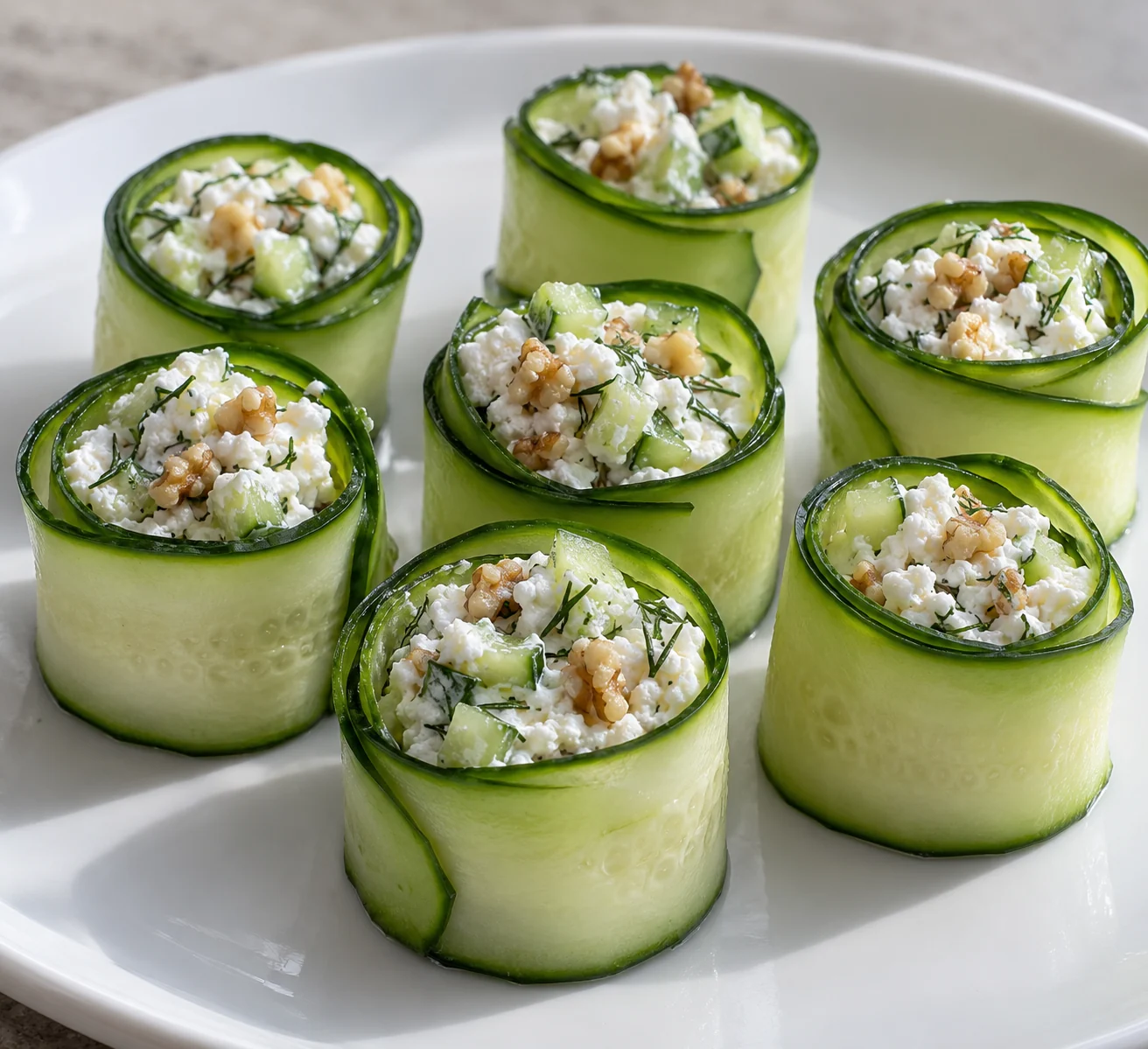
These chilled rolls use cucumber as an edible wrapper around a ricotta, walnut and dill filling. They need no cooking, but they do need careful slicing and sensible moisture control. All edible cucumber offcuts go into the filling, so the measured vegetable is not partly discarded during shaping. Twelve rolls make six appetizer portions. Prepare them close to serving for the clearest contrast between crisp cucumber and soft cheese.
Cucumber, ricotta & walnut rolls makes 6 servings, with 35 min estimated total time. View the standalone recipe page.
Choose cucumber for long flexible ribbons
A long cucumber with a relatively even shape gives more usable strips than a short bulbous one. Wash it, remove the ends and weigh the edible amount before slicing. Keep the skin because it is part of the specified profile and helps define the ribbon edge. A vegetable peeler can make thin flexible strips; use the guard if working with a mandoline. Aim for ribbons that bend without cracking. Very thick slices behave like rigid planks, while extremely thin translucent strips can tear as soon as filling is added. Use ribbons at least four centimeters wide and roughly twenty to twenty-five centimeters long for these generous open rolls.
Retain and finely chop the offcuts
Set aside twelve suitable ribbons and keep every remaining edible piece. Dice these offcuts finely before mixing them into the ricotta. Large chunks can push against the wrapper and make a neat roll difficult, whereas small pieces distribute through the filling. Pat the ribbons dry with clean paper towel rather than salting them to draw out liquid. The recipe does not include a salting-and-draining stage or an estimated discard factor. Keeping the stated cucumber in the dish makes its portion and nutrient accounting straightforward.
Mix a filling that can be portioned
Use whole-milk ricotta as sold, without draining away part of its mass. Finely chop the walnuts and dill so each roll contains a little of both. Stir in the diced cucumber, lemon, salt and pepper, then assess the texture. A short chill can make a loose mixture easier to handle, but it will not turn a watery cheese into a firm block. Divide the whole filling into twelve portions before rolling. This prevents generous early rolls from leaving the last wrappers with almost nothing inside.
Roll gently and use the seam
Place a filling portion near the end of a ribbon and fold the cucumber over it, then continue rolling without squeezing the cheese out. Leave enough overlap to form a stable seam. Where one ribbon is too narrow, overlap strips to make a wrapper while preserving the planned twelve portions. Set each roll seam down as you work. The rolls do not need toothpicks, and there is no hidden garnish holding them together. A few irregular edges are natural; forceful tightening is more likely to tear the cucumber than improve its appearance. After chilling seam down, the rolls can stand on an open end if stable; each is a small cylinder rather than a tightly wound pinwheel.
Chill briefly and serve promptly
Give the assembled rolls their short final chill on a plate, then serve two per person. Keep them refrigerated until needed rather than placing the whole platter out early. Cucumber releases moisture over time, so this is a dish for near-term serving rather than several days of elaborate advance assembly. Refrigerate leftovers within two hours and use within one day for the best texture. The filling contains milk and walnuts. Vegetarian classification also depends on the ricotta's enzymes, so choose the labeled ingredient specified in the recipe.
Common questions
Why do my ribbons split?
They may be too thick to bend or so thin that their centers are fragile. Adjust the slicer and work slowly, supporting the filled section as it rolls. Two overlapping narrow strips can form one wrapper without changing the total cucumber amount.
Can I prepare the filling ahead?
A short refrigerated wait is practical, but the diced cucumber will gradually release water. Keep the mixture covered and assemble close to serving. Stir before dividing it, and do not pour away liquid without recognizing that this changes the measured batch.
Technique & food-safety references
These primary references support the technique, safety and storage guidance. The recipe and cooking explanations are original Recipe Pinboard content.


