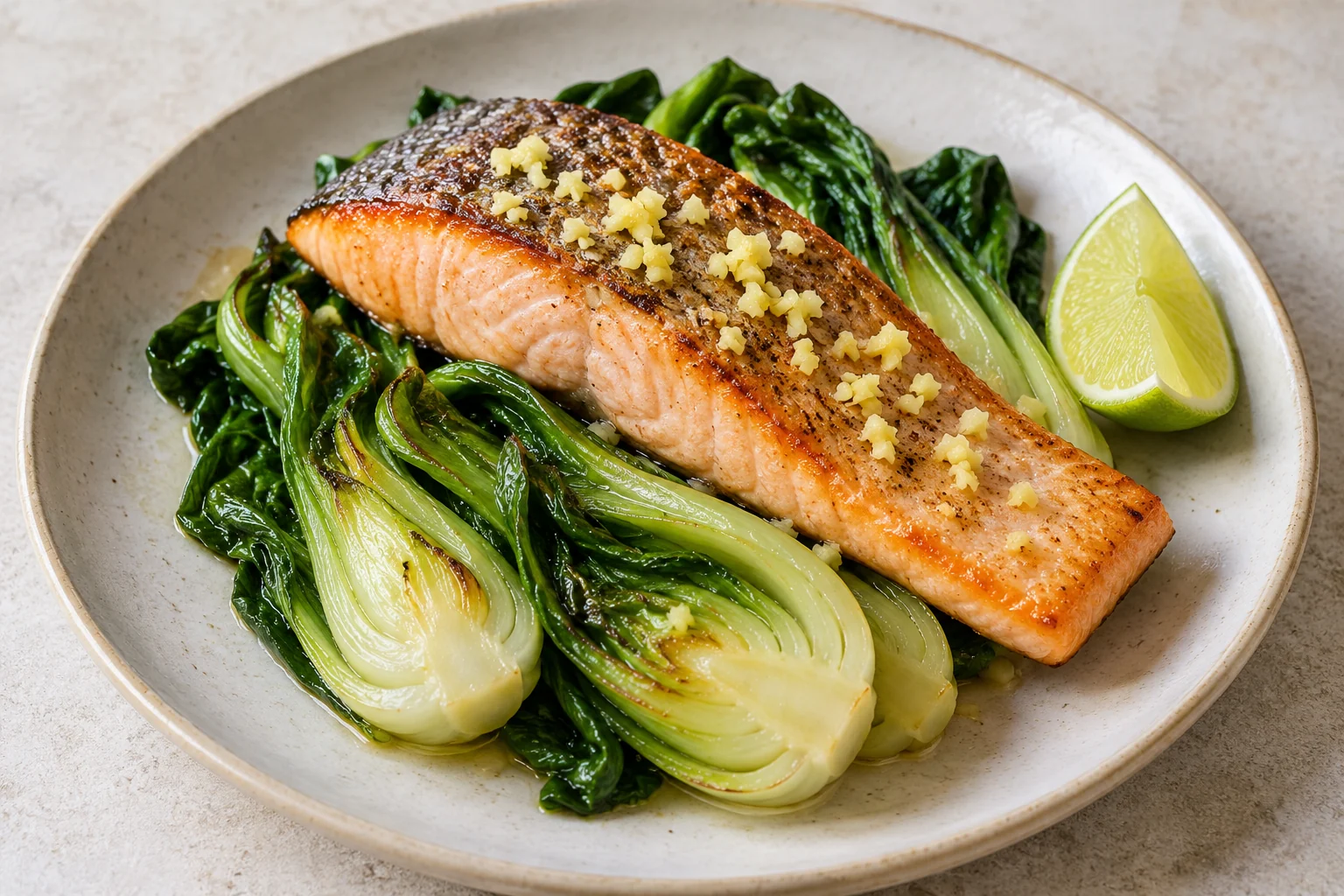
Two trays make this salmon dinner easier to control. Bok choy gets a head start, while the fish enters later with ginger, garlic and lime on its upper surface. The recipe serves four in about 35 minutes, with 15 minutes of active work. Matching the separate finishing points matters more than removing both pans together.
Ginger-lime salmon with bok choy makes 4 servings, with 35 min estimated total time. View the standalone recipe page.
Start with clean, dry halves and even portions
Wash between the bok choy leaves after halving the heads lengthwise, then dry them thoroughly. Water trapped near the base runs onto the tray and works against browning. Keep the halves connected at the base so you can turn them as units. The stated 800 g is the trimmed amount, ready for cooking.
Check the four skin-on salmon portions for pin bones and pat their surfaces dry. Each begins at 150 g raw weight, but thickness can still vary. Place them skin-side down on their own lined tray. Prepare the lime wedges separately from equipment used for raw fish, and wash hands and contacted surfaces before handling the cooked meal.
Give the bok choy its eight-minute lead
Heat the oven to 425°F (220°C), with racks in the upper and lower thirds. Use rimmed sheets and parchment rated for that temperature. Coat the bok choy with 12 g oil and 1.5 g salt, arranging the halves cut-side down without overlap. Start that tray on the upper rack for eight minutes.
Meanwhile, combine the remaining 12 g oil with the measured ginger, garlic, lime juice, zest, pepper and remaining 1.5 g salt. Spread this over the salmon rather than pouring it underneath. Fine grating helps distribute the aromatics across four portions; large ginger chunks would create concentrated bites and be less easy to spread evenly.
Check the fish and stalks separately
Put the salmon on the lower rack for the stated 10–15-minute roasting window. Rotate the pans once, and turn the bok choy as directed. Its total oven time is about 18–23 minutes, counting the head start. Use a timer for the separate stages so the vegetable clock does not restart when the fish goes in.
Check each salmon portion in its thickest part with a food thermometer; the target is 145°F (63°C). A thin end or a reading against the tray will not represent the center. Test bok choy by stalk tenderness and browned leaf edges. If one tray finishes first, remove it while the other completes its own cooking.
Protect texture without changing the coating
Salmon thickness, oven hot spots and the amount of room between bok choy halves can all affect timing. Avoid prolonging the fish merely to get darker color on the vegetables. This coating contains wet citrus and aromatics, so a dramatic dry crust is not the objective. The skin stays underneath throughout the roast.
Bok choy leaves may brown before its thicker bases are tender. Cut-side contact, dry surfaces and the prescribed turning help balance those textures. Check several halves, especially the largest. If your 800 g does not fit without overlapping, larger trays are preferable to a pile; additional batches will extend the stated total time.
Plate the juices and handle leftovers promptly
Divide the bok choy and cooked pan juices evenly among four plates, then add one salmon portion and one lime wedge to each. The portion label refers to the salmon's starting raw weight, not a promise of the same weight after roasting. Serve promptly; the skin may be eaten or left on the plate.
Transfer leftovers to shallow containers and refrigerate within two hours, or one hour above 90°F (32°C). Keep at 40°F (4°C) or colder and use within three to four days. Reheat to 165°F (74°C). Keeping the fish with its allocated pan juices helps retain the intended flavors without needing a separate new sauce.
Common questions
Can both ingredients go on one tray?
The recipe uses separate trays because bok choy starts eight minutes earlier and the two ingredients have different doneness checks. Combining them removes that flexibility and can crowd the vegetables. Keep the two-tray arrangement for the stated method.
Does the lime cook the salmon before roasting?
No. Lime is part of the flavor coating, and the recipe has no curing or marinating stage. Roast every fillet to its specified 145°F (63°C) internal temperature rather than relying on surface color or citrus exposure.
Technique & food-safety references
These primary references support the technique, safety and storage guidance. The recipe and cooking explanations are original Recipe Pinboard content.