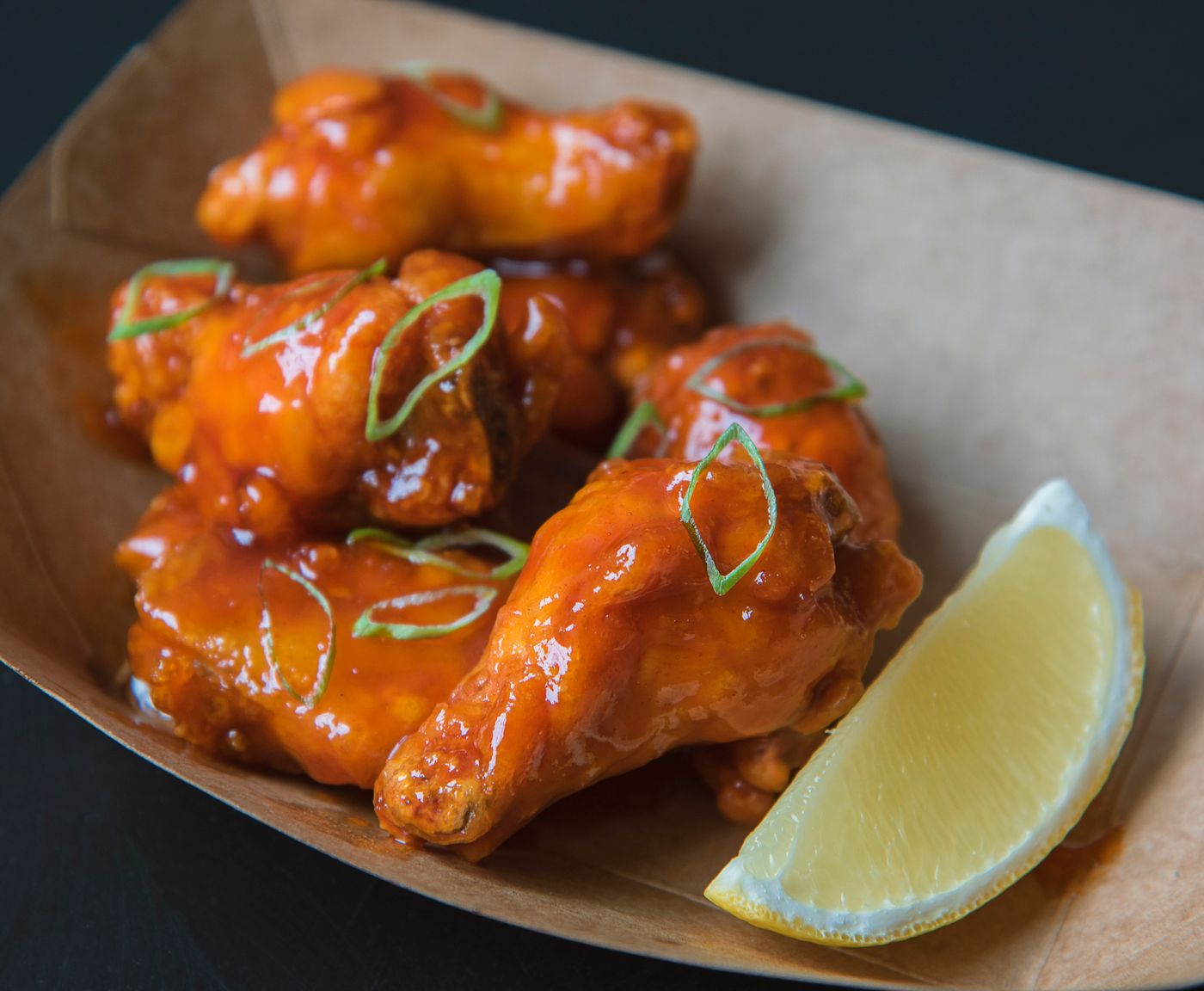
These honey-hot-sauce wings serve four from 1.2 kg of split wings and take about 65 minutes overall. Their cooking sequence separates browning from glazing: the wings roast with oil, salt and paprika, while honey, hot sauce, butter and lemon become a finishing sauce. Keeping the sweet coating out of the long roast gives you more control over both the skin and the glaze.
Honey-Hot-Sauce Wings with Scallions makes 4 servings, with 1 hr 5 min estimated total time. View the standalone recipe page.
Prepare a rack that lets the skin roast
Heat the oven to 425°F / 220°C. Set a lightly oiled wire rack over a rimmed baking tray, checking that the rack sits securely and the tray can contain drips. The wings should be flats and drumettes with the tips removed, as specified. Whole unsplit wings will not arrange or turn quite the same way.
Pat the pieces thoroughly dry before tossing with 15 g neutral oil, 5 g salt and the paprika. Drying is a practical step, not decorative advice: wet skin has to lose that surface water before it browns well. Keep raw chicken and its packaging away from the scallion greens and lemon wedges that will be served uncooked.
Space the pieces and turn on schedule
Arrange the wings with gaps between them. A rack is most useful when hot air can reach the sides as well as the tops; stacking pieces defeats that purpose. Roast for 40–45 minutes, turning after 25 minutes. Use the first turn to check whether one corner of the tray is coloring faster and reposition pieces if necessary.
Do not judge all the wings by one small flat. Drumettes and larger pieces may need longer. Check the thickest meat reaches at least 165°F / 74°C without the probe touching bone. Use the time range for organizing dinner, then let those checks determine when the chicken leaves the oven.
Make a glossy sauce rather than a sticky candy
During the last 5 minutes of roasting, combine 90 g smooth cayenne hot sauce, 60 g honey, 30 g unsalted butter and 15 g lemon juice in a small saucepan. Simmer for 2–3 minutes while stirring. The butter should melt into the sauce and the honey should disperse, leaving a glossy mixture that pours readily.
Keep the simmer moderate. Reducing this small quantity hard can make the coating disproportionately thick and concentrate the hot sauce. Have the roasting tray nearly ready before starting the saucepan. If the wings need extra cooking, move the finished sauce off the heat rather than continuing to reduce it while you wait.
Toss cooked wings in a clean bowl
Transfer the safely cooked wings to a clean mixing bowl. Do not reuse the unwashed bowl that held the raw seasoned chicken. Pour over the hot glaze and turn the pieces until the coating reaches their undersides and joints. A large bowl gives you space to mix without pushing the wings off the worktop.
A little sauce collecting underneath the wings is normal; it does not mean you need another oven roast. The recipe finishes with a toss rather than baking the honey coating for an extended period. That leaves a shiny, soft glaze over browned skin. Even well-roasted wings gradually lose some crispness once coated, so serving time matters.
Add scallions last and avoid a steamy hold
Move the wings to a platter and scatter over the 30 g sliced scallion greens. Set the four lemon wedges alongside for diners to squeeze. The additional lemon is a serving finish, so there is no need to automatically pour all its juice into the saucepan and change the glaze balance.
Use an open platter for immediate serving rather than sealing hot wings under a tight lid. If there are leftovers, refrigerate them within two hours, or one hour when the surrounding temperature exceeds 90°F. Reheat leftovers to 165°F. Expect the stored glaze to soften the skin; freshness of texture and safe storage are different considerations.
Common questions
Should the honey sauce go on before roasting?
Not in this method. The wings roast unglazed for 40–45 minutes, then receive the hot sauce mixture after cooking. Early glazing would expose the honey to a much longer, hotter cook.
Why are some wings done before others?
Size and placement affect cooking. Check large drumettes as well as flats, and continue cooking any pieces that have not reached 165°F / 74°C.
Technique & food-safety references
These primary references support the technique, safety and storage guidance. The recipe and cooking explanations are original Recipe Pinboard content.