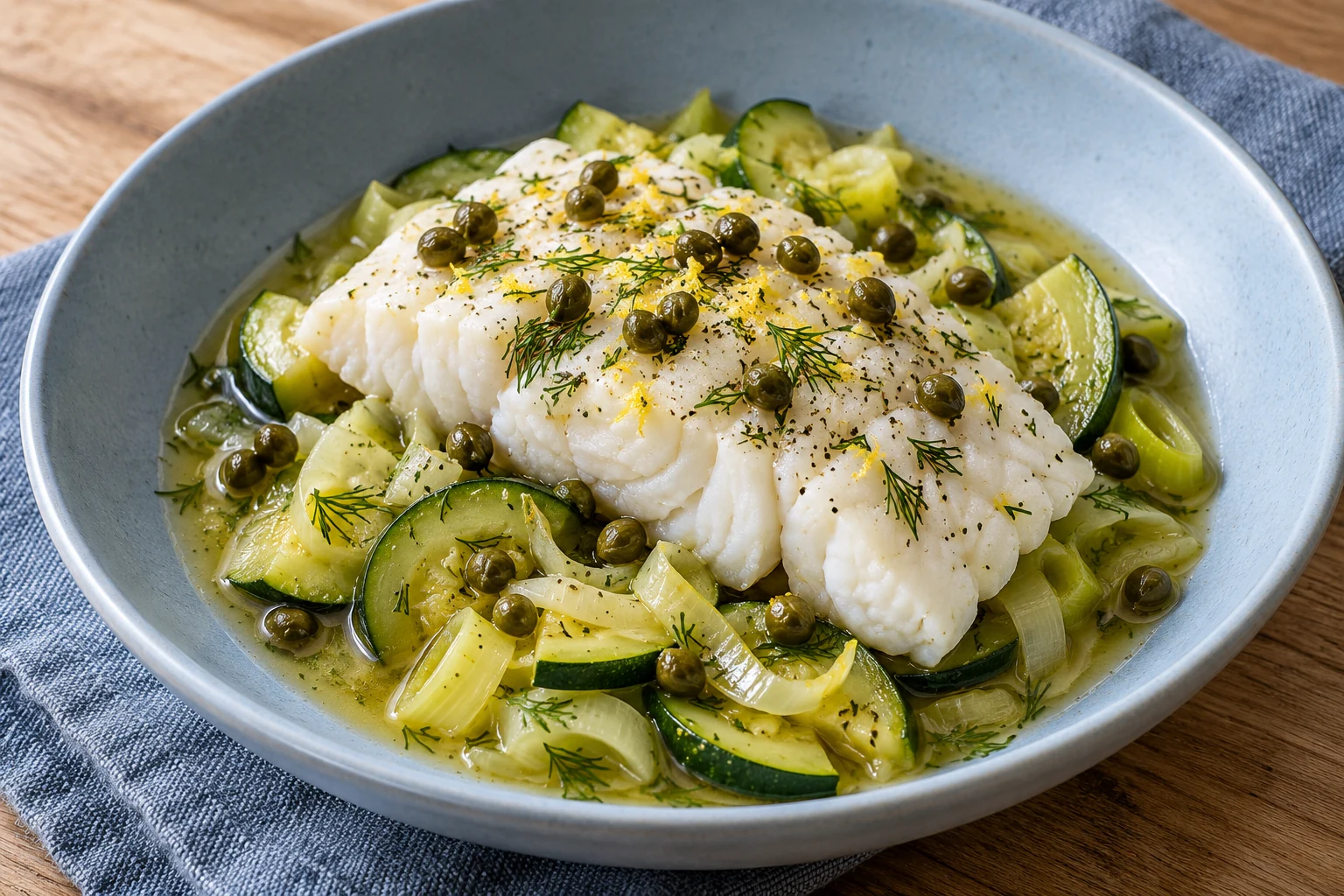
This cod stays pale and flaky because it cooks above vegetables in a covered pan rather than searing against a hot skillet. Leeks need thorough cleaning and a head start; lemon and dill belong at the finish. The forty-minute recipe serves four, with one roughly 170 g cod fillet per bowl and an equal share of leeks, zucchini, capers and pan juices.
Lemon-caper cod with leeks makes 4 servings, with 40 min estimated total time. View the standalone recipe page.
Wash between leek layers and drain thoroughly
Use 600 g trimmed white and light-green leek portions. Halve lengthwise and slice one centimeter thick, then swish the pieces in a large bowl of cold water. Soil can hide between the layers. Lift the leeks into a colander instead of pouring the whole bowl through it, which would send settled grit back over the vegetables.
Drain well before cooking. Excess wash water changes the small liquid allowance in the pan and can make the leeks boil before they soften in oil. Prepare the zucchini half-moons and rinse the salt-packed capers thoroughly, then drain those too. The capers specified here contain capers and salt; retain that ingredient choice rather than assuming all jarred products have identical seasoning.
Soften leeks before introducing the fish
Heat the oil in a wide, deep sauté pan over medium heat. Add the leeks and half the salt, cover and cook for seven to nine minutes, stirring several times. They should soften without browning. A lid traps steam while the oil coats the layers, so check the bottom when stirring rather than leaving the pan unattended.
Add garlic for thirty seconds, then zucchini, the 120 ml water and capers. Bring to a gentle simmer and cook uncovered for three minutes. This is the vegetable head start that allows the fish to cook briefly later. Do not put the raw cod into a cold, tightly packed bed of vegetables and expect the same timing.
Arrange evenly thick fillets in a single layer
Pat the cod dry and check for pin bones before placing it in the pan. The four fillets should be about 2.5–3 cm thick. A thin tail piece and a thick center cut will not finish together simply because they weigh the same. Season with the remaining salt and half the pepper as directed.
Lay the fillets over the vegetables in one layer without overlap. Choose a pan wide enough for their shapes and leave the simmer gentle. The measured water and moisture from the vegetables create the enclosed cooking environment. This is not a poaching pot in which the fish must be submerged under a large additional quantity of liquid.
Keep the simmer gentle and check every fillet
Cover and cook for eight to twelve minutes, adjusting the burner to maintain a gentle simmer. Rapid boiling can move the vegetables and knock delicate fish apart. Avoid repeated lid lifting before it is time to check, but do not treat the maximum time as proof of doneness if the pieces are unusually thick.
Look for opaque flesh that separates into flakes and verify 145°F/63°C in the thickest part of every fillet with a food thermometer. Insert the probe so its sensing tip reaches the center rather than the hot vegetables below. If any portion has not reached that temperature, keep cooking and check again. Flaking is a texture cue alongside the required temperature check.
Lift carefully and finish the vegetables off the fish
Use a broad spatula to transfer the cooked cod into four shallow bowls, supporting each piece across its width. Once cooked, the fillets can break if pinched firmly with tongs. Keep the vegetables and juices in the pan temporarily so the final lemon, zest, dill and remaining pepper can be stirred through them evenly.
Divide the finished vegetables and juices among the bowls, spooning some over each fillet. The dill and citrus should be distributed rather than landing as a concentrated topping on the first plate. Serve promptly while the fish holds its delicate flakes. There is no cream or separate thickened sauce here; the light lemon-caper pan liquid is the intended finish.
Common questions
How do I avoid gritty leeks?
Slice first, swish in a bowl of water and lift the pieces out, leaving sediment behind. Drain well before cooking. Rinsing only the outside of an intact leek does not reliably reach dirt trapped between its layers.
Why did the cod break apart?
A vigorous boil, overlapping pieces or tight tongs can damage cooked cod. Maintain a gentle covered simmer and transfer each fillet with a broad spatula after verifying 145°F/63°C.
Technique & food-safety references
These primary references support the technique, safety and storage guidance. The recipe and cooking explanations are original Recipe Pinboard content.