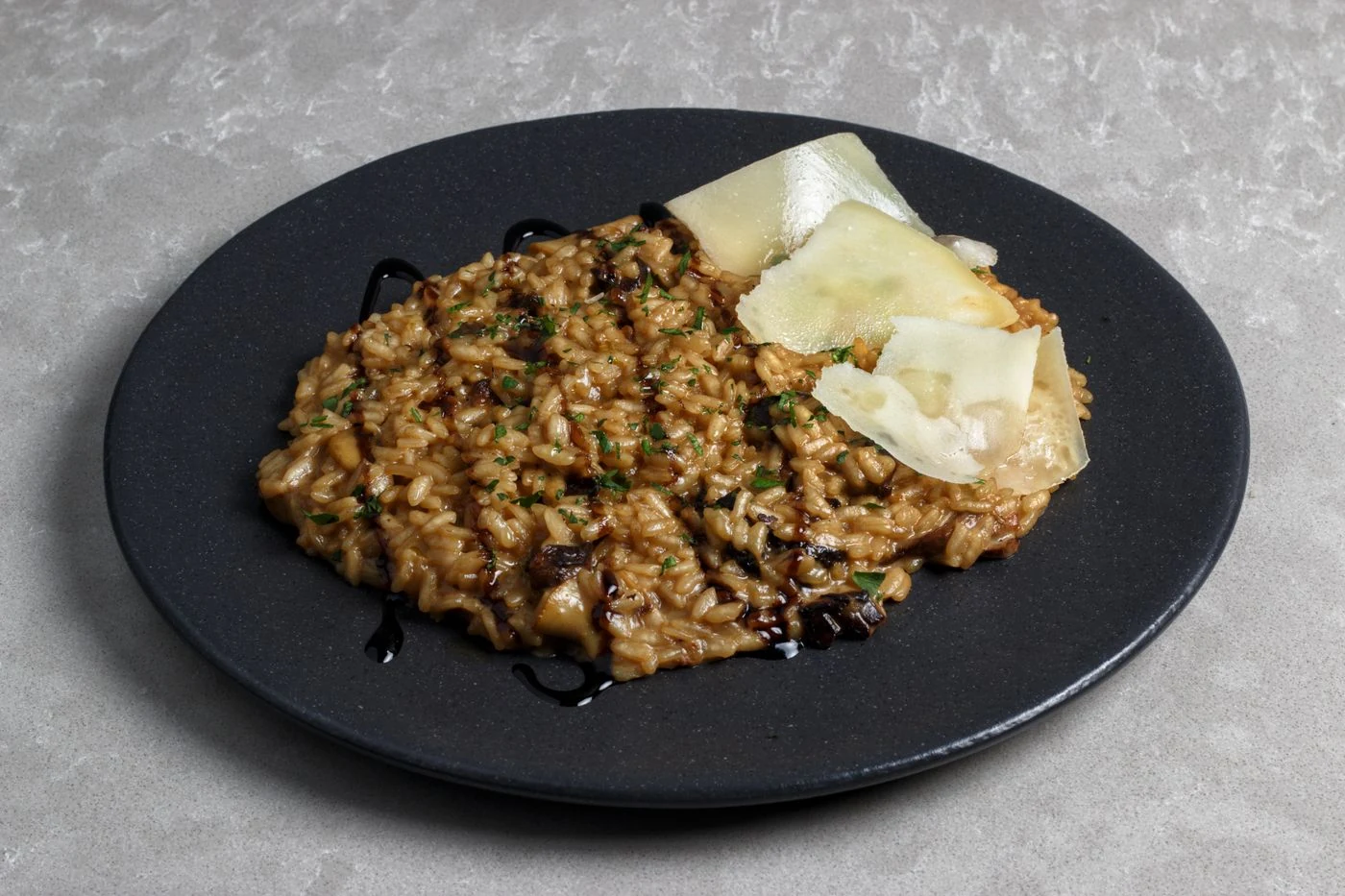
This risotto makes four servings and allows 60 minutes total, with about 50 minutes of active work. Its creaminess comes from cooking arborio rice gradually in hot liquid, followed by butter and cheese. There is no cream in the ingredient list. Browned cremini mushrooms and a measured balsamic finish provide contrast without changing the underlying rice method.
Mushroom risotto with balsamic & cheese makes 4 servings, with 1 hr estimated total time. Open the complete ingredient list and method.
Organize the hot broth and divided ingredients
Keep 1.1 litres reduced-sodium vegetable broth hot at a bare simmer in a separate saucepan. Measure up to 200 ml extra hot water for use only if needed. Having both ready avoids stopping the rice’s gentle bubbling with repeated cold additions.
Divide the 27 g oil: 14 g for the mushrooms and the remainder for the onion. Of the 60 g vegetarian Italian-style hard cheese, finely grate half and shave half. The grated portion melts into the rice; the shavings finish the bowls. Check for microbial rennet if keeping the dish vegetarian, rather than assuming any Parmesan-style cheese is suitable.
Brown mushrooms before introducing rice
Cook the 400 g trimmed, diced cremini mushrooms in the first portion of oil over medium-high heat for 8–10 minutes. At first they may release enough moisture to look as though they are simmering. Continue until that liquid evaporates and the pieces brown, then transfer them to a bowl.
This separate stage prevents their water from entering at an uncontrolled moment in the risotto. Use a wide, heavy pan and stir occasionally, allowing some contact time with its surface. Dicing also distributes mushrooms through the finished rice rather than leaving a few large slices in each serving.
Soften onion and briefly toast the grains
Reduce the heat to medium. Add the remaining oil and 120 g finely diced onion; cook for 5–6 minutes until softened. Add the 6 g minced garlic for 30 seconds, then the 300 g arborio rice for 2 minutes, stirring until the grain edges appear translucent.
The aim is to coat and warm the rice, not make it deeply brown. Keep the garlic moving and have your first ladle of broth nearby. Do not rinse the arborio before this method: the surface starch is useful for the sauce you are about to build.
Add broth gradually and taste the rice
Start with approximately 150 ml hot broth. Stir until it is mostly absorbed, then add another ladle. Continue for 20–25 minutes, stirring frequently and maintaining gentle bubbling. There should be enough movement to prevent sticking and distribute liquid, but you do not need to beat the grains vigorously.
Return the mushrooms after 15 minutes of this rice-cooking stage. Near the end, taste a grain for tenderness with a slight bite rather than a hard, chalky center. If the broth runs out first, use the measured hot water. If the rice is ready before every drop is used, its texture should guide you rather than forcing in liquid.
Finish off the heat and keep it flowing
Remove the pan from the heat and stir in 20 g butter, the 30 g grated cheese, 2 g salt, 0.5 g pepper and half the 8 g parsley. Rest for 2 minutes. If the rice tightens, loosen it with a little of the remaining measured hot water.
A good target for this recipe is rice suspended in a loose sauce that spreads in a shallow bowl. A stiff mound usually needs a small liquid adjustment. Divide among four warm bowls, then add the cheese shavings, remaining parsley and exactly 5 g balsamic glaze to each. Glaze is concentrated; a heavy pour can overwhelm the mushrooms.
Variations and safe storage
White button mushrooms can replace the cremini by weight as a straightforward variation. Regular balsamic vinegar is more fluid and sharp than glaze, so it is not an identical tablespoon-for-tablespoon topping. For the original result, retain the specified glaze and measure it.
Refrigerate leftover risotto promptly in shallow containers, within two hours or one hour above 90°F. Use within 3–4 days and reheat to 165°F. Cold rice absorbs liquid and firms up, so loosen it with a little water when reheating. Its texture will change; do not leave it at room temperature in an attempt to preserve creaminess.
Common questions
Do I need to stir continuously?
The recipe calls for frequent stirring, not uninterrupted stirring. Keep the grains moving often enough to avoid sticking and add liquid as it is mostly absorbed.
Can I make this far ahead for dinner?
The freshest loose texture is easiest to serve immediately. If preparing ahead, cool and refrigerate safely, then expect to add liquid and accept a firmer reheated texture.
Food-safety references
These official references support the safety and storage guidance. The recipe and cooking explanations are original Recipe Pinboard content.