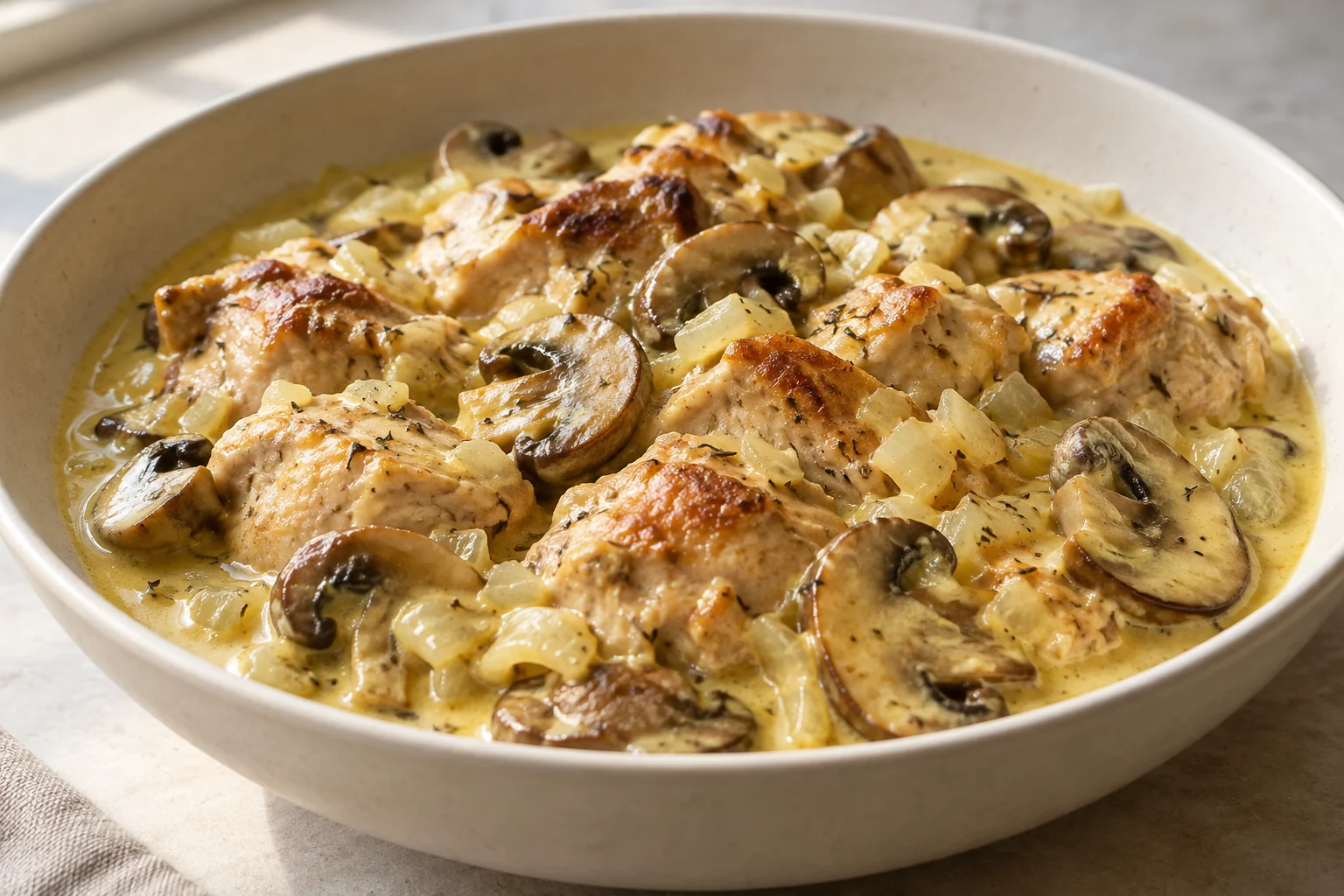
This skillet dish has two separate heat requirements. Chicken and mushrooms need enough heat to brown and cook safely; yogurt benefits from a gentler finish after the pan leaves the burner. Keeping those stages separate gives the sauce body without boiling the dairy into coarse curds.
Mustard & mushroom chicken braise makes 4 servings, with 1 hr 5 min estimated total time. View the standalone recipe page.
Brown the chicken in manageable batches
Pat the boneless thigh pieces dry and leave space around them. Crowding the skillet traps steam and makes the first stage resemble poaching rather than browning. The initial sear is only for flavor; it does not finish the chicken. Transfer the pieces to a clean plate that can hold their juices, and keep utensils that touched raw poultry away from ready-to-eat ingredients. Wash hands and work surfaces rather than rinsing raw chicken in the sink.
Let mushroom water evaporate
Mushrooms release considerable liquid as they heat. Stir occasionally, allowing that liquid to reduce before adding the onion. If onion goes in immediately, everything can soften together without developing the intended browned mushroom flavor. Keep any browned deposits on the pan bottom as long as they are brown rather than burnt black. Add garlic later so its tiny pieces do not scorch during the longer mushroom stage. The reserved liquid in the recipe will loosen the useful browned bits.
Use a quiet simmer for the braise
After adding the measured water, scrape the bottom and return the chicken with its collected juices. Cover and maintain gentle bubbling instead of a hard rolling boil. Check several large pieces at their thickest centers with a food thermometer; all must reach 165°F (74°C). A pink or white appearance alone is not the deciding test. If the sauce is thin, uncover near the end, but remove safely cooked chicken temporarily if an extended reduction would dry it out.
Temper yogurt off the heat
Whisk plain whole-milk Greek yogurt and smooth prepared mustard together before adding hot pan liquid a little at a time. This raises the yogurt temperature gradually. Fold the mixture into the skillet only after taking it off the burner. Do not return it to a vigorous boil to make it thicker. Fat content, acidity and stabilizers differ by brand, so some fine separation can still occur; a smooth result cannot be guaranteed by timing alone.
Divide the complete pan
A portion is one quarter of the chicken, mushrooms, onion and sauce together. There is no rice or bread hidden in the nutrition estimate. All measured oil and juices are counted because the method retains them. Refrigerate leftovers in shallow containers within two hours and use within three to four days. During reheating, gentle heat and stirring protect the texture, but the complete portion still needs to reach 165°F (74°C); sauce appearance does not replace the thermometer.
Common questions
Can I use chicken breast here?
Breast changes the fat estimate, thickness and cooking behavior. It can dry sooner than thigh in a braise. Treat it as a revised recipe and verify both nutrition and internal temperature.
Why is the sauce grainy?
Yogurt can separate when added directly to a boiling pan or reheated too aggressively. Remove it from heat, temper gradually and avoid further boiling. Separation is a texture issue, not a reliable food-safety indicator.
Technique & food-safety references
These primary references support the technique, safety and storage guidance. The recipe and cooking explanations are original Recipe Pinboard content.