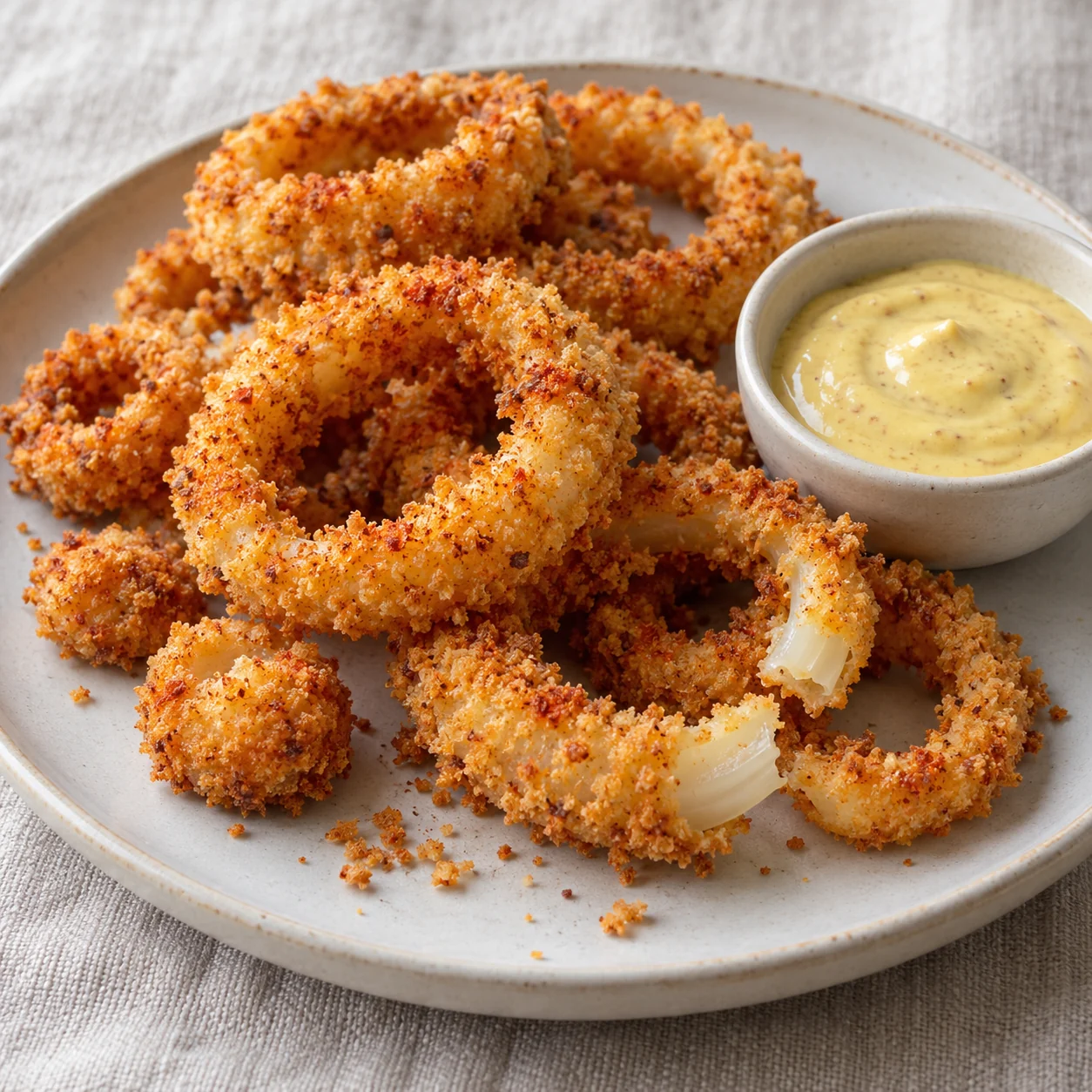
These onion rings use flour, egg and oiled crumbs to create a baked coating around tender onion. They are served with a separate mustard-yogurt dip. The full card above provides the ingredients for four equal portions, including the small onion centers. The main tasks are keeping the coating thin, giving the pieces room and protecting the first side while turning.
Oven-baked onion rings with mustard yogurt makes 4 servings, with 1 hr estimated total time. View the standalone recipe page.
Cut rings to a consistent width
Peel the onions, slice them across their width and separate the layers carefully. Keep the pieces close to the stated half-inch thickness. Very narrow rings can overbrown before thicker ones become tender. Retain the small centers as bite-size pieces; they are part of the measured onion quantity even though they are not hollow circles. Pat the cut surfaces dry before coating. Avoid leaving a wet layer that makes flour clump immediately. Arrange the prepared pieces near the coating bowls so the assembly process is orderly.
Set up three distinct coating bowls
Keep flour in the first bowl, beaten egg in the second and the crumb mixture in the third. Work the measured oil through the crumbs until they are evenly damp rather than leaving a few greasy lumps. The oil helps the oven coating brown, but it does not turn this into deep-fried batter. Add the paprika and roasting portion of salt to the crumbs, saving the remaining salt for the dip. Read breadcrumb labels: cheese or other animal-derived ingredients can affect the vegetarian tag.
Use a light layer at each stage
Dust an onion piece with flour and shake off the loose excess. Dip in egg, allow obvious drips to fall back into the bowl, then press gently into the crumbs. One hand for wet ingredients and one for dry can reduce the buildup of coating on your fingers. A thick paste around the onion is harder to bake evenly than a thin attached layer. If the crumb bowl becomes clumpy, continue carefully rather than packing every lump onto the next ring. Discard unused raw coating after assembly.
Leave gaps and turn with support
Spread the pieces across two trays in a single layer. Rings should not be nested tightly inside one another or covered by overlapping pieces. Bake the first side undisturbed, then use a thin spatula to lift and turn each piece. Swap tray positions because upper and lower shelves may brown differently. Loose crumbs may remain on the paper. Judge doneness by golden color, a set coating and tender onion, not merely the end of the shortest time. Avoid extending the bake until every crumb is very dark.
Keep the dip separate and understand the estimate
Mix the yogurt dip while the trays bake, then hold it in the refrigerator. Serve it alongside rather than pouring it over the entire plate, which softens the coating rapidly. Divide the onion pieces by equal shares rather than a fixed ring count, since onions produce different sizes. The panel includes all listed coating ingredients and oil. Bowl leftovers and tray residue mean the amount actually eaten can be lower; no exact absorption percentage is assumed. Refrigerate leftovers promptly and keep the dip separate for easier reheating.
Common questions
Why did the crumbs fall off?
A wet onion surface, excess flour or a heavy egg layer can weaken the coating. Dry the onion, shake off surplus flour and let egg drips fall away before adding crumbs. Turn only after the first side has set, supporting the whole ring instead of grabbing one edge.
Will leftovers stay crisp?
Onion moisture gradually softens the coating in storage. Reheating on a tray can restore some texture, but it will not precisely recreate a fresh batch. Heat the onion pieces to the stated safe temperature and serve cold dip separately; do not warm the yogurt repeatedly with the rings.
Technique & food-safety references
These primary references support the technique, safety and storage guidance. The recipe and cooking explanations are original Recipe Pinboard content.


