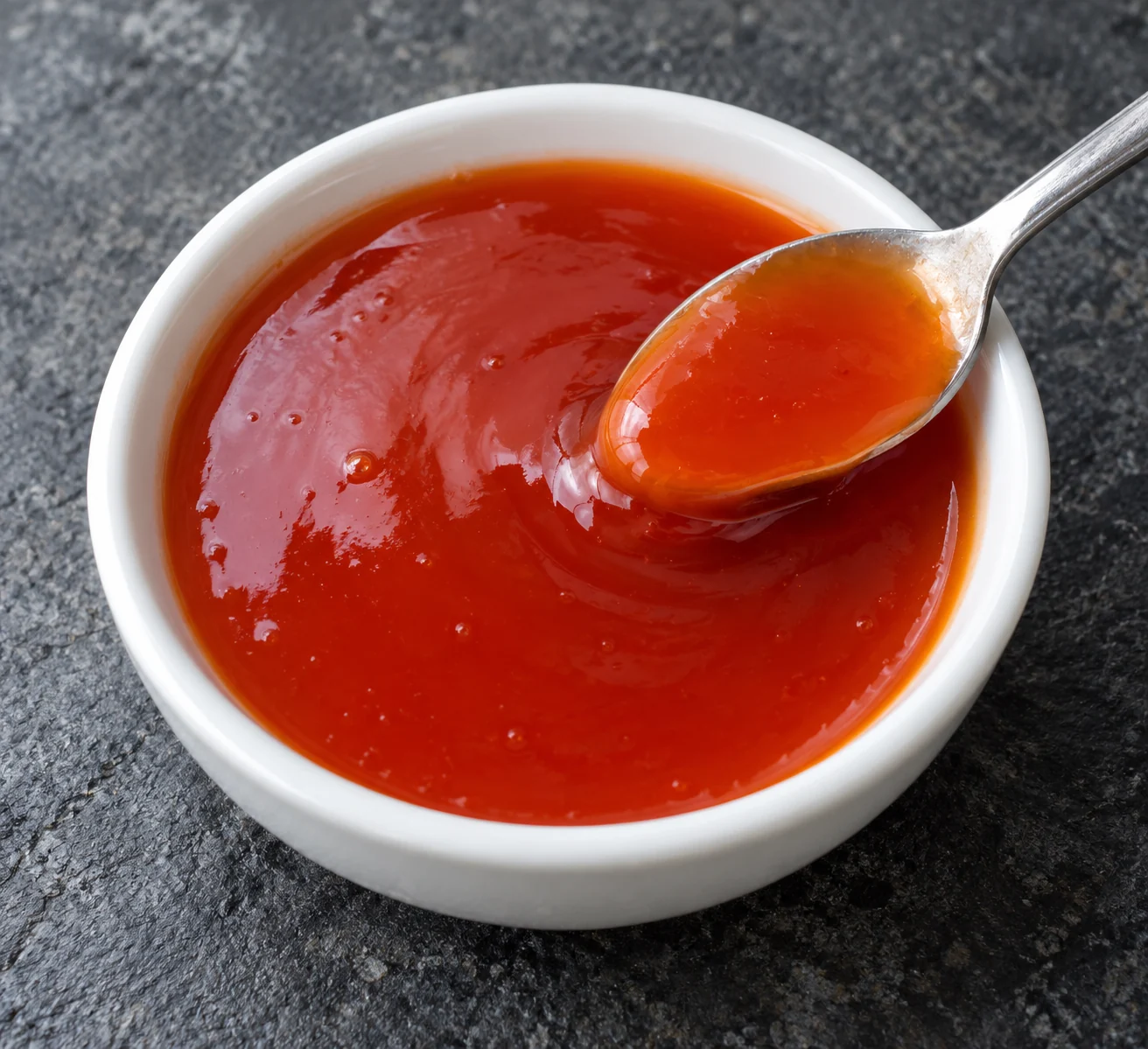
This small saucepan sauce balances a sharp vinegar base with sugar and ketchup, then uses a measured cornstarch slurry to give it gloss. It is intended for dipping or spooning over food that is already cooked. There is no pineapple juice, fruit pulp or food coloring in this formulation. Its red-orange appearance comes from ketchup, while its consistency depends on brief starch cooking and the temperature at which it is served.
Quick sweet-and-sour sauce makes 8 servings, with 25 min estimated total time. View the standalone recipe page.
Measure the acid and sweetness together
Use ordinary culinary distilled white vinegar labeled five percent acidity. Cleaning vinegar and stronger concentrates are not interchangeable with that ingredient. Weigh the ketchup as well as the separate sugar: ketchup contributes sweetness of its own, and brands differ in both sugar and salt. Reduced-sodium soy sauce adds a small savory note but also introduces wheat and soy in the reference used here. The sauce is not gluten-free simply because cornstarch supplies its thickener. Check each label before relying on the vegan or dairy-free ingredient screen.
Reserve cold water for the starch
Set aside the slurry water before putting the remaining water into the saucepan. Cornstarch disperses more evenly in cold liquid than when dry powder hits a hot sauce. Stir until the bowl has no dry corners or compact white lumps. The slurry can settle while the sauce heats, which is normal; it is not ready to pour merely because it was smooth five minutes earlier. Stir it again immediately before adding it, making sure the bottom of the bowl releases its heavier settled starch.
Dissolve the sugar before thickening
Heat the sauce base gently while stirring, paying attention to the bottom edge of the saucepan. The sugar should dissolve into the liquid before starch changes its movement. A small pan makes this amount easier to stir than a wide skillet where water evaporates quickly. Avoid using an unusually high burner setting to rush the process. If the mixture spatters vigorously or leaves a drying ring high on the pan, reduce the heat. Scrape sauce back down while it is still fluid rather than letting it scorch.
Stop after the short thickening stage
Pour in the freshly stirred slurry while whisking so it disperses through the hot liquid. The sauce will become clearer and glossier as it thickens. Once it has simmered for the short interval in the card, remove it from the heat rather than continuing to reduce it. The ten-minute stand is part of judging the finished texture: very hot sauce flows more freely than warm sauce. Adding more starch immediately can make the cooled batch too firm. This recipe aims for a coating sauce, not a sliceable gel.
Keep the portion basis separate from serving suggestions
Divide the complete batch into eight equal shares when using the estimated panel. A dip alongside another recipe does not include that other food in its nutrient values. Any ketchup left on the measuring spoon or sauce stuck in the saucepan introduces ordinary equipment variation, not a reason to invent a precise loss factor. Refrigerate leftovers promptly in a shallow container and use within the stated window. The vinegar flavor does not establish shelf stability, and this formula has not been developed as a home-canning process.
Common questions
Why are there pale lumps in the sauce?
Dry starch or a poorly re-stirred slurry can clump as it meets heat. Whisking promptly may break up small lumps, but it is easier to prevent them with cold water and a complete stir before pouring. Do not add dry cornstarch directly to the finished hot sauce; that usually creates another set of lumps rather than fixing the first.
Can I replace the sugar with a non-sugar sweetener?
That would change both the flavor balance and the behavior of this measured formulation. The posted estimate counts the granulated sugar and ketchup sugars in full. Use this recipe as written for matching results and accounting, rather than treating a different sweetener as a nutritionally or technically identical ingredient.
Technique & food-safety references
These primary references support the technique, safety and storage guidance. The recipe and cooking explanations are original Recipe Pinboard content.


