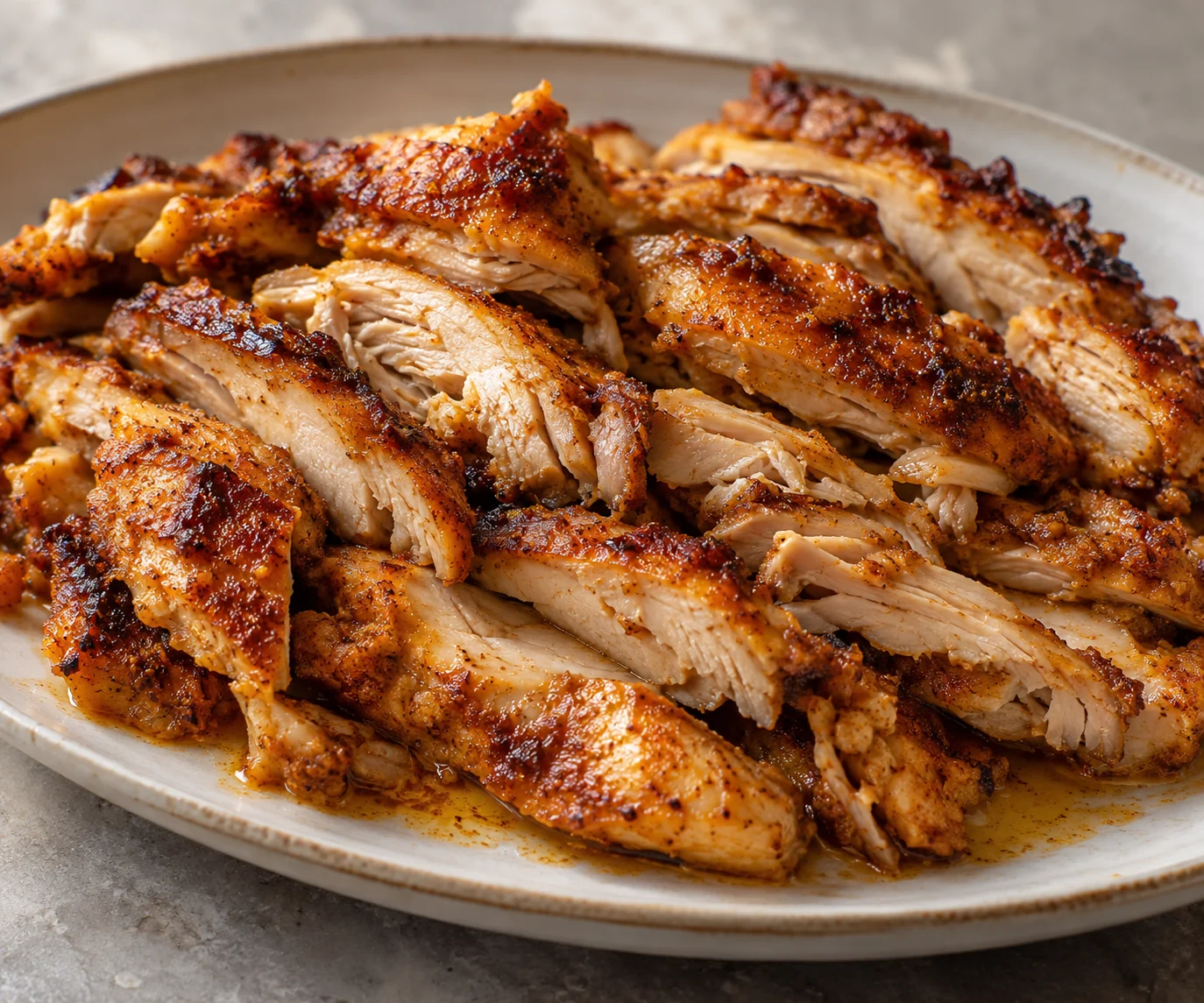
This home-oven adaptation layers boneless thigh pieces in a loaf tin, cooks the dense center thoroughly, then slices and briefly broils the meat. It does not reproduce a turning restaurant spit or use ground meat to make a smooth sausage-like loaf. The yogurt-and-spice coating stays with the chicken, and all cooking juices are returned during finishing. Expect some loosely connected strips when slicing; that is normal for pieces of whole thigh meat.
Shawarma-style chicken loaf makes 4 servings, with 3 hr 30 min estimated total time. View the standalone recipe page.
Keep the meat and marinade measurements together
Trim and weigh the edible boneless skinless thigh meat before coating it. Neither bones nor skin belong in the stated quantity. Open the pieces flat so the marinade reaches their surfaces, halving only unusually large pieces. Mix the yogurt, oil, lemon, garlic, cornstarch and ground spices thoroughly before adding the meat. Whole cumin or coriander seeds are not the same visible texture as the specified ground spices. Keep the covered mixture in the refrigerator throughout its marinating hour; acid and yogurt do not make raw chicken safe at room temperature.
Pack a consistent loaf without empty pockets
Brush the measured tin oil across its surface, then lay the coated pieces across the base. Alternate their direction and press gently as you build the layers. Large gaps create an uneven shape and can make slicing more difficult later. Scrape in the remaining marinade rather than abandoning a significant part of the measured yogurt and seasoning in the bowl. The tin dimensions matter because a deeper, narrower vessel produces a thicker center that takes longer to cook. Do not assume another vessel has an identical baking time.
Check several places in the dense center
The top can brown well before the packed middle is ready. Insert a thermometer into more than one central position, avoiding a reading taken only in hot liquid near the edge. Every checked center must reach the chicken endpoint before the loaf leaves the oven. Foil can protect a darkening surface while the middle finishes. The recipe's range is deliberately a planning allowance, not a substitute for measurement. The later broiling step is for browned edges, not a way to compensate for an undercooked center.
Retain the juices and expect irregular slices
Let the chicken rest in its tin before carefully pouring the juices into the saucepan. Keep the fat and yogurt solids as well as the liquid; all are part of the ingredient accounting. Bring the juices to the specified boil and simmer while arranging the meat. Turn the cooked layers onto a board and slice across them. Some strips will hold together and others will separate along the original thigh surfaces. Gather every piece for the finishing tray instead of discarding loose pieces because they do not resemble a neat deli slice.
Broil for edges, then portion the whole dish
Spread the meat in a shallow layer on a rimmed metal tray and spoon the hot juices over it. Keep the tray within the stated distance from the element and watch continuously, because thin edges can darken quickly. Do not put ordinary baking parchment beneath a broiler. The aim is a few browned edges with moist meat underneath, not drying every strip until crisp. Divide the complete tray into four shares, including its juices. Bread, salad, rice or additional yogurt are separate accompaniments outside this recipe's estimated panel.
Common questions
Why does the loaf fall apart when sliced?
Whole thigh pieces do not create the uniform bind of minced meat. Packing without large gaps, resting and using a sharp knife help, but loose strips are expected and are suitable for the broiling stage. Do not add an unmeasured binder merely to force a smooth sandwich-meat texture.
Can the chicken be broiled first and baked afterward?
That reverses the intended control of doneness and browning. The dense layered chicken must first reach 165 F /74 C in the center. Broiling then adds surface color to already cooked strips. Keep raw utensils separate from the cooked meat, and use the reheating endpoint for refrigerated leftovers rather than judging them only by browned edges.
Technique & food-safety references
These primary references support the technique, safety and storage guidance. The recipe and cooking explanations are original Recipe Pinboard content.


