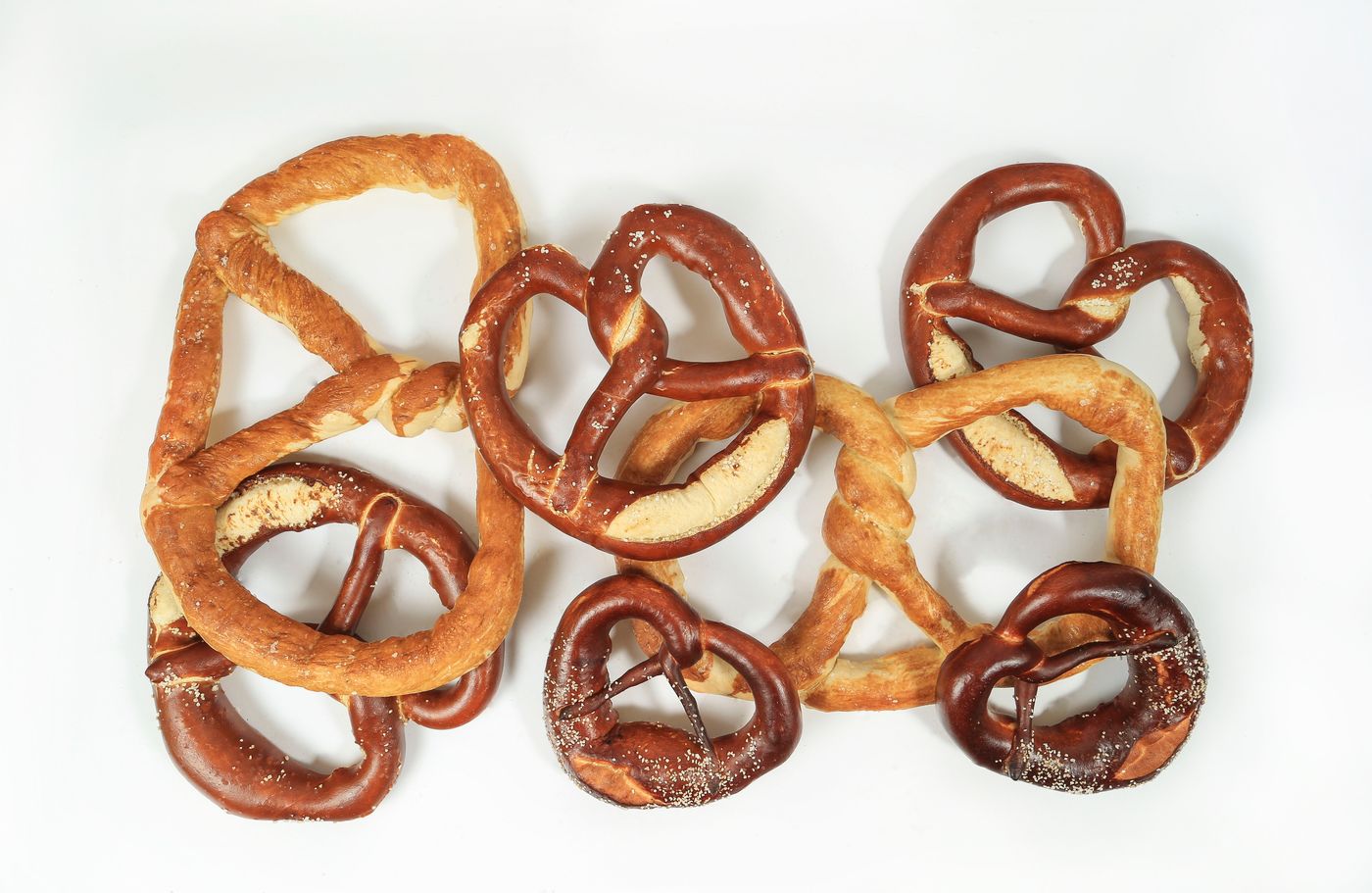
Soft salted pretzels combine a bread dough with a short baking-soda bath before baking. This recipe yields eight pretzels in about 110 minutes, including the rise and a ten-minute cooling period. The bath changes the dough’s surface so it browns differently from an ordinary bread roll. Keep the shaping, water treatment and egg wash as separate stages rather than trying to compensate for a rushed dough with extra time in the bath.
Soft salted pretzels makes 8 servings, with 1 hr 50 min estimated total time. View the standalone recipe page.
Mix a smooth dough and wait until puffy
Combine 500 g bread flour, 7 g instant yeast, 1 tbsp brown sugar and 1 tsp fine salt. Add 300 ml warm water and 30 g melted butter, then knead for about eight minutes until smooth. The fine salt belongs in the dough; the separate 2 tsp coarse salt is for the finish.
Cover and let rise for forty-five to sixty minutes until puffy. The dough’s expansion is more useful than an exact timer when the kitchen is cool. Do not add the bath’s baking soda to the dough mixture. It serves a surface-treatment role later and is not a substitute for the yeast that gives the bread its rise.
Divide evenly and roll patient ropes
Heat the oven to 425°F (220°C) and line two baking sheets with parchment. Divide the dough into eight similar pieces so they bake at a comparable rate. Roll each piece into a rope about 55 cm long, working outward from the middle. Keep the thickness fairly even instead of leaving one end much thinner than the other.
If a rope repeatedly shrinks back, let that piece rest briefly while you roll another, then return to it. Pulling hard can tear the surface. Form a U, cross and twist the ends, then bring them down toward the lower curve and press them into place. Leave the openings visible; they will become smaller as the dough cooks and expands.
Prepare the bath with room for foaming
Bring 2 liters water to a gentle boil in a large pot. Add the 60 g baking soda carefully in small additions and allow foaming to settle between them. Keep your face and hands away from the steam, and choose a pot with ample headroom. A full pot that overflows is not an acceptable shortcut for the stated bath volume.
Use ordinary baking soda as specified. Professional pretzel methods sometimes use lye, but that is a different chemical and handling process, not an interchangeable ingredient here. Have a slotted spatula ready before adding the first pretzel, and keep the baking sheets close enough to transfer the wet dough without a long dripping journey.
Dip briefly, drain and apply the finish
Lower each pretzel into the bath for twenty to thirty seconds. Support its shape with the slotted spatula and lift it out gently, letting excess liquid drain before placing it on the tray. Work with enough space that pretzels do not stick together. A longer bath is not automatically better and can make the dough harder to handle.
Weigh 20 g beaten whole egg into a small dish. Brush the full measured amount thinly and evenly over the eight pretzels, then distribute the 2 tsp coarse salt across them. Avoid puddles under the twists. The egg and salt are measured finishing ingredients. Wash utensils and surfaces that contact raw egg before handling the baked pretzels.
Bake, cool on a rack and store the cooled bread
Bake for twelve to sixteen minutes until deep golden. With two trays, check both positions because browning can differ; follow your oven’s needs rather than assuming the upper tray predicts the lower one. The centers should be baked through, and raw dough should never be tasted. Transfer to a rack and cool for ten minutes before serving.
Eat warm for the strongest contrast between the chewy outside and soft center. Let any leftovers cool fully before wrapping so steam does not make the surface damp. Freeze cooled pretzels for longer storage and warm them before eating. Coarse salt can draw moisture and become less distinct in storage, so reheated pretzels may not look exactly as they did on the first day.
Common questions
Why do the pretzel holes close during baking?
Ropes that are too short or loops shaped too tightly leave little room for expansion. Aim for the listed 55 cm rope and open curves before the bath. Some narrowing is expected, but generous initial openings preserve the recognizable shape.
Can I skip the baking-soda bath?
You could bake the shaped dough, but it would not have the same pretzel-like surface and browning. The bath is a central part of this recipe. Follow its stated concentration and twenty-to-thirty-second dip rather than substituting a different treatment.
Technique & food-safety references
These primary references support the technique, safety and storage guidance. The recipe and cooking explanations are original Recipe Pinboard content.