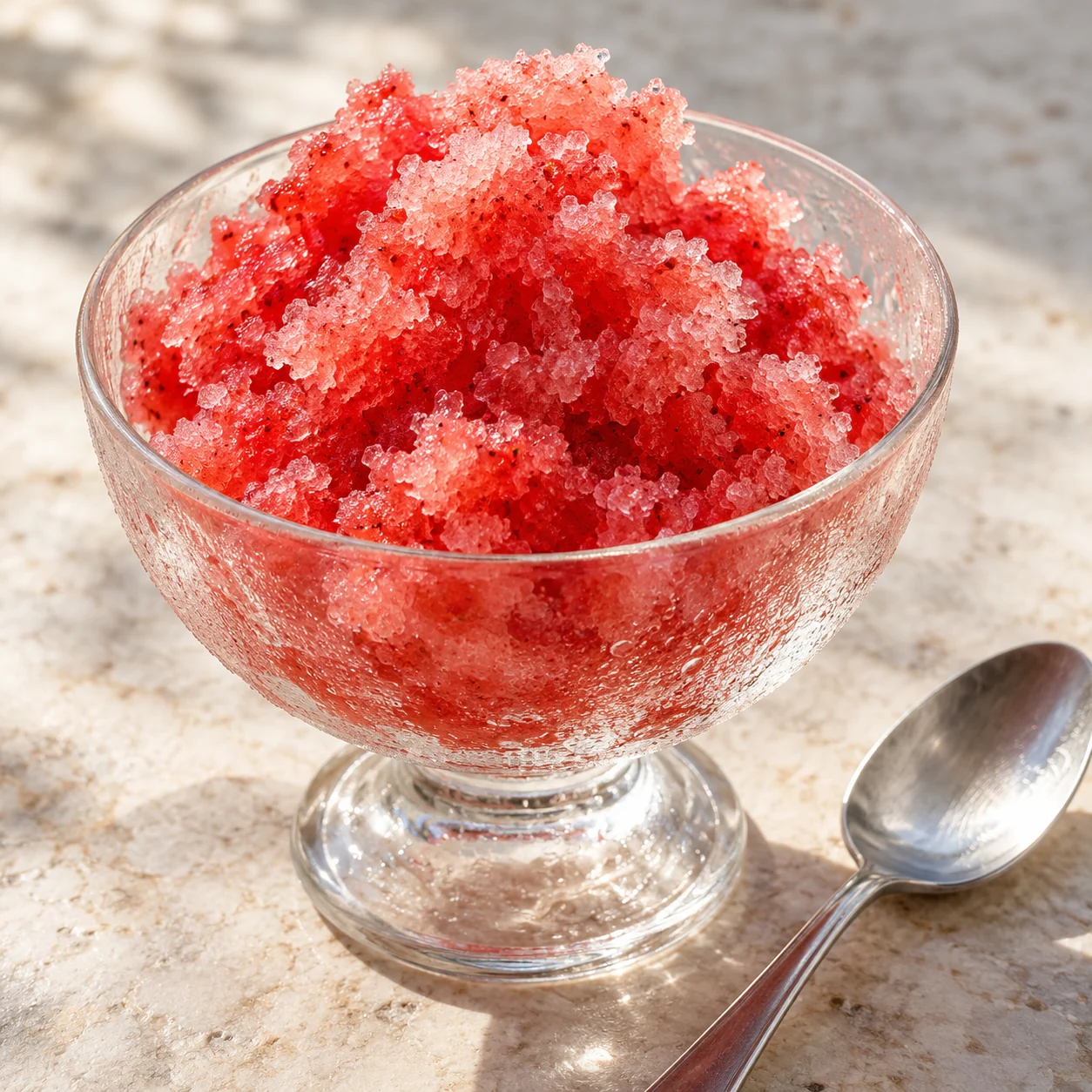
Granita is a scraped fruit ice, so its appeal comes from separate coarse crystals rather than the smooth churned texture of ice cream. This strawberry version keeps the pulp and seeds, balances the fruit with measured sugar and lemon, and freezes in a shallow metal pan. The full recipe makes six portions. Plan for about six and a half hours including cooling and repeated freezer visits, while recognizing that freezer temperature, available space and pan depth can change the finishing time.
Strawberry & lemon granita makes 6 servings, with 6 hr 30 min estimated total time. View the standalone recipe page.
Prepare the fruit before weighing it
Rinse the strawberries under running water and remove the leafy caps before weighing the edible fruit. Discard spoiled berries rather than blending them into the batch. Use clean utensils and a clean blender jar because the fruit mixture is not subsequently cooked. The brief heating stage dissolves sugar in water; it does not pasteurize the strawberries added later. Keeping all pulp and seeds also makes the ingredient accounting straightforward. Straining would change the retained mass and the texture, so it is not an invisible optional step for this recipe.
Dissolve the sugar without concentrating the syrup
Warm the sugar and measured water only until the crystals disappear. Avoid a long bubbling reduction, which removes water and changes the balance before freezing. Transfer the syrup to a heatproof bowl for its cooling interval, then blend it with the fruit and lemon juice. The finished puree should be uniform enough that the sugar is distributed throughout. Sugar contributes to texture as well as sweetness; substantially reducing it can make a harder ice. Keep the card quantities for the stated result and nutrition estimate.
Make room for a shallow level pan
Before pouring, find a level freezer shelf that can hold the nine-by-thirteen-inch metal pan. A deep bowl freezes differently because its center stays liquid after its outside becomes hard. Pour the puree into the shallow pan, keeping the layer below the stated depth, and cover it. Move the pan carefully so liquid does not spill over its rim. Avoid wedging it against warm newly added food. The initial hour is a starting checkpoint, not a promise that every freezer will produce exactly the same frozen border.
Scrape the edges back through the center
At each visit, draw a fork through the frozen perimeter and across the bottom, breaking the ice into smaller pieces and mixing them into the softer middle. Return the pan to the freezer between passes. Work through the whole pan instead of fluffing only the top while a solid slab forms underneath. Continue at the card intervals until no liquid center remains and the crystals separate readily. This repeated attention is the active technique: an unattended block can still be broken up, but it takes more effort to recover a loose texture.
Fluff once more just before serving
Use chilled bowls or glasses so the crystals do not immediately melt against a warm surface. Divide the entire batch into six comparable portions, including any softer fruit ice near the edges. Do not pack it down firmly like a snowball; a loose mound shows its texture better. Cover remaining granita and keep it frozen, scraping again before a later serving. If it has hardened, soften only enough to make scraping possible. Freezing preserves the mixture but does not eliminate all harmful germs, so clean preparation still matters.
Common questions
Why is my granita solid rather than fluffy?
Long gaps between scraping allow a continuous layer of ice to form. Let it soften briefly, then rake across the surface and break up the bottom as well. Keep it cold rather than melting the entire batch on the counter.
Are the dietary tags an allergy guarantee?
No. The listed fruit, sugar, lemon and water contain no intentional dairy or gluten, and a vegan-suitable sugar supports the vegan label. Check packaged ingredients and preparation surfaces for relevant cross-contact; the tags do not certify an allergen-free kitchen.
Technique & food-safety references
These primary references support the technique, safety and storage guidance. The recipe and cooking explanations are original Recipe Pinboard content.


