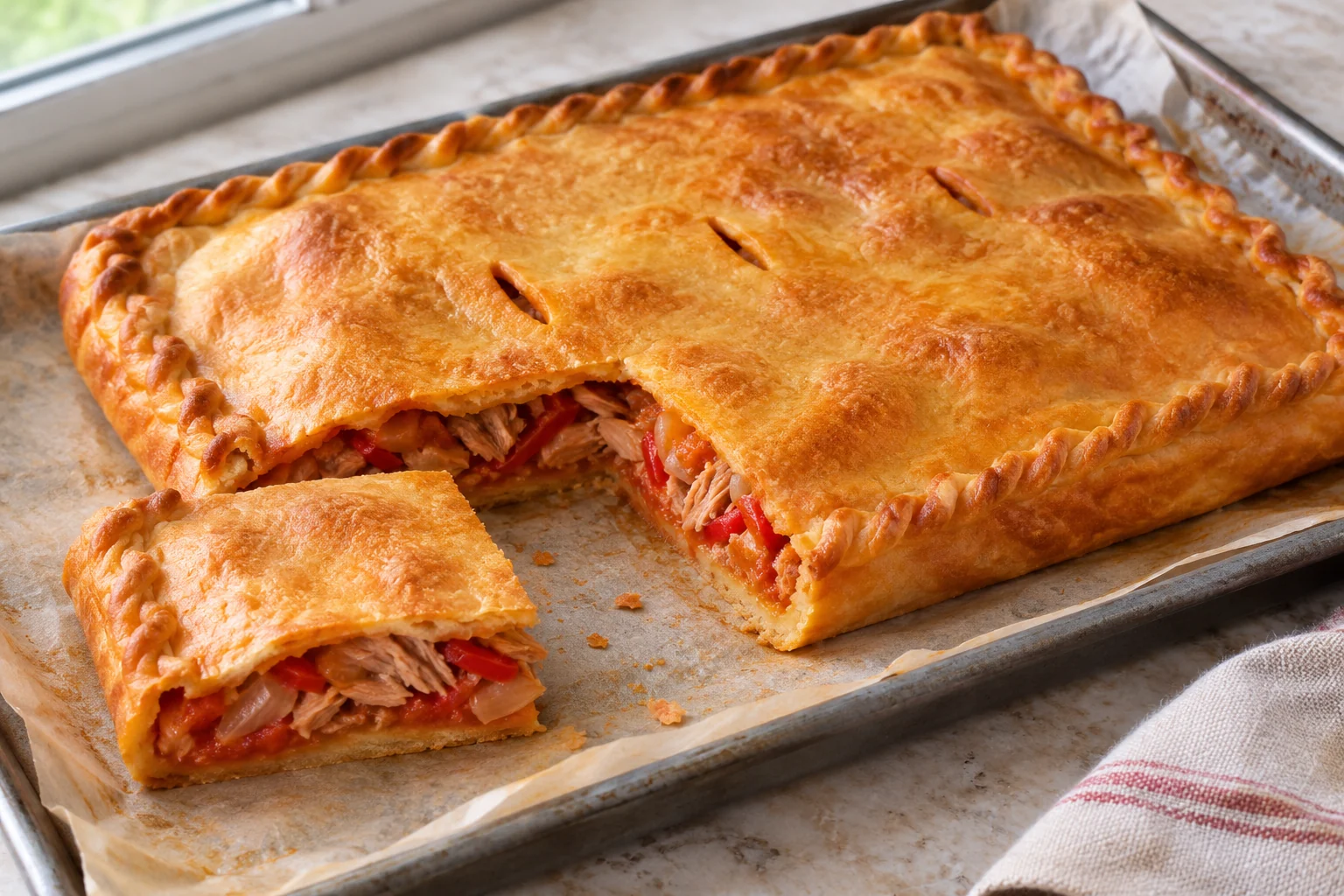
This Galician-style pie encloses a moist tuna and vegetable filling between two sheets of yeast dough. The main challenge is balancing a tender filling with a fully baked bottom crust. Softening the vegetables, reducing their loose liquid and cooling them before assembly all help. Start the dough first so its rise can overlap with the filling preparation, then give yourself an unhurried interval for rolling and sealing.
Tuna and pepper Galician-style pie makes 6 servings, with 3 hr 10 min estimated total time. View the standalone recipe page.
Let the dough become puffy before rolling
Stir the active dry yeast and sugar into comfortably warm water, then wait for signs of activity before mixing the dough. Hot water is not a shortcut to a faster rise. Knead until the dough becomes smoother and more elastic, cover it and allow the scheduled rise. Look for a puffy mass that has roughly doubled rather than relying only on the clock. A cool kitchen may take longer. Keep the dough covered while the filling finishes so the exposed surface does not form a dry skin.
Reduce the vegetables before adding tuna
Thinly sliced onion and pepper soften more evenly than large pieces. Cook them gently in the measured oil, then add the tomatoes and seasoning. The filling should remain juicy, but a spoon drawn across the pan should not immediately fill with a puddle of thin liquid. Fold in the drained tuna after the vegetables have cooked down. Break apart large clumps without grinding the fish into a paste. Spread everything in a shallow dish to cool; hot filling makes the lower dough sticky and harder to transfer or seal.
Roll between parchment and keep a clear border
Divide the risen dough and roll the two sheets to similar thickness, making the bottom slightly larger. Parchment lets you roll without adding flour and helps move the broad sheet onto the tray. If the dough springs back strongly, cover it and pause briefly before continuing. Spread the cooled filling evenly rather than leaving a tall mound in the center. Keep the border clean: wet vegetables or oil trapped between the dough edges can prevent a firm seal and allow juices to escape during baking.
Close the edges and give steam an exit
Lay the upper sheet over the filling without pulling it tight. Fold the lower border up against it and pinch continuously around the perimeter. Decorative crimping is optional, but a closed seam is useful. Cut the short vents through the top layer so steam has a planned route out. Brush with the measured finishing oil and bake on a roomy metal sheet. Check the underside as well as the surface; a browned top does not guarantee that a thick bottom layer has finished cooking.
Rest before cutting clean portions
Confirm that the filling center reaches 165°F and that the crust is cooked through. Let the pie rest for fifteen minutes before using a sharp knife to divide it. That pause reduces the rush of hot juices from the first cut and helps the filling stay between the crusts. Use a broad spatula to lift each portion. Refrigerate leftovers within two hours and use within three to four days. Reheat to 165°F; an oven helps recover some crust texture, while a microwave tends to soften it.
Common questions
Why is the bottom crust damp?
The filling may have been too wet or too hot at assembly, or the lower dough may be thicker than the top. Reduce loose vegetable liquid, cool the filling and roll both sheets evenly before baking.
Can I use oil-packed tuna?
The written recipe uses drained water-packed tuna plus separately measured olive oil. Oil-packed fish changes the fat and moisture balance. Choose the specified canned tuna for the intended filling and recipe quantities.
Technique & food-safety references
These primary references support the technique, safety and storage guidance. The recipe and cooking explanations are original Recipe Pinboard content.


