Whole fish has thin areas near the tail and thicker flesh behind the head, so it does not cook like a uniform fillet. This two-serving recipe takes about 45 minutes and uses two cleaned 600 g fish, such as red snapper. Their stated weights include heads and bones. A fish basket helps with turning, while a cooler grill area gives you somewhere to finish the center if the skin colors quickly.
Whole Grilled Fish with Charred Lemon makes 2 servings, with 45 min estimated total time. View the standalone recipe page.
Start with cleaned fish that fits your basket
The fish should already be scaled, gutted and have its fins trimmed. Check that both fish fit securely in the basket without being crushed together. Pat them very dry inside and out. Surface moisture makes crisping more difficult, and water trapped in the cavity can drip as you move the fish over the grill.
Make two shallow diagonal slashes through the skin on each side, avoiding the backbone. Keep the cuts controlled rather than slicing deeply through the entire fish. Prepare a clean platter, thermometer and wide serving utensils now so the cooked fish will not return to the tray used for raw preparation.
Oil the fish, lemon and basket in measured portions
Rub the fish inside and out with 20 g olive oil, the salt and pepper. Brush the 1 cm lemon rounds and the inside of the grilling basket with the remaining 10 g oil. Make sure the areas of basket that will touch the skin receive a light coating.
Secure the fish in the basket before approaching the hot grill. A loose closure can make a planned single turn into an awkward attempt to catch fragile fish. Check the manufacturer's handling instructions and use heatproof gloves or suitable utensils; handles and clasps can become hot even when they extend beyond the main cooking area.
Use direct heat for color and a cooler area for control
Heat a clean grill to medium-high and establish a cooler finishing area. Grill over direct heat for 7–9 minutes per side, turning the basket carefully. Keep your movements deliberate so oil or juices do not splash toward you. The basket holds the fish together but does not remove the need to watch the heat.
If the skin is coloring faster than the center cooks, move the basket to the cooler area and close the lid. This preserves control without forcing the same surface to remain over intense direct heat. Tail sections may brown sooner than the shoulder, so inspect more than the most attractive-looking part of the fish.
Check thick flesh without touching the backbone
Insert a thermometer into the thickest flesh just behind the head, avoiding bone. Each fish must reach 145°F / 63°C. Total cooking usually takes 18–25 minutes for this size, but the thermometer determines completion. Two fish of the same weight can have different shapes and therefore different thicknesses at the measuring point.
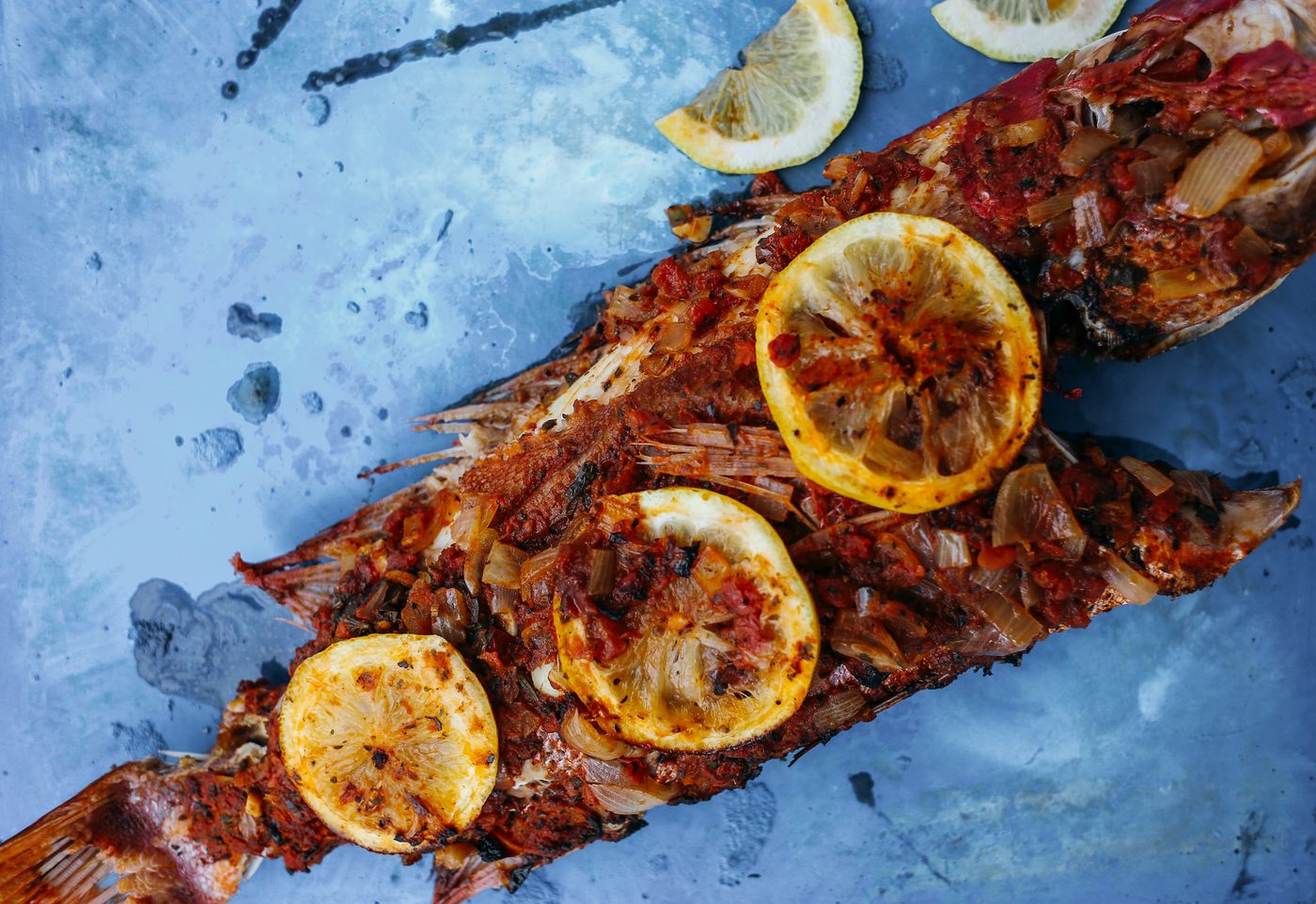
During the final minutes, grill the lemon rounds for 2–3 minutes per side. Use tongs and place them where they can be retrieved without reaching across the fish. The goal is browned cut surfaces that provide a grilled lemon finish, not rounds left until their peels and pulp are completely blackened.
Open the basket gently and serve with bone awareness
Transfer the cooked fish to a platter, releasing the basket gently if the skin has caught in places. A broad fish slice can support the body while you lift. Top with the charred lemon and chopped parsley. Serve one whole fish per person rather than calculating portions from an assumed edible-yield percentage.
Lift flesh away from the backbone carefully and check for small bones as you serve and eat. Even properly cleaned fish contains bones; whole-fish presentation is not a boneless meal. Set out a small side plate for bones and used lemon pieces so diners can work comfortably instead of hiding them beneath the remaining food.
Common questions
Why is the skin dark but the center still underdone?
Direct heat may be too intense for the fish thickness. Move it to the prepared cooler area, close the lid and continue until the thickest flesh reaches 145°F / 63°C.
Does the 600 g weight mean 600 g edible fish?
No. Each fish is weighed cleaned but whole, including head and bones. The recipe serves one fish per person without claiming a fixed edible yield.
Technique & food-safety references
These primary references support the technique, safety and storage guidance. The recipe and cooking explanations are original Recipe Pinboard content.