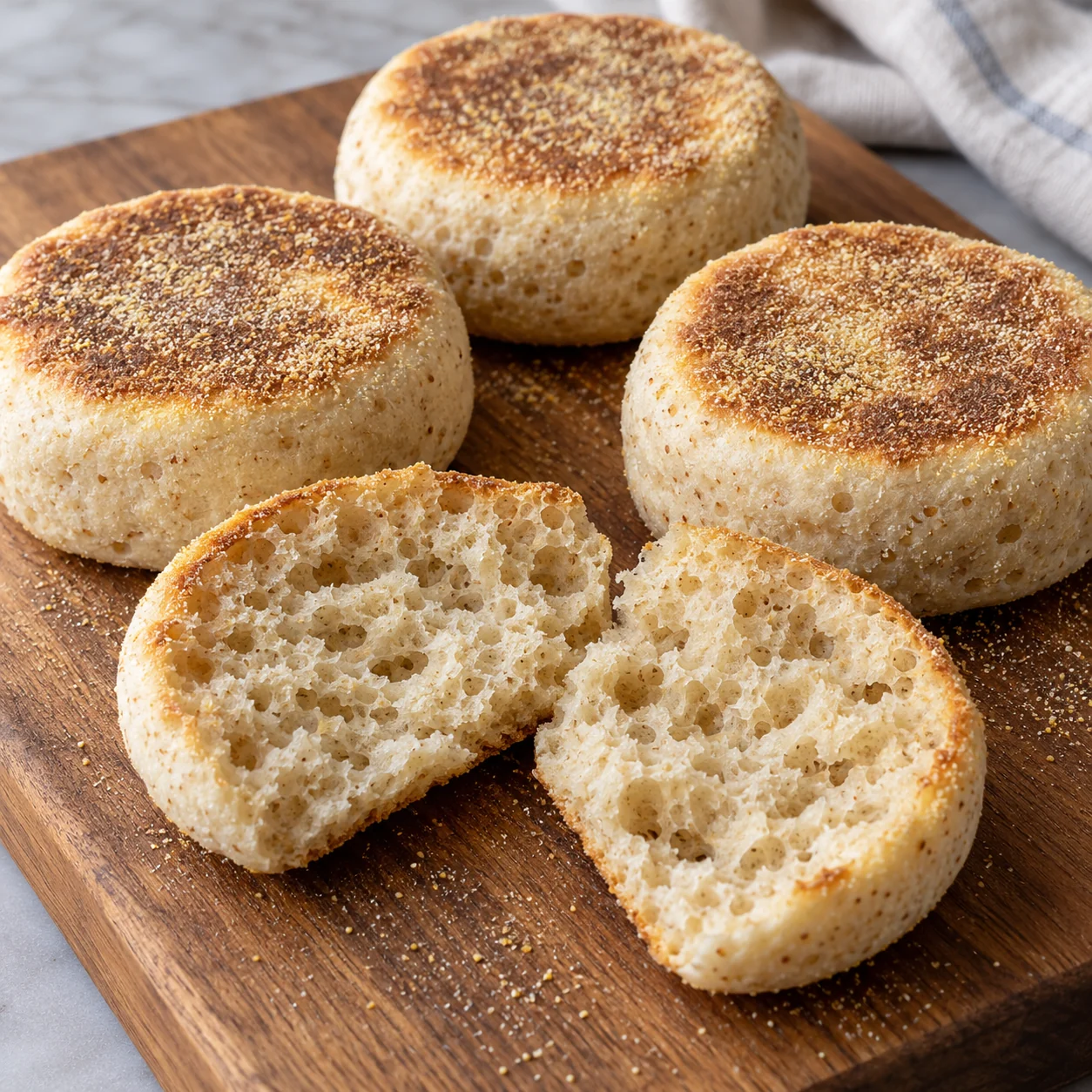
These English muffins combine a yeast-raised dough with gentle griddle browning and a short oven finish. A quarter of the flour is whole-wheat, giving a lightly flecked crumb without replacing the white bread flour entirely. The full card above makes eight muffins. The four-hour allowance includes both rises, two griddle batches and cooling, with extra time possible in a cool kitchen.
Griddled whole-wheat English muffins makes 8 servings, with 4 hr estimated total time. View the standalone recipe page.
Keep the dough formula intact
Combine the yeast and sugar with the measured warm water, then add milk, butter, flour and salt as directed. The butter should be melted but no longer hot. Knead in the bowl so an unmeasured layer of bench flour does not gradually enter the dough. It should become elastic and cohesive, though it may remain a little tacky. Adding flour until it feels completely dry can produce a firm, closed crumb. Do not taste raw dough; flour requires cooking even though this formula contains no egg.
Use the rise as a volume checkpoint
Cover the bowl and allow the dough to become roughly doubled. Time depends on room temperature and yeast condition, so the range tells you when to start checking rather than guaranteeing readiness. Avoid placing the bowl against an actively heating burner. If the surface develops a dry skin, it becomes harder to shape smooth rounds later. Once risen, divide the dough into eight equal portions. Using equal portions gives a more consistent cooking time and makes the stated one-muffin serving meaningful.
Shape with the measured cornmeal
Flatten the balls gently into broad, relatively low rounds on the cornmeal-dusted tray. Keep their thickness similar, because a tall center takes longer to cook than the browned faces suggest. Use the remainder of the measured cornmeal on top rather than adding extra flour. Cover the rounds loosely while they become puffy. The second rise matters: moving dense freshly flattened dough directly to the griddle produces a heavier result. Some cornmeal will remain behind, and the nutrition estimate conservatively includes the entire measured amount.
Brown on modest heat without pressing
Use a heavy nonstick or well-seasoned surface so the muffins can cook without extra unlisted oil. Transfer four at a time with a broad spatula, preserving their shape. Keep the heat low enough that the faces become golden gradually. If the cornmeal turns black before the sides have begun to set, reduce the heat. Pressing the tops with the spatula forces out gas and makes the crumb denser. Turn once the first face is established, then allow the second side its own cooking time.
Finish in the oven and cool before splitting
Move browned muffins to the oven to finish the center. Check a representative thick muffin rather than relying on the surface color; the card gives an approximate internal temperature for a set bread crumb. Transfer to a rack and allow the cooling period. Cutting a very hot muffin can compress or smear the interior. For a rougher surface suitable for toasting, work a fork around the middle and gently separate the halves. Count one whole muffin as one serving, with butter, jam or other toppings added separately.
Common questions
Why are the outsides dark but the middle doughy?
The griddle was probably too hot, or the rounds were too thick. The oven finish helps complete the center without requiring more aggressive browning. Next time control the thickness and reduce the griddle heat instead of pressing the muffins flat during cooking.
Can I substitute sourdough starter for the yeast?
Not directly. Starter changes the flour, water and fermentation schedule, so it needs a separately balanced formula. This card's quantities and timing belong to active dry yeast. Once completely cool, freeze surplus muffins if you will not use them within the stated storage window.
Technique & food-safety references
These primary references support the technique, safety and storage guidance. The recipe and cooking explanations are original Recipe Pinboard content.


