Chicken · ALWAYS FREE
Paprika-yogurt chicken with roasted cauliflower
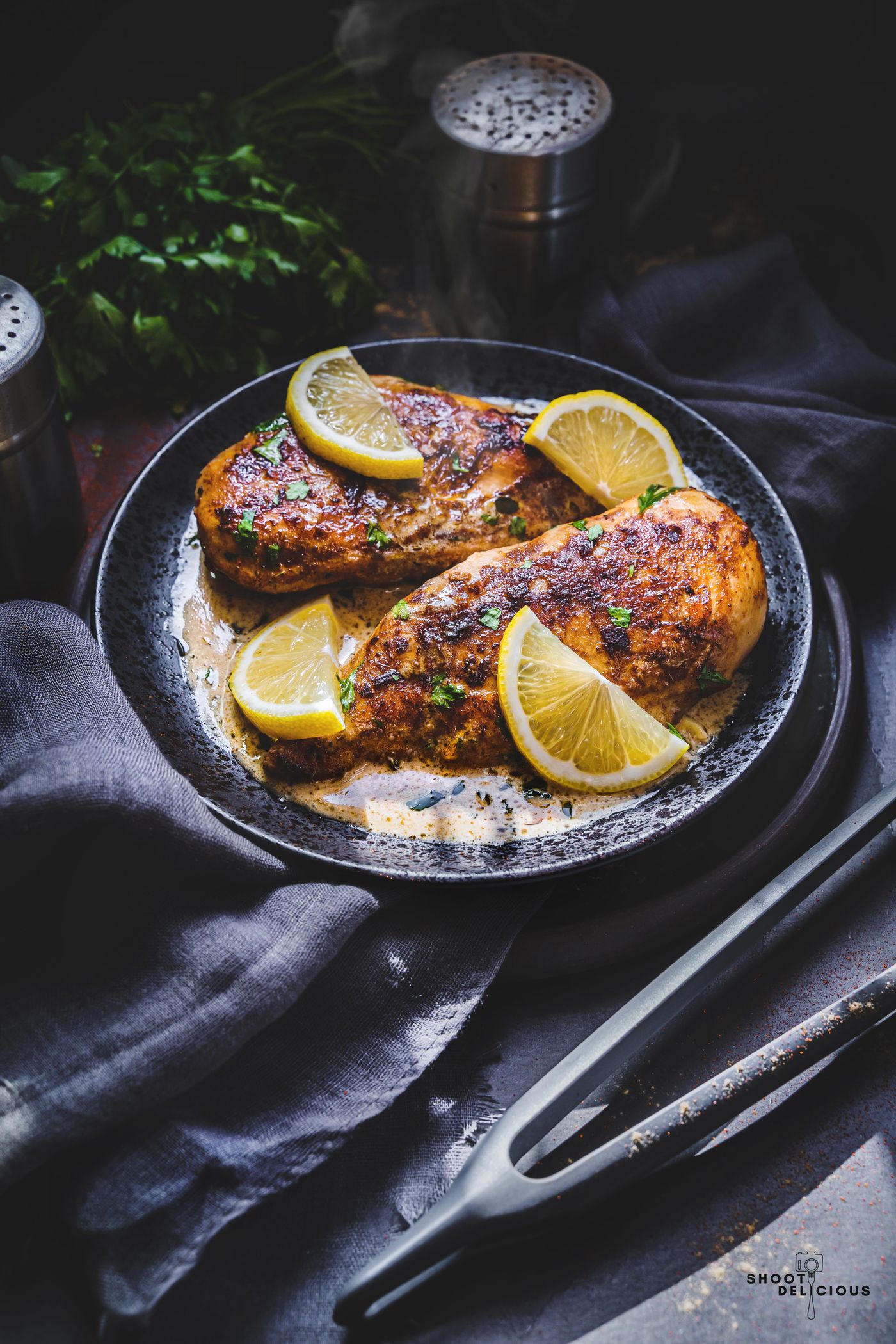
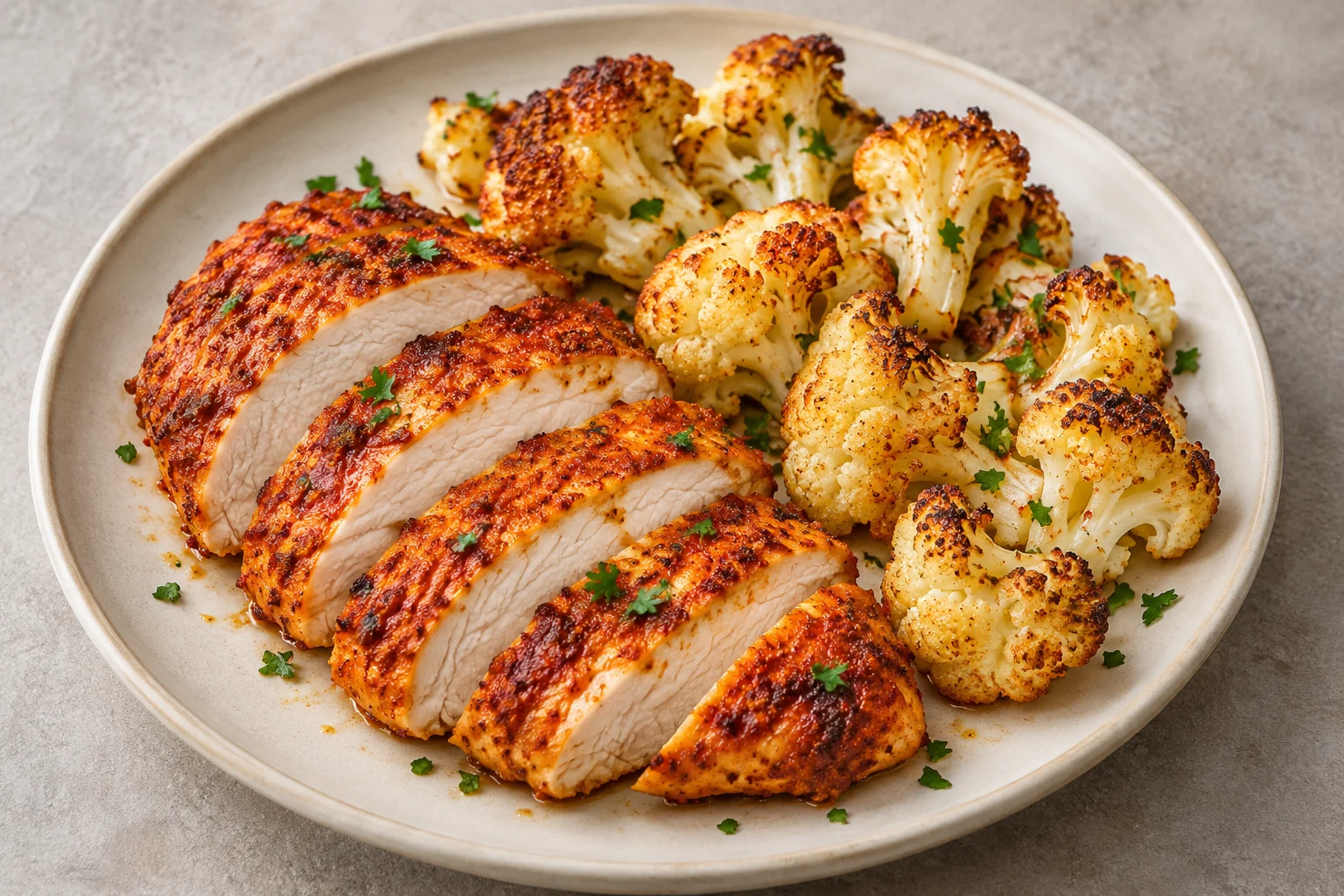
Thin paprika-yogurt-coated chicken breasts roast beside a tray of browned cauliflower, finished with parsley and lemon.
Ingredients
Volumes are approximate. For baking, use a scale; Metric keeps the specified gram weights.
Let’s make it
- Heat the oven to 425°F (220°C), with racks in the upper and lower thirds. Line two rimmed baking sheets with parchment rated for this temperature. Pat the cauliflower dry; toss with 0.564 oz oil and 0.0705 oz salt and spread on one sheet with space between the florets.
- Roast the cauliflower on the upper rack for 10 minutes. Meanwhile, place each chicken portion between sheets of parchment and gently pound the thick end to an even 2 cm thickness. Do not wash raw chicken; wash hands, the board and utensils after handling it.
- In a clean bowl, mix the yogurt, remaining 0.282 oz oil, lemon juice, garlic, paprika, cumin, remaining 0.0705 oz salt and pepper. Arrange all four chicken portions separately on the second sheet. Spoon the entire measured yogurt mixture over the chicken and scrape the bowl clean, dividing the coating evenly. No marinating time is required. Wash utensils and surfaces that touched raw chicken.
- Put the chicken on the lower rack. Roast for 18–25 minutes, until a food thermometer inserted into the thickest part of every portion reads at least 165°F (74°C). Turn the cauliflower and rotate both sheets halfway through. Remove the cauliflower when its edges are browned and the stems are tender, about 30–35 minutes in total; let the chicken cook longer if it needs to reach temperature.
- Rest the cooked chicken for 5 minutes, then slice each portion crosswise. Give each of 4 plates one chicken portion and one-quarter of the cauliflower and cooked pan juices. Scatter the parsley evenly over the plates. Pack leftovers into shallow containers and refrigerate promptly at 40°F (4°C) or colder, within 2 hours of cooking or 1 hour above 90°F (32°C). Use within 3–4 days; reheat to 165°F (74°C).
Estimated nutrition
Per serving · 1 of 4- Calories
- 341 kcal
- Protein
- 44.8 g
- Total carbohydrate
- 12.9 g
- Total fat
- 12.5 g
- Total sugars
- 5.1 g
Calculated from the listed ingredients and yield. Brands, draining, cooking and portioning can change the result. Not a laboratory analysis.
Calculation notes & sources
Estimated from listed ingredient amounts and identified food-composition profiles, divided by the stated number of servings. Not laboratory analysis or kitchen testing. The ingredient-sum method uses raw or cooked food profiles matching the ingredient state. Moisture gain/loss does not change the stated serving count. No general cooking/fermentation nutrient-retention factors are applied. Unless a discard/absorption blocker is listed, all measured pan fats and sauces are assumed consumed. Actual amounts left in pans, on utensils or during cooking can reduce intake. Optional additions are excluded when noted. Calories are kcal. Protein, total carbohydrate, total fat and total sugar are grams. Total carbohydrate includes fiber; these are not net carbs. No %DV or FDA-compliance claim. Null means unavailable, never zero. Sodium and fiber are omitted because retention, brands, rinsing and missing source rows make them less reliable here. This version specifies whole-milk Greek yogurt and applies all 100 g in the coating, along with the oil, lemon juice and seasonings. It does not infer a retained amount from discarded marinade. Cooked pan juices are divided among four plates as the recipe already instructs. USDA FDC171304 is the named generic whole-milk Greek-yogurt profile. Brand fat, protein and sugar values vary. Authored specification clarification on6 October2026. Explicit measured inputs are preparation instructions, not a claim of kitchen-measured retention or laboratory analysis; small utensil/pan residue can reduce intake.
View the ingredient calculations · Source 1Why it’s in this collection
- High Protein: Protein-only lower-bound estimate within an ingredient-sum model: 680 g raw boneless skinless chicken breast × 22.5 g protein per 100 g ÷ 4 equal portions = 38.25 g, rounded down to 38.2 g per portion. Other ingredients are not counted. The raw weight matches the exact USDA raw-food record. This is an estimate, not a guaranteed minimum in the cooked dish or a full nutrition panel; ingredients, preparation and portioning vary. USDA reference · USDA reference · USDA reference
- Weight Loss Journey: One of four measured equal portions includes 200 g raw trimmed nonstarchy vegetables (800 g trimmed cauliflower) and an anchor-only protein estimate of 38.2 g. Vegetable figures are raw edible weights before cooking, not cooked serving weights. The exact ingredient list specifies no added sugar and the method is not deep-frying. This meets the site’s portion-aware criteria (at least 20 g estimated protein and 150 g nonstarchy vegetables per portion); it does not prescribe calories or promise weight loss. Supporting reference · Supporting reference · Supporting reference · Supporting reference
- Mediterranean: Chicken breast and cauliflower with olive oil, lemon, garlic, paprika, cumin, parsley, salt and pepper; yogurt is explicitly made only from milk and live cultures. Selected for the vegetable/legume/olive-oil-centered ingredient pattern, with any seafood, poultry or dairy shown explicitly above.
Required label checks: Keep the stated yogurt restriction of milk and live cultures only; flavored or thickened yogurt is not assumed equivalent.
Supporting reference - Gluten-Free: Chicken breast and cauliflower with olive oil, lemon, garlic, paprika, cumin, parsley, salt and pepper; yogurt is explicitly made only from milk and live cultures.
Required label checks: Keep the stated yogurt restriction of milk and live cultures only; flavored or thickened yogurt is not assumed equivalent. Gluten-Free eligibility is conditional: choose gluten-free-labeled packaged the specified plain yogurt, paprika and cumin; verify all other packaged ingredients and avoid gluten cross-contact during preparation.
Supporting reference
Calculations are estimates from the specified ingredients and portions. Brands, trimming, substitutions, and cooking losses change the result. This is recipe guidance, not individualized nutrition or medical advice.
Times are estimates. Images illustrate the dish; check ingredients and portions for your needs.
Use a food thermometer for meat, fish, and egg dishes. Refrigerate perishable food within 2 hours, or 1 hour above 90°F (32°C). Reheat leftovers to 165°F (74°C). Safe cooking temperatures · USDA leftover guidance