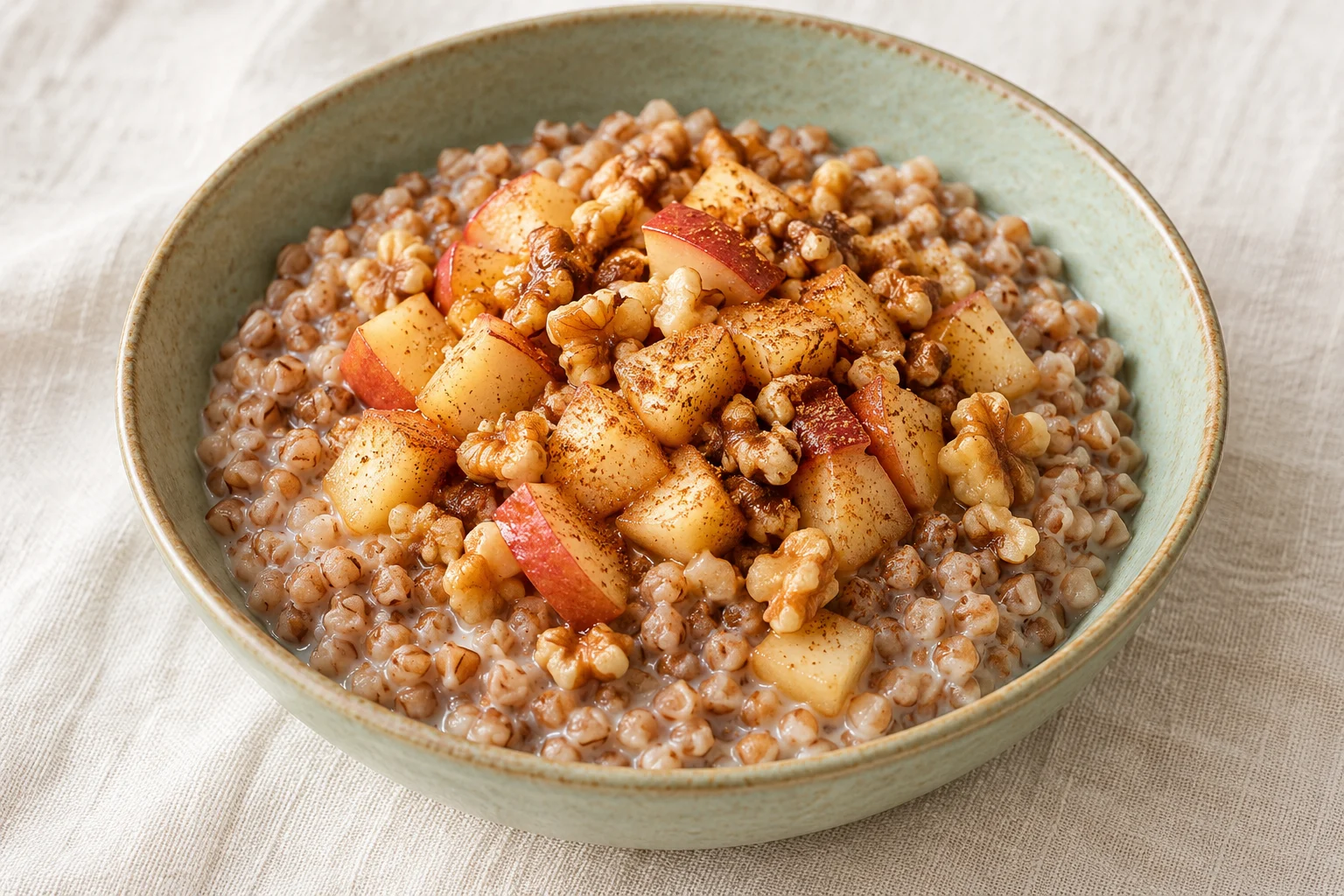
Whole buckwheat groats give this breakfast a more distinct texture than oatmeal. The porridge should have tender visible grains beneath warm cinnamon apples and chopped walnuts. Four bowls take about 40 minutes, with 15 minutes of active work. Cooking the apples alongside the simmering groats keeps the two components on the same schedule.
Apple & walnut buckwheat porridge makes 4 servings, with 40 min estimated total time. View the standalone recipe page.
Choose raw hulled groats and rinse them well
Use 200 g raw hulled buckwheat groats, not flour or roasted kasha. Those products differ in form and flavor, so they are not interchangeable in this measured porridge. Rinse the groats in a fine sieve and drain well. The sieve needs holes small enough to hold the grains while water runs through.
Measure 400 g water and 400 g whole milk into a medium saucepan with the drained groats, 1 g salt and half the cinnamon. Keep the other 1 g cinnamon for the apples. The equal milk and water quantities are deliberate; using only milk or estimating by eye changes how the porridge behaves over heat.
Bring the milk mixture only to a gentle simmer
Warm over medium heat, stirring so the milk does not catch at the bottom. Stay nearby as the mixture approaches a simmer instead of using the pot as unattended preparation time. Milk can rise and stick quickly when heated hard. Once gently simmering, reduce the heat to low and partially cover the saucepan.
Cook for 18–22 minutes, stirring regularly, until the groats are tender and most liquid is absorbed. Run the spoon across the base as well as around the sides. If the pan dries before the grains soften, add a little water as allowed. A dry saucepan is not evidence that the buckwheat is fully cooked.
Prepare apples that stay in recognizable pieces
Core the red-skinned apples and weigh 400 g edible fruit, then cut into 1 cm dice with the skin retained. Similar pieces soften more evenly than a mixture of tiny fragments and large wedges. The apples are a separate topping, so their texture should remain distinct from the creamy liquid around the groats.
Melt 20 g butter in a skillet over medium heat and add the apples with the remaining cinnamon. Cook for seven to ten minutes, stirring occasionally, until tender but still holding their shape. Check a piece from the pan rather than cooking until every edge is dark. The recipe does not add sugar or syrup to this stage.
Rest the grains before judging the final consistency
Once the groats are tender, remove the saucepan from the heat, cover and leave for five minutes. This rest belongs inside the total cooking plan. Keep it separate from the active simmer rather than simply leaving the burner on for five extra minutes. Continued direct heat can dry the base while the upper surface still looks soft.
After resting, the grains should remain visible. Do not blend them or beat the porridge vigorously to imitate smooth oatmeal. A gentle stir is enough to bring the mixture together before portioning. If the apples finish slightly earlier, take their skillet off the heat rather than continuing to soften them throughout the groats' rest.
Build four bowls and save the topping’s crunch
Divide all the porridge among four bowls, then distribute all the warm apples and 40 g chopped walnuts equally over them. The walnuts go on at serving; there is no separate toasting step in this recipe. Keeping them above the porridge preserves a contrast with the soft grains instead of stirring every element into one texture.
Refrigerate leftovers promptly in shallow containers within two hours, or one hour above 90°F (32°C). Keep at 40°F (4°C) or colder for three to four days, and reheat to 165°F (74°C). The milk-based porridge thickens as it stands, so check the center during reheating and stir rather than relying on steam at the surface.
Common questions
Can I substitute buckwheat flour for the groats?
No. Flour cannot preserve the visible whole-grain texture or follow the same absorption schedule. This method is specifically written for raw hulled groats, and also excludes roasted kasha as a direct replacement.
Why is the bottom dry while the groats are still firm?
The simmer may be too strong, or liquid may be escaping faster than expected. Lower the heat, stir regularly and add a little water as the recipe allows. Continue until tender, then take the covered five-minute rest off the heat.
Technique & food-safety references
These primary references support the technique, safety and storage guidance. The recipe and cooking explanations are original Recipe Pinboard content.