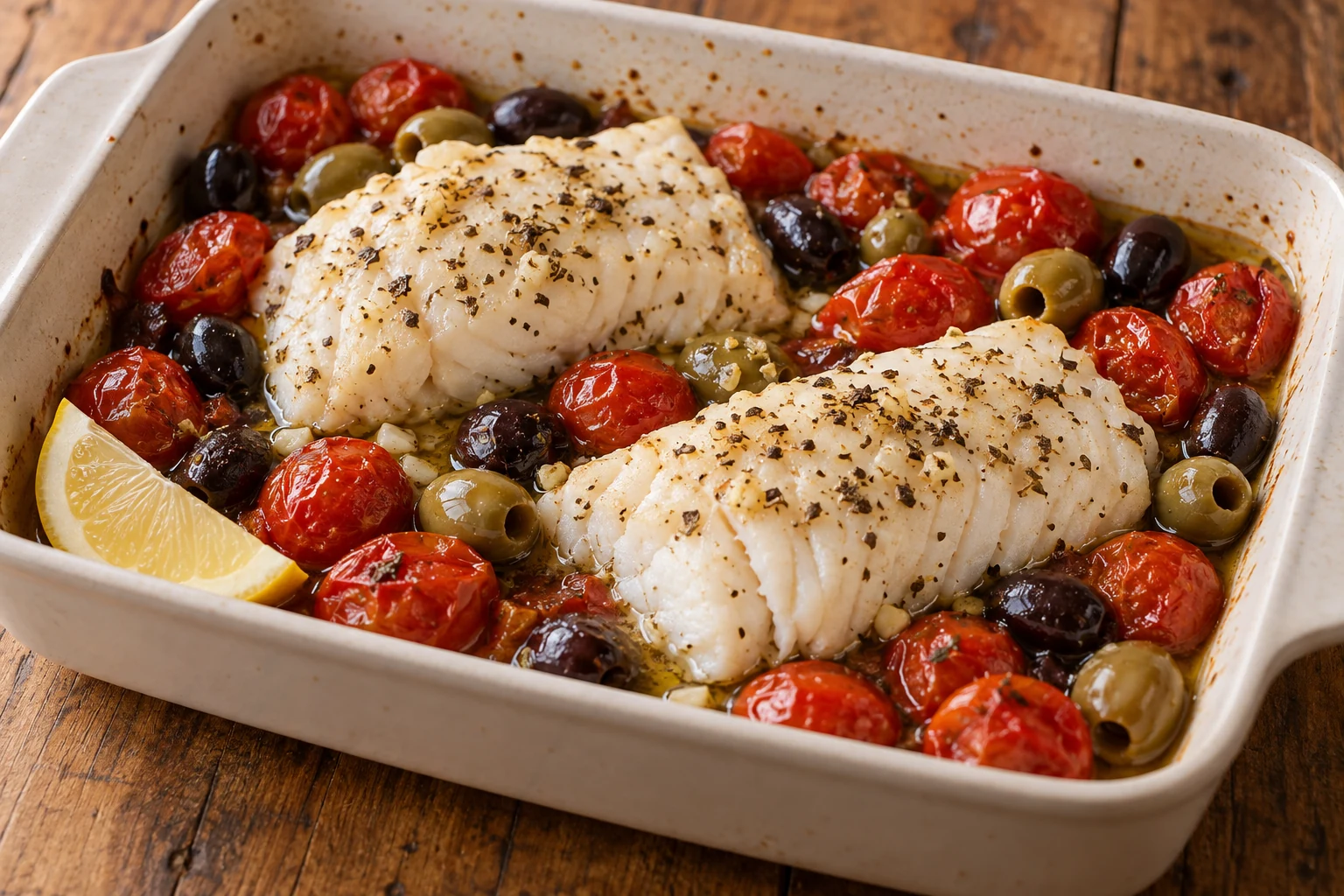
The tomatoes and olives get a ten-minute head start because they tolerate a longer roast than the cod. Adding everything at once would change that balance. This recipe pairs four 170 g fillets with juicy tomatoes, olive oil and briny olives; the pan juices are part of the finished dish, not a separate thickened sauce.
Tomato & olive baked cod makes 4 servings, with 35 min estimated total time. View the standalone recipe page.
Choose a dish that holds juices and four fillets
Use a baking dish large enough to fit the fish in one layer without folding one fillet over another. A very tight dish makes it harder to check individual pieces, while a very broad exposed surface can reduce the juices more quickly. The method uses a baking dish even though the card carries a sheet-pan tag.
Preheat to 400°F (200°C) before the tomato mixture enters. Toss the cherry tomatoes, pitted olives, olive oil, minced garlic and oregano together so the garlic is distributed rather than sitting in a dry pile. The tomatoes are whole in this ingredient list; halving them would change how quickly their juice escapes.
Give the tomatoes their head start
Roast the mixture alone for ten minutes. Look for the first signs of softened tomato skins and juices collecting in the dish. The tomatoes do not have to collapse completely before the fish is added; they will continue cooking alongside it.
Keep the cod refrigerated while this first stage runs. Pat its surface dry before seasoning with the specified salt and pepper. Since the olives already contribute salt to the pan, retain the measured seasoning rather than assuming the entire dish needs a generous extra layer.
Use thickness, not weight alone, to judge progress
Nestle the seasoned cod into the hot dish carefully and return it to the oven. Equal 170 g portions can still have different thicknesses: a compact center-cut piece takes a different path to doneness than a long tapering piece. Avoid piling vegetables so high over the fish that you cannot find the thickest section.
Begin checking during the twelve-to-eighteen-minute range. Insert a thermometer into the center of the thickest part without touching the baking dish. The cod must reach 145°F (63°C). Check the separate fillets rather than assuming a single reading represents all four.
Lift tender fish without breaking it apart
Once a fillet reaches its endpoint, avoid leaving it in the oven simply to obtain deeply browned tomatoes. The vegetable head start is intended to reduce that conflict. Cooked cod separates readily into flakes, so a broad spatula is more helpful than pinching the fillet with narrow tongs.
Serve the fish with the roasted tomatoes, olives and pan juices. Add the lemon wedges alongside as written; squeezing every wedge into the baking dish before cooking would change the acid balance and the intended finishing step. The dish should have juicy vegetables and moist fish rather than a dry roasted coating.
Keep leftovers with their juices
Pack remaining fish with some tomatoes and cooking liquid to make later reheating easier to manage. Refrigerate promptly in shallow containers and use within three to four days. Do not leave the baking dish at room temperature until it feels completely cold before portioning it for storage.
Reheat leftovers to 165°F, checking the fish itself as well as the surrounding sauce. Because cod is delicate, handle it as little as possible during reheating. A warmed tomato on the edge of the container does not show that the center of a thick fillet has reached the required temperature.
Common questions
Why is one fillet dry while another needs longer?
Their thicknesses may differ even at the same weight. Check each thickest center and remove pieces that are ready rather than judging all four by the largest.
Should I wait until every tomato bursts?
No. The required finish is safely cooked cod with softened roasted tomatoes. Leaving cooked fish in the oven only to collapse every tomato risks drying it out.
Technique & food-safety references
These primary references support the technique, safety and storage guidance. The recipe and cooking explanations are original Recipe Pinboard content.