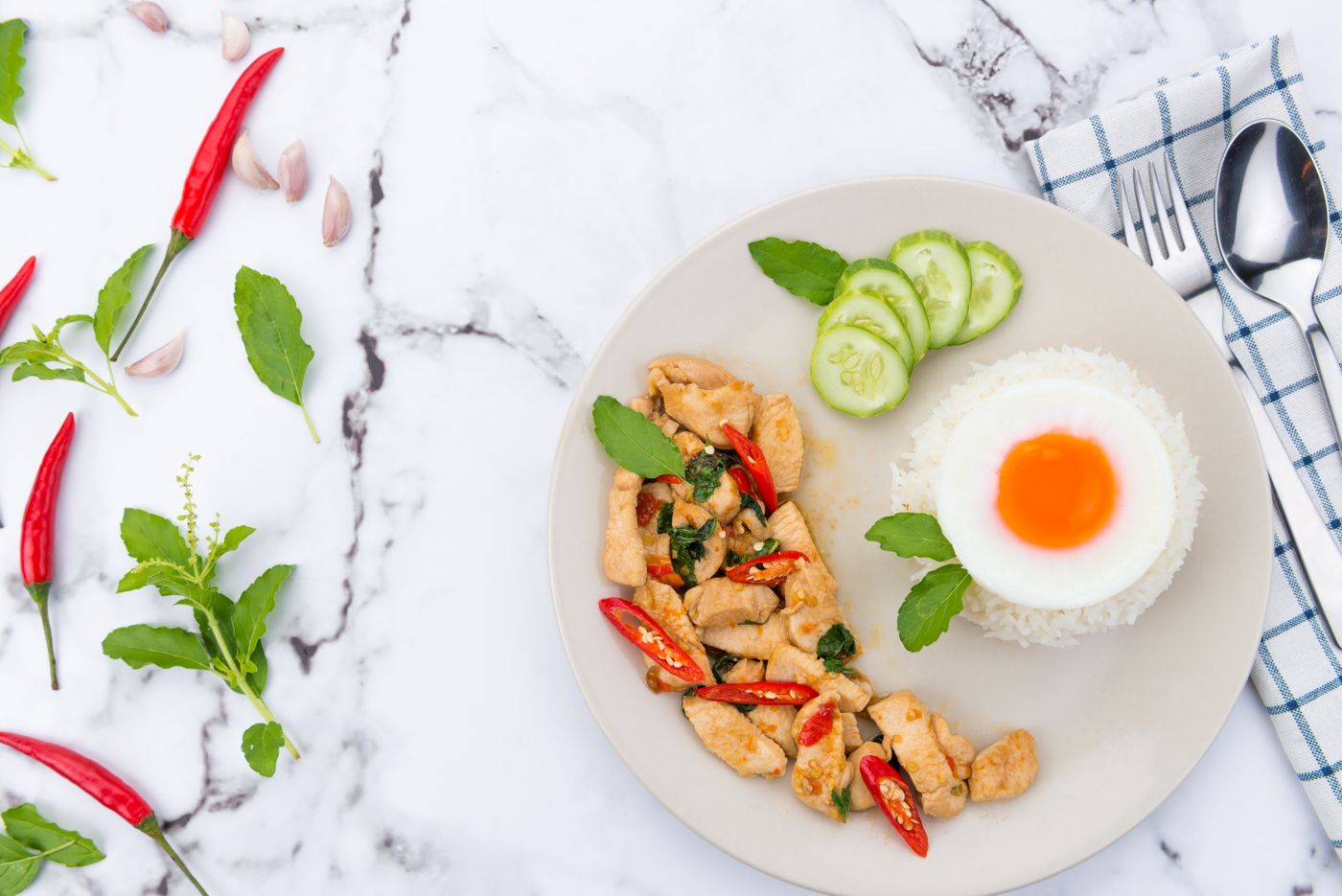
This basil chicken plate has four components but a manageable order: rice first, prepared stir-fry ingredients next, then chicken and eggs. The recipe serves two in about 40 minutes using 350 g chicken thigh and 150 g dry jasmine rice. Its success depends less on dramatic wok tossing than on having the sauce measured and the basil picked before the chicken enters the pan.
Basil Chicken Rice Plates with Fried Egg makes 2 servings, with 40 min estimated total time. View the standalone recipe page.
Give the rice its covered cooking and resting time
Rinse the jasmine rice and put it in a saucepan with the specified 225 ml water. Bring to a boil, lower the heat and cook covered for 15 minutes. The following 10-minute covered rest happens off the heat. Start here so the rice can finish resting while you deal with the faster stovetop work.
Use a lid that fits well and resist lifting it repeatedly. Escaping steam changes the conditions inside the saucepan. Keep the 225 ml rice water separate in your thinking from the additional 30 ml water for the stir-fry sauce; pouring the combined amount into either pan would alter both components.
Measure a complete sauce before the pan is hot
Whisk the oyster sauce, soy sauce, sugar and 30 ml water together. Chop the 12 g garlic, slice the red chili and cucumber, and pick the 25 g Thai basil leaves. Set aside 5 g basil for serving, leaving 20 g for the hot chicken. Clean ready-to-eat cucumber and herbs belong on a different board from raw chicken.
Cut the thigh meat into narrow strips with reasonably consistent thickness. The garlic and chili enter near the end of the initial stir-fry, so keep them separate from the chicken rather than mixing everything together raw. This simple arrangement makes it possible to follow the intended sequence without stopping to find ingredients over a hot burner.
Stir-fry the chicken, then reduce the sauce briefly
Heat 15 g of the oil in a large frying pan over medium-high heat. Add the chicken and stir-fry for 5–7 minutes, moving pieces so they contact the hot surface. Add the garlic and chili during the last minute of that stage. The pan should be broad enough to spread the strips rather than hold them in a tall heap.
Pour in the mixed sauce and cook for another 2–3 minutes. Turn the strips through it as it reduces lightly, and check the thickest chicken reaches 165°F / 74°C. You want a coating with enough liquid to season the rice, not a dry, dark layer stuck to the pan. Fold in the 20 g basil just until wilted, then cover off the heat.
Use the second pan to finish the eggs
Heat the remaining 10 g oil in a nonstick pan over medium heat. Add the two eggs, cover and cook for 4–6 minutes, lowering the heat if the edges brown too rapidly. The lid helps the tops cook without requiring very intense heat underneath. Keep its handle and any escaping steam away from your hands.
For this recipe, both whites and yolks must be firm. Check them rather than taking the shortest time as a guarantee. The egg is a cooked topping rather than a runny sauce for the rice. If it needs another minute, leave the chicken briefly covered off the heat rather than continuing to boil away its sauce.
Plate the components without losing their contrast
Fluff the rested rice gently and divide it between two plates. Set an egg on each mound, with chicken and cucumber beside it. Spoon over the chicken sauce and add the reserved basil leaves. Keeping cucumber out of the frying pan preserves a cool, crisp element beside the hot rice and savory chicken.
The total time assumes the rice and stovetop work overlap. If preparing alone with limited workspace, prioritize the sauce and chopping during rice cooking, then give the chicken your full attention. Keep basil near the end of the process: prolonged cooking turns a fresh herbal finish into a less distinct part of the sauce.
Common questions
Can I stir the basil in with the raw chicken?
Keep it for the finish. Most leaves are folded into safely cooked chicken just until wilted, with the final 5 g added on the plates.
Why is my stir-fry too watery?
Crowding and uneven chicken strips can release water faster than it evaporates. Use a wide pan and let the measured sauce reduce lightly, while avoiding prolonged cooking once the chicken is done.
Technique & food-safety references
These primary references support the technique, safety and storage guidance. The recipe and cooking explanations are original Recipe Pinboard content.