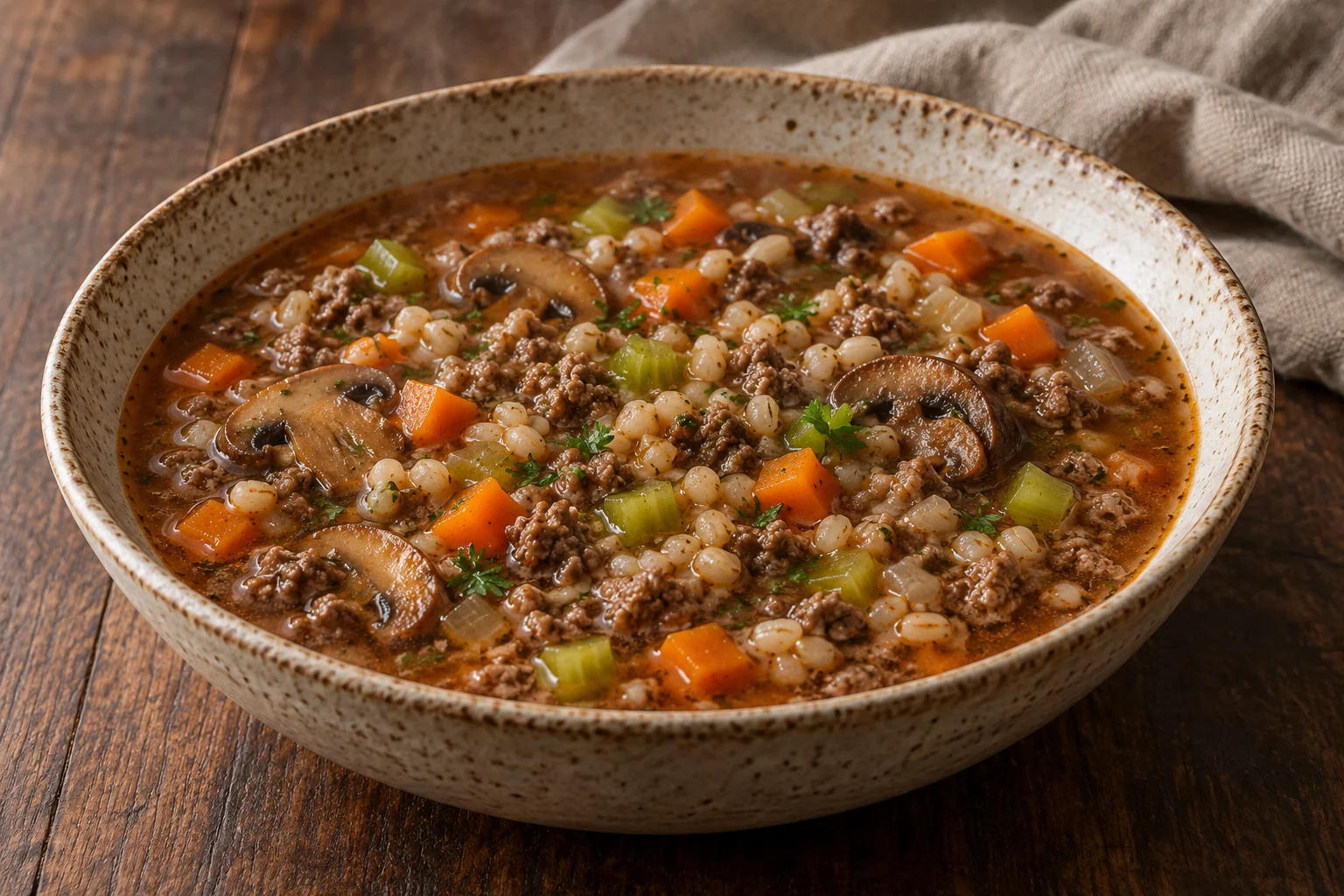
This beef and barley soup begins with ground-beef crumbles, not cubes of stewing beef. The long simmer is mainly there for the pearl barley and vegetables. Keeping visible broth around the solids is the useful finishing cue, especially because barley continues taking up liquid while the soup rests and during refrigerated storage.
Beef, barley & mushroom soup makes 4 servings, with 1 hr 35 min estimated total time. View the standalone recipe page.
Choose pearl barley and cut the vegetables evenly
The 120 g barley is weighed dry, then rinsed and drained. Use pearl barley rather than assuming quick-cooking or hulled barley follows the same forty-to-fifty-minute simmer. The recipe does not require a separate pot of cooked grain. Its broth and water are measured with the barley cooking directly in the soup.
Slice cremini mushrooms about 5 mm thick and cut the carrots and celery into the specified small pieces. Even cuts make it easier for the vegetables to soften during the grain’s cooking time. Have onion, garlic and tomato paste ready before browning starts, and reserve the vinegar and parsley for the end.
Brown crumbles before adding the wet vegetables
Heat the olive oil in a large heavy saucepan or Dutch oven over medium-high heat. Add the 450 g ground beef and break it into small crumbles while it cooks for approximately seven to nine minutes. Check for 160°F (71°C) with a thermometer rather than deciding that browned surfaces alone establish doneness.
Add mushrooms, onion, carrot and celery and cook for another nine to ten minutes. Stir often enough to move the vegetables through the hot base without constantly pressing the mushrooms into fragments. They should lose their raw appearance while the onion softens. Garlic and tomato paste then get their short one-minute cook before liquid enters.
Add the first water amount and establish a gentle simmer
Add barley, beef broth, the initial 300 g water, thyme, salt and pepper. Scrape the bottom gently to loosen the browned residue into the broth. Bring the pot to a boil, then lower the heat. The remaining optional 250 g water is held back for adjustment, not automatically poured in at the beginning.
Partially cover so the pot can simmer without sealing in every bit of vapor. Look for gentle bubbling rather than a rolling boil that rapidly reduces the broth. Stir occasionally, reaching the bottom where barley can settle. The cover position, pot width and burner strength all influence how much liquid remains near the end.
Check grain tenderness before judging final thickness
After the planned forty-to-fifty-minute simmer, taste a cooled grain. It should be tender with a slight chew, rather than having a hard chalky center. Check carrot pieces as well. A thick-looking broth is not proof that the barley has finished; starch can thicken the liquid before every grain reaches the desired texture.
If the mixture is becoming too thick, add some or all of the measured extra water. Work in additions and stir before deciding how much more is useful. Visible broth should remain between the beef, grains and vegetables. Do not turn the recipe into a dense barley mound simply to avoid using an adjustment already built into the card.
Finish with vinegar and portion the solids fairly
Stir in the red wine vinegar and parsley only after the barley and vegetables are ready. Rest off the heat for five minutes, then divide among four bowls. Stir from the bottom as you serve so one bowl does not receive mostly broth while another takes the concentrated barley and beef that have settled underneath.
Refrigerate leftovers promptly in shallow containers rather than leaving the deep cooking pot to cool slowly on the stove. Use within three to four days and reheat to 165°F (74°C), stirring to reduce cold spots. Extra water can loosen the stored soup because the barley may have absorbed more broth; that texture change does not mean it was originally undercooked.
Common questions
Why does the soup become much thicker overnight?
The barley continues absorbing liquid. Reheat with a little water and stir thoroughly rather than treating the stored texture as the required consistency of the freshly cooked soup.
Can I substitute chunks of beef for the ground beef?
That changes the recipe’s cooking requirements. This method browns small ground-beef crumbles first; tougher stew cuts need a different tenderness schedule and should not be slipped into the same timeline.
Technique & food-safety references
These primary references support the technique, safety and storage guidance. The recipe and cooking explanations are original Recipe Pinboard content.