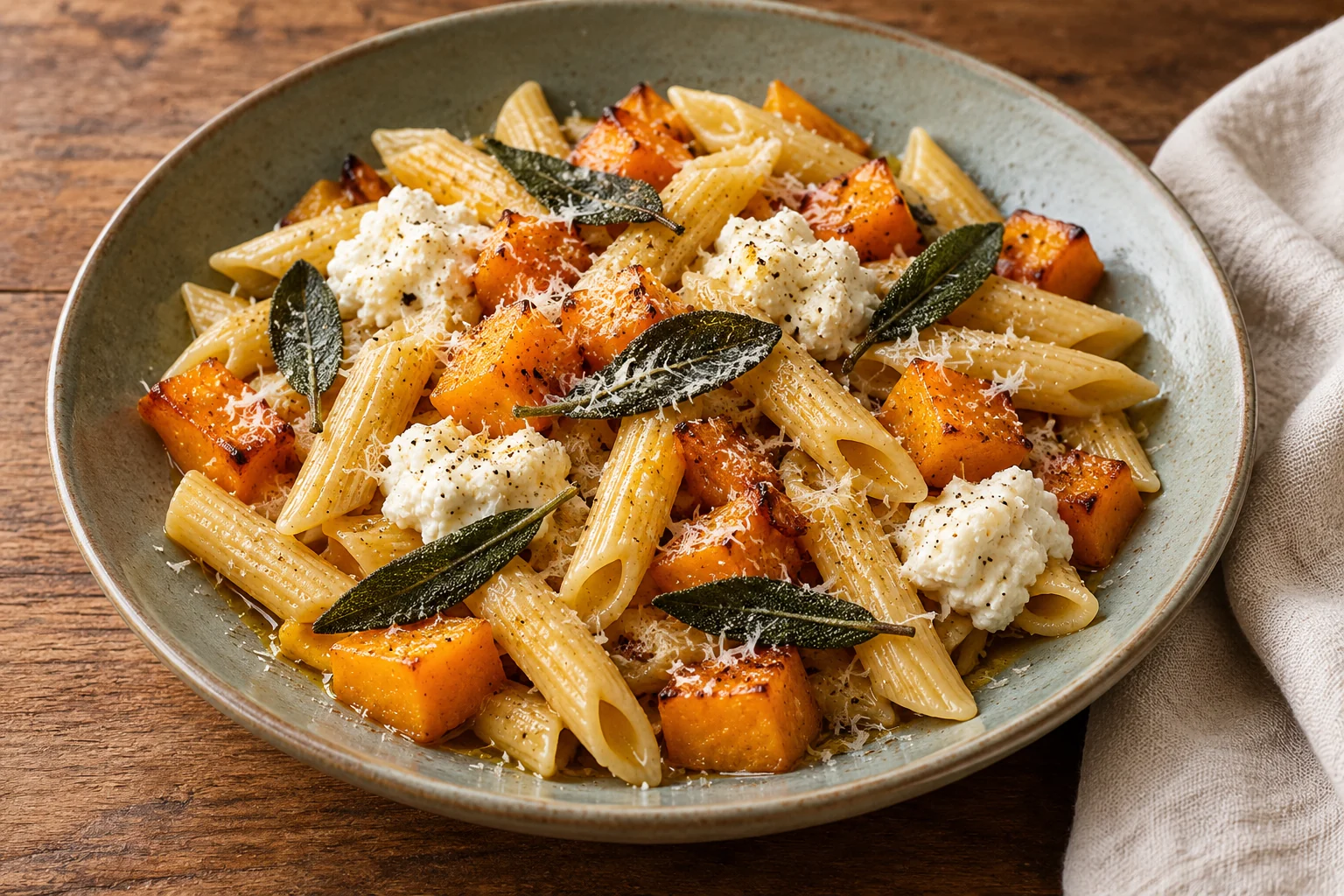
This penne has a light sage-butter coating with ricotta added in small dollops at the table. The squash should remain recognizable rather than becoming a blended sauce. Four portions take about 50 minutes, with 25 minutes of active work. Starting the squash first gives you a useful window for boiling pasta and preparing the finishing ingredients.
Butternut, sage & ricotta penne makes 4 servings, with 50 min estimated total time. View the standalone recipe page.
Roast evenly sized squash before building the sauce
Use 600 g peeled, seeded butternut squash cut into 2 cm cubes. Weighing the prepared squash avoids counting peel and seeds in the serving amount. Toss with the 20 g oil, 2 g salt and pepper, then spread across a rimmed sheet in one layer. Leave space for browned corners rather than a wet pile.
Roast at 425°F (220°C) for 25–30 minutes, turning halfway. A cube should be tender inside as well as browned at its edges. Larger pieces can stay firm after the surface colors, while very small pieces may disintegrate during the final toss. The specified size keeps those two outcomes closer together across the tray.
Cook the penne with its finishing stage in mind
Bring the measured 3000 g water and 12 g pasta salt to a boil. Cook 320 g dry penne according to the packet until tender with a slight bite. Check the packet early enough to coordinate it with the squash. Different penne products have different cooking times, so the shape alone is not a timer.
Before draining, reserve 200 g cooking water in a heatproof container. Set that container where it will not be mistaken for waste liquid. The recipe starts the skillet finish with half of it and uses the balance only if needed. This staged addition lets you loosen the coating without drowning the roasted cubes.
Crisp the sage, then lower the heat for garlic
Melt 25 g butter in a wide skillet over medium heat. Add the 3 g whole sage leaves and cook for one to two minutes until crisp, then lift them onto a small plate. Keeping the leaves whole makes them easier to retrieve and preserves their distinct role as a finishing garnish over the ricotta.
Lower the heat before adding 6 g minced garlic to the remaining butter. Stir for 30 seconds without browning it. This short step needs attention because finely chopped garlic can change quickly in a hot pan. Have the drained pasta, squash and reserved water nearby before the garlic enters, rather than leaving it unattended.
Toss gently and stop before the squash becomes sauce
Add penne, roasted squash and 100 g reserved water, tossing over medium heat for one to two minutes. Lift and turn with a broad utensil instead of vigorously crushing the mixture against the pan. The goal is to distribute butter and cooking water around the pasta while retaining distinct orange pieces among the tubes.
Turn off the heat before folding in 15 g Parmesan and 10 g lemon juice. If the pasta looks dry, add up to the remaining 100 g reserved water in small splashes. Allow each addition to spread through before judging again. Finely grated cheese incorporates more evenly than thick shreds in this brief, off-heat finish.
Add the ricotta after dividing the pasta
Share all the pasta and squash among four warm bowls. Give each bowl 50 g ricotta in small dollops, one-quarter of the crisp sage and one-quarter of the remaining 15 g Parmesan. The ricotta is made with pasteurized milk. Stirring all 200 g into the skillet would change the intended appearance and texture.
Serve immediately, before the pasta absorbs more of its coating. Refrigerate leftovers in shallow containers within two hours, or one hour above 90°F (32°C), at 40°F (4°C) or colder. Use within three to four days and reheat to 165°F (74°C). Crisp sage will soften in storage; that is a texture change, not a cue to omit reheating.
Common questions
Why has my squash broken up?
Very small or excessively soft cubes are fragile, especially under vigorous stirring. Keep the 2 cm cut, check tenderness during roasting and fold gently during the short skillet stage. The finished dish should contain distinct cubes rather than a squash purée.
Should all the reserved pasta water go in?
No. Start with 100 g and add up to another 100 g only if the pasta looks dry. The correct amount depends on how much water clings to the drained pasta and how quickly the skillet liquid reduces.
Technique & food-safety references
These primary references support the technique, safety and storage guidance. The recipe and cooking explanations are original Recipe Pinboard content.