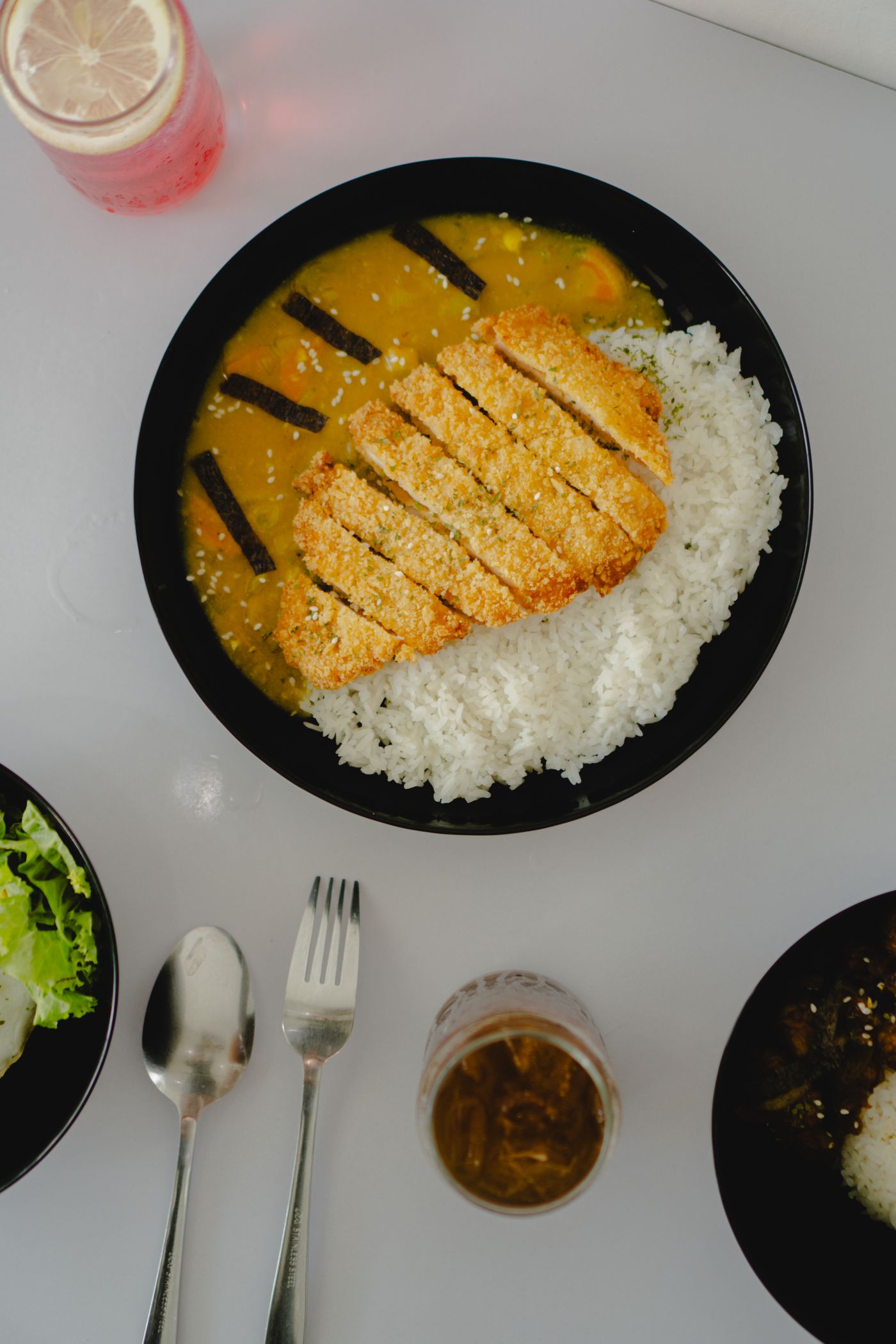
Chicken katsu with carrot curry has three separate tasks: covered rice that needs a rest, a sauce that needs time to soften carrots, and a breaded cutlet best served soon after frying. Starting the rice and sauce first makes the fifty-five-minute plan more manageable. The crisp finish depends as much on assembly as it does on the panko.
Chicken Katsu with Golden Carrot Curry makes 2 servings, with 55 min estimated total time. View the standalone recipe page.
Start the rice and sauce before breading
Rinse the 150 g dry short-grain rice and combine it with the specified 220 ml water. Once boiling, cover and lower the heat for fifteen minutes, then remove it from the burner for its ten-minute covered rest. Do not keep lifting the lid while trying to judge the other pans; that disrupts a deliberately covered cooking stage.
While the rice cooks, soften the onion and small carrot half-moons in butter. Similar-sized carrot pieces are helpful because a large piece can remain firm after the sauce has thickened. The sauce’s simmering window is fifteen to twenty minutes, so it should be underway before the chicken becomes the main attention-demanding task.
Split the flour into its two jobs
The forty grams of flour is divided deliberately: fifteen grams belongs in the curry sauce and the remaining twenty-five grams coats the chicken. Set those amounts apart before handling raw poultry. Mixing the entire amount into either location would change the sauce thickness or leave the cutlets without their first coating.
Stir the sauce flour and spices into the softened vegetables for one minute. Whisk in the stock gradually rather than pouring it onto a dry lump all at once, then add soy sauce and sugar. Simmer until the carrots are tender and the sauce coats a spoon. Stir along the bottom to prevent a thickening layer from catching.
Coat thin, even cutlets with separate utensils
The two cutlets are each about 180 g and roughly 1.5 cm thick. An even thickness is important because an unusually thick center takes longer than the pale, thin edges. Season with the measured salt, then work through the three dishes in order: flour, beaten egg and panko, pressing the last layer onto the chicken.
Use one hand or utensil for wet coating and another for dry crumbs to limit clumps on your fingers. Keep the rice, nori and serving bowls away from the raw-chicken station. Any remaining flour, egg or panko that has contacted raw chicken must be discarded, even if it still looks dry and unused.
Use oil and center temperatures for different checks
Heat a 1.5 cm depth of oil to about 340°F (170°C) in a deep pan that remains less than half full. The listed 500 ml is a frying supply, not an assertion that the chicken absorbs that volume. A different pan diameter changes how much oil is needed to establish the stated depth.
Fry for the approximate four to five minutes per side, adjusting the burner and cooking in batches if needed. Check the thickest chicken center for 165°F (74°C); golden crumbs alone cannot establish doneness. If the coating browns too quickly, reduce the heat while continuing to cook through. Stay beside the pan and never add water to hot oil.
Rest on a rack and keep the curry alongside
Give cooked cutlets the specified three-minute rack rest, then slice into strips on a clean board. A rack leaves room below the crust instead of trapping steam against a flat plate. Fluff and divide the rested rice, then spoon the carrot curry alongside it so the entire cutlet is not submerged before the first bite.
Finish with the nori strips and sesame seeds, both already included in the ingredients. Serve the two bowls promptly. Refrigerate leftover chicken, rice and sauce separately within two hours, or one hour in temperatures over 90°F (32°C). Reheat leftovers to 165°F (74°C); a revived crust may still be less crisp than freshly fried panko.
Common questions
Why is my curry lumpy?
The flour needs even mixing with the buttered vegetables and gradual stock additions. Whisk small additions smooth before adding more; a hard boil will not reliably remove dry flour pockets.
Can the golden crust tell me the chicken is cooked?
No. The crust and chicken center heat differently. Use a thermometer in the thickest part and reach 165°F (74°C), regardless of whether the suggested frying time has elapsed.
Technique & food-safety references
These primary references support the technique, safety and storage guidance. The recipe and cooking explanations are original Recipe Pinboard content.