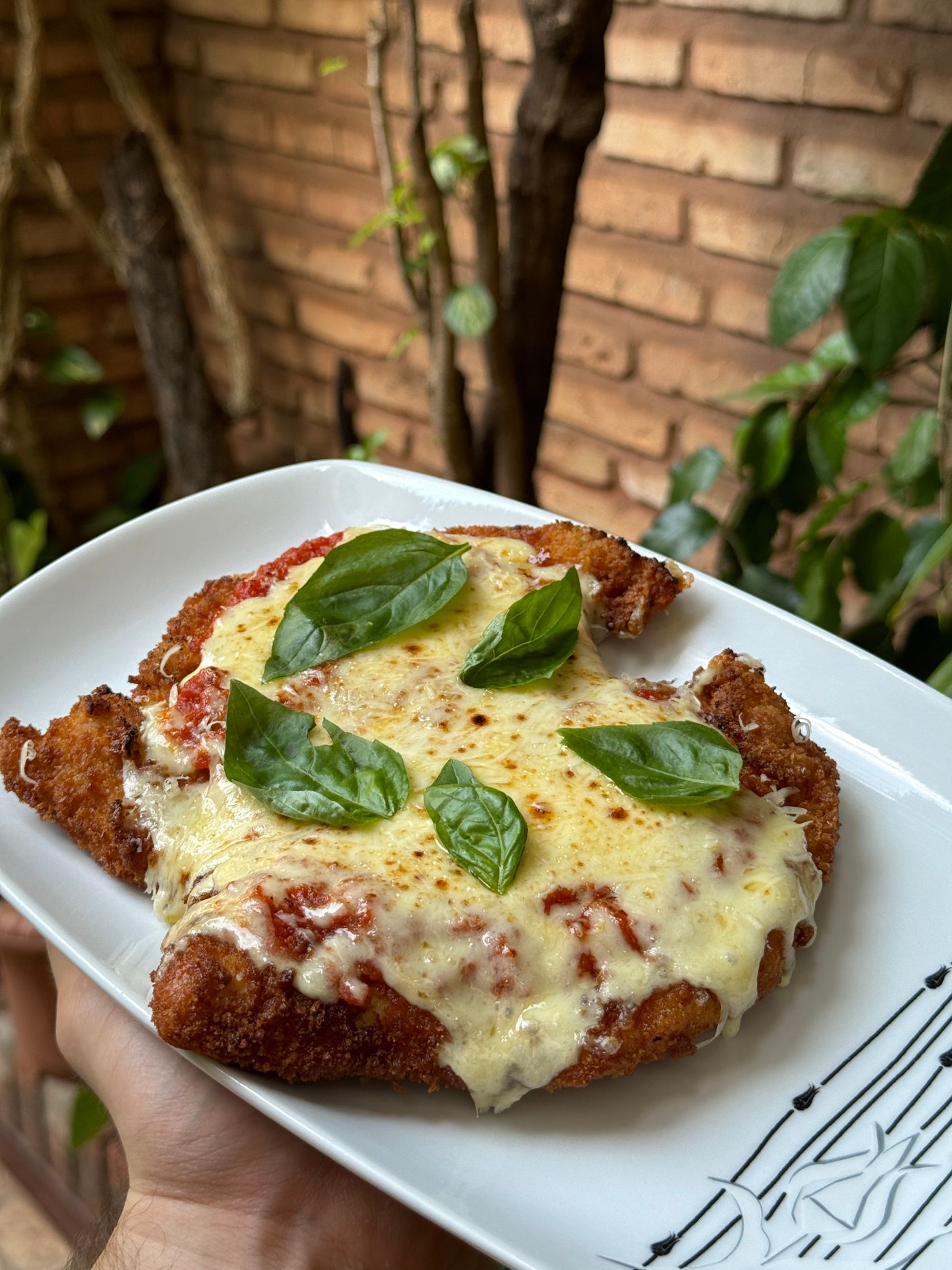
Chicken Parmesan brings several textures to the same plate: a firm breadcrumb crust, tender chicken, spoonable tomato sauce and melted cheese. This two-serving version takes about 45 minutes and uses two 180 g cutlets, each 1.5 cm thick. Success depends on keeping those layers distinct. The sauce belongs mainly in the center, and the oven finishes chicken that has already gained its golden coating in the frying pan.
Basil and Mozzarella Chicken Parmesan makes 2 servings, with 45 min estimated total time. View the standalone recipe page.
Start the sauce before breading
Heat the oven to 425°F / 220°C and start the tomato sauce in a saucepan with 10 g of the olive oil. Give the minced garlic its short 30-second cook, then add the 250 g crushed tomatoes, oregano and 1 g salt. The 12-minute simmer overlaps with preparing the cutlets, so this is the first job rather than something to squeeze in after frying.
Stir occasionally and watch the consistency. You want sauce that can sit on the chicken instead of immediately flooding the pan. An aggressive boil can throw tomato onto the stove and reduce the sauce unevenly. Keep it gentle, scraping the bottom and corners so a thick patch does not catch while the top still looks loose.
Build an even, well-attached coating
Season the chicken with the remaining 2 g salt and the pepper. Set flour, beaten egg and the breadcrumb-Parmesan mixture in three shallow dishes, arranged in that order. Dry patches need flour, but a heavy flour blanket creates a loose layer. Lift each cutlet after flouring and tap away the excess before moving to the egg.
Let excess egg drip back into its dish, then press crumbs onto both faces and the edges. A dry hand for crumbs and a separate hand for egg can make the process tidier. Once both cutlets are coated, discard leftover flour, egg and breadcrumbs that contacted raw chicken. Wash the work area and utensils before using them for the finished food.
Brown the crust without rushing the center
Heat the remaining 35 g oil in a wide ovenproof frying pan over medium-high heat. Lay the cutlets in carefully, leaving enough room to turn them without scraping their coatings against each other. Fry for about 3 minutes per side. Slide a broad turner underneath rather than gripping the fragile breading repeatedly with tongs.
This stage establishes the crust; it is not the final doneness check. If crumbs darken very quickly, reduce the burner before turning. Parmesan and fine crumbs can color faster than the chicken cooks. Avoid increasing the heat just because the surface has not become uniformly dark: golden is the intended stopping point before the oven stage.
Keep the sauce and cheese inside a crisp border
Remove the pan from the heat and spoon sauce onto the centers. Leave a visible border of breading uncovered, then distribute the 100 g low-moisture mozzarella over the sauce. That particular cheese is useful here because the recipe is designed around its moisture level; fresh mozzarella packed in liquid would change the topping.
Bake for 10–12 minutes, checking the center of each cutlet reaches 165°F / 74°C. Insert a thermometer sideways when possible to measure chicken rather than the hot sauce above it. Bubbling cheese alone cannot establish doneness. Remember that the pan handle is now oven-hot even after you return the pan to the stovetop.
Finish and serve while the textures are distinct
Let the chicken stand for 3 minutes, then lift each cutlet onto a plate and add the whole basil leaves. Adding basil after baking keeps its flavor more noticeable and avoids burying the leaves under the cheese. Slide underneath the entire cutlet so the sauced center remains supported during transfer.
Serve promptly: a covered pan traps steam and softens the exposed crumb edges. If planning ahead, measure the coating ingredients and prepare the sauce separately rather than assembling raw breaded chicken under tomato sauce. Pasta or a salad would be optional accompaniments; neither is included in the quantities for these two cutlets.
Common questions
Why did the breading slide off?
A thick flour layer, excess egg or rough turning can loosen it. Shake off flour, let egg drip, press on the crumbs and turn with a broad utensil once the first side has browned.
Can I cover the whole cutlet with sauce?
You can, but more of the coating will soften. Keeping sauce and mozzarella near the center is the intended way to retain a crisp border.
Technique & food-safety references
These primary references support the technique, safety and storage guidance. The recipe and cooking explanations are original Recipe Pinboard content.