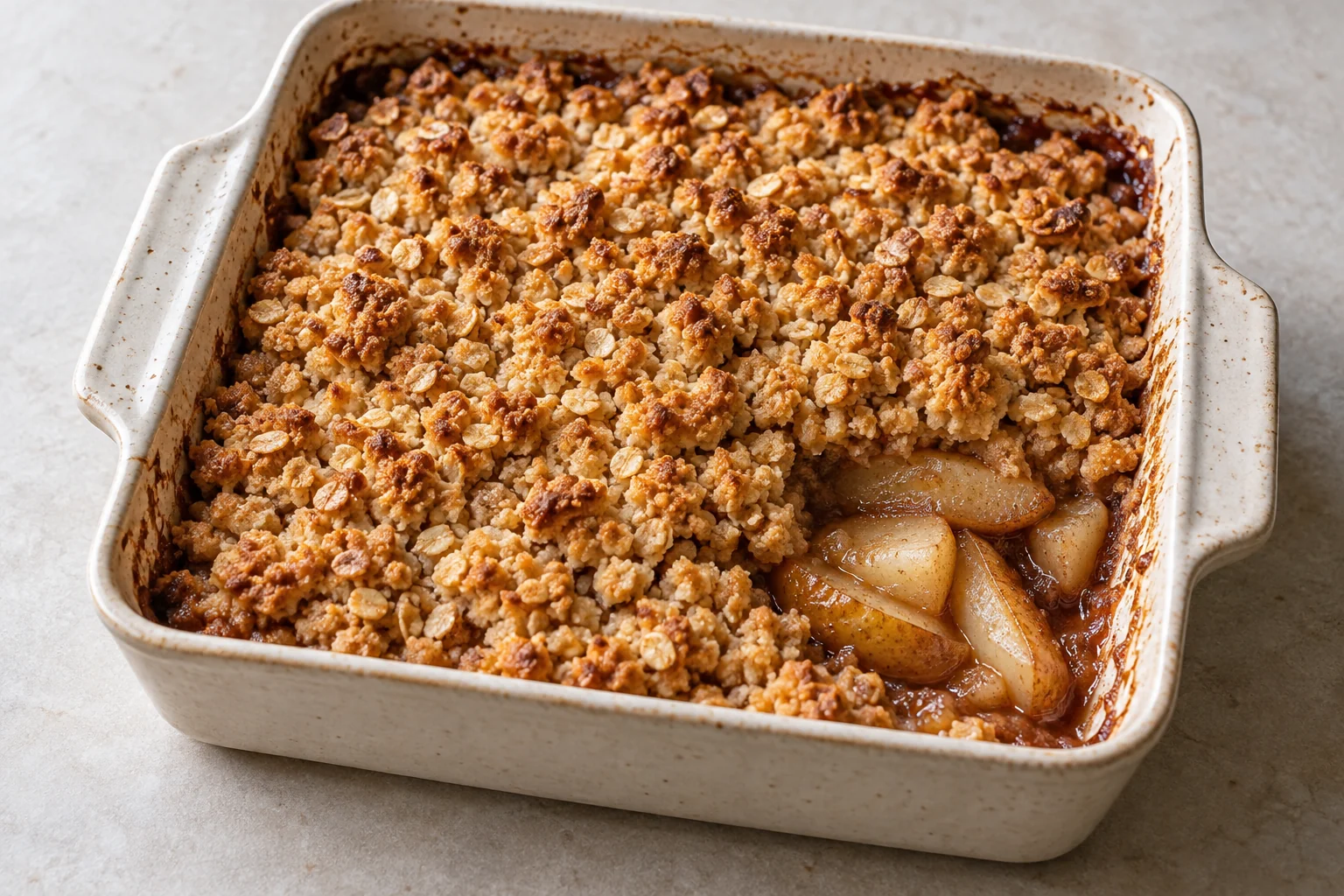
Pear crisp is a useful dessert when you want the fruit to remain recognizable beneath a loose, buttery topping. This six-serving version leaves the skins on and uses a small amount of cornstarch to gather the juices. Its two jobs happen at different speeds: the oats brown on top while the pear pieces soften underneath. Check both before deciding the baking dish is ready.
Cinnamon pear oat crisp makes 6 servings, with 1 hr 15 min estimated total time. View the standalone recipe page.
Weigh the prepared fruit and cut consistently
Choose pears that yield slightly near the stem but still hold their shape when cut. Very hard fruit can need extra oven time, while collapsing fruit is difficult to distribute in distinct pieces. Wash before coring, keep the skins on, and weigh 800 g after discarding the cores and damaged areas.
Cut into roughly 1.5 cm pieces rather than combining large wedges and tiny scraps. That keeps the filling's cooking time reasonably even. A 20 cm square baking dish gives the intended depth. A much smaller dish creates a thicker fruit layer that may still be firm after the surface topping has browned.
Spread the thickener through the pear juices
Mix the cornstarch with the filling's 20 g brown sugar and 1.5 g cinnamon before it touches the fruit. Dispersing the fine powder through the sugar makes dry lumps less likely. Toss the pears with the lemon juice first, then turn them through the dry mixture until no isolated white patches remain.
Scrape the juices and seasoning from the mixing bowl into the buttered baking dish. They belong to the filling. Spread the pieces into a reasonably level layer without crushing them. This recipe does not call for an added pour of water; the fruit supplies liquid as it heats, and the lemon juice is already measured.
Make small clusters instead of a solid lid
Combine the oats, flour, remaining brown sugar, cinnamon and salt before stirring in the melted butter. Work through the mixture with a fork until the flour is moistened. Aim for irregular small clusters with some loose flakes, rather than kneading it into a single ball that would need slicing or rolling.
Scatter the topping across the pears without pressing it down. A few small gaps are useful for seeing the bubbling juices underneath. Check the corners as well as the middle so there is no bare pocket of fruit beside a thick mound of topping. Keep the baking dish level when transferring it to the oven.
Use the fruit as the final doneness check
At forty minutes, look for a golden oat surface and bubbling juice around the edges. Push a small knife through a gap into several pear pieces, including some near the center. The fruit should yield easily. A browned surface alone cannot tell you whether firm pears underneath have finished softening.
If the topping has enough color but the fruit resists the knife, loosely cover the dish with foil and continue baking. The stated forty-to-forty-five-minute window assumes firm-ripe fruit cut to the specified size. Let the finished crisp rest for ten minutes so it is easier to scoop and the hot juices settle around the pears.
Serve and save without promising a crisp crust forever
Spoon through the topping to the bottom so each of the six portions receives fruit, juices and oats. The recipe is complete on its own. Ice cream, cream or yogurt would be an extra serving choice rather than an ingredient included in the card or its nutrition estimate.
Refrigerate leftovers within two hours, or one hour when the room is above 90°F (32°C), in shallow covered containers at 40°F (4°C) or below. Use within three to four days. Expect the oats to soften as they absorb moisture in storage. An oven reheating can improve the surface texture, but the filling should reach 165°F (74°C).
Common questions
Do I have to peel the pears?
No. This card deliberately uses the skin-on edible weight. Remove cores and any damaged areas, then cut uniformly. Peeling would change the recipe’s ingredient state and slightly alter the filling texture.
Why is my crisp still watery?
Check that the filling actually bubbled, that the cornstarch was evenly distributed, and that the dessert had its ten-minute rest. Very ripe fruit also breaks down more readily. Avoid judging the final texture immediately after lifting a spoon through boiling-hot juices.
Technique & food-safety references
These primary references support the technique, safety and storage guidance. The recipe and cooking explanations are original Recipe Pinboard content.