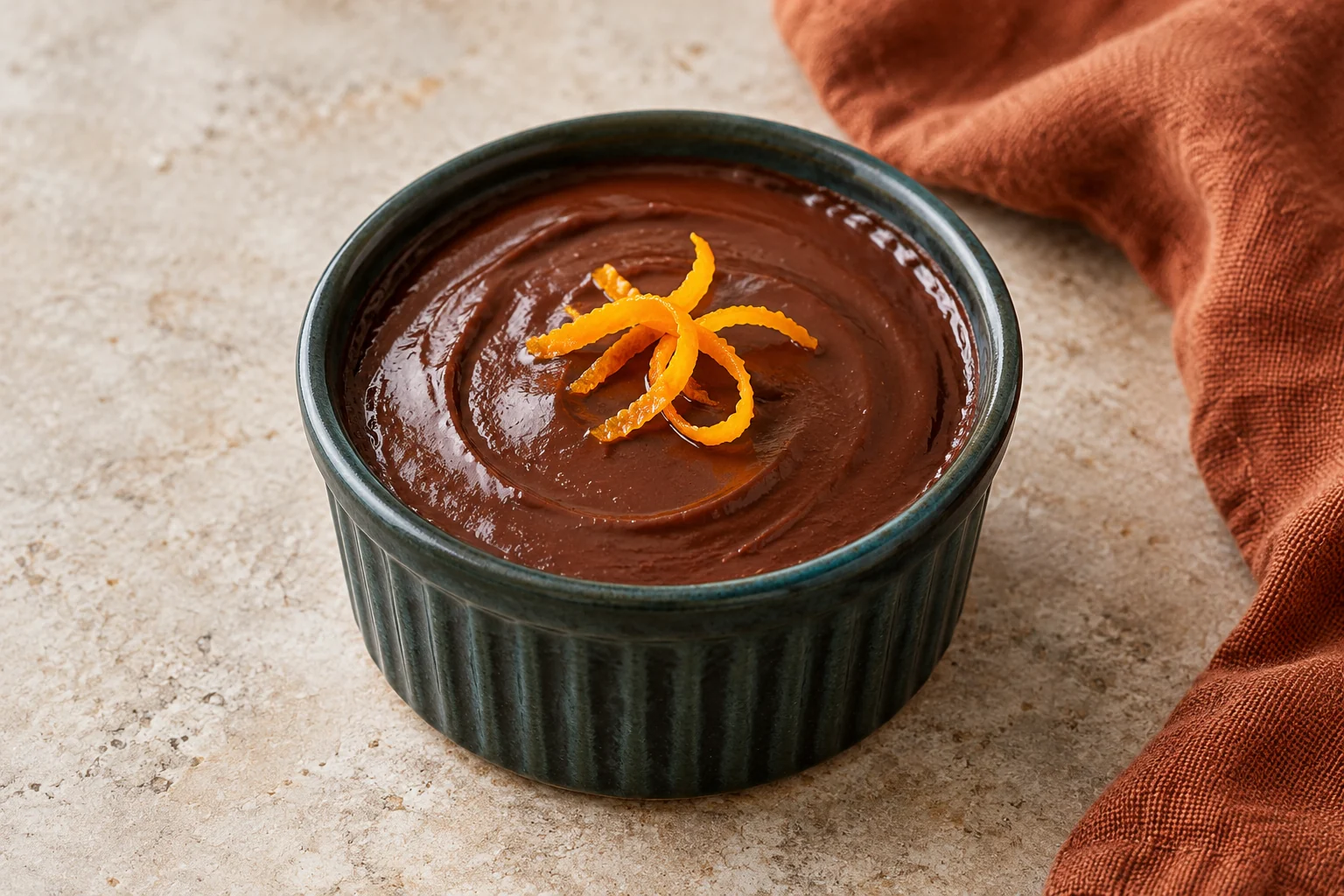
These chocolate pots rely on finely chopped dark chocolate and hot dairy followed by refrigeration. There is no egg-cooking stage, but there is a substantial setting stage: the 270-minute total includes at least four hours in the refrigerator. Active preparation is about 15 minutes. Set out six small heatproof pots before heating anything so portioning is unhurried.
Dark chocolate & orange pots makes 6 servings, with 4 hr 30 min estimated total time. View the standalone recipe page.
Measure the chocolate and choose appropriate pots
Use 200 g dark chocolate labeled 65–70% cocoa, together with 300 g heavy cream and 100 g whole milk. Those weights define this softly set dessert. A different chocolate percentage or an improvised cream-to-milk balance can change its firmness, so do not treat this as a formula for any chocolate and any dairy.
Chop the chocolate finely and place it in a dry heatproof bowl. Large chunks are more likely to remain after the hot cream has lost heat. Each of the six pots should hold at least 120 ml and sit securely on a refrigerator-ready tray. Check that the tray fits before filling the containers.
Heat the dairy gently with the first orange-zest portion
Put cream, milk, 1 g finely grated orange zest and 0.5 g salt in a small saucepan. Keep the separate 1 g zest strips or curls for garnishing later. Avoid white pith when preparing either form of zest; the tiny grated pieces should distribute through the cream without large chewy strips inside each spoonful.
Warm over medium-low heat, stirring, until the mixture steams and small bubbles appear around the edge. Do not boil it vigorously. Watch the saucepan rather than leaving it while chopping chocolate or locating ramekins. The hot dairy has a melting job to do, and uncontrolled boiling is not needed for that job.
Let the chocolate soften before stirring
Pour the hot mixture over the chopped chocolate and leave it undisturbed for two minutes. This pause lets heat reach the pieces throughout the bowl. Begin stirring slowly in the center, gradually widening the movement until the mixture becomes smooth and glossy. A brief uneven appearance at the start does not by itself mean failure.
Stir in the 2 g vanilla. If small chocolate pieces remain, place the bowl over barely simmering water, keeping its base above the water, and stir briefly until smooth. This is a controlled finishing step, not a reason to boil the entire dessert. Keep stray water from splashing into the bowl and altering the measured mixture.
Portion first, then chill for the full setting time
Divide all the mixture evenly among the six pots. A scale can help keep the portions similar without assuming the pots must be filled to their rims. Tap each gently to release large bubbles. Avoid vigorous whisking at this stage; the goal is a smooth chocolate cream rather than a foamy or whipped dessert.
Let the filled pots stand for 15 minutes, then refrigerate loosely covered for at least four hours, until cold and softly set throughout. Cover tightly once cold. The mixture will look looser while warm, so assess the set only after chilling. A quick freezer shortcut is not part of this recipe's timing or method.
Add the finishing curls immediately before serving
Divide the reserved 1 g orange-zest strips or curls over the six cold pots just before serving. Each person receives one pot. The garnish is small on purpose: the dessert already contains finely grated zest. There is no extra cream layer, syrup or fruit portion to add to the recipe's stated yield.
Keep the pots covered at 40°F (4°C) or colder and use within three to four days. Their lack of eggs does not make the dairy mixture shelf-stable. Discard portions left unrefrigerated longer than two hours, or one hour above 90°F (32°C). Take out the portions needed for serving while the rest stay chilled.
Common questions
Why is the mixture still runny just after mixing?
The chocolate cream is meant to be portioned while fluid and set in the refrigerator. Allow the complete four-hour minimum chill before evaluating it. The result should be softly set, not a firm sliceable ganache or a baked custard.
Can I add more chocolate to make it set faster?
Keep the listed ratio for this recipe. Extra chocolate changes both the yield and texture, while a shorter chill may leave the centers warm. Use the specified dark chocolate and plan for the full refrigeration stage instead.
Technique & food-safety references
These primary references support the technique, safety and storage guidance. The recipe and cooking explanations are original Recipe Pinboard content.