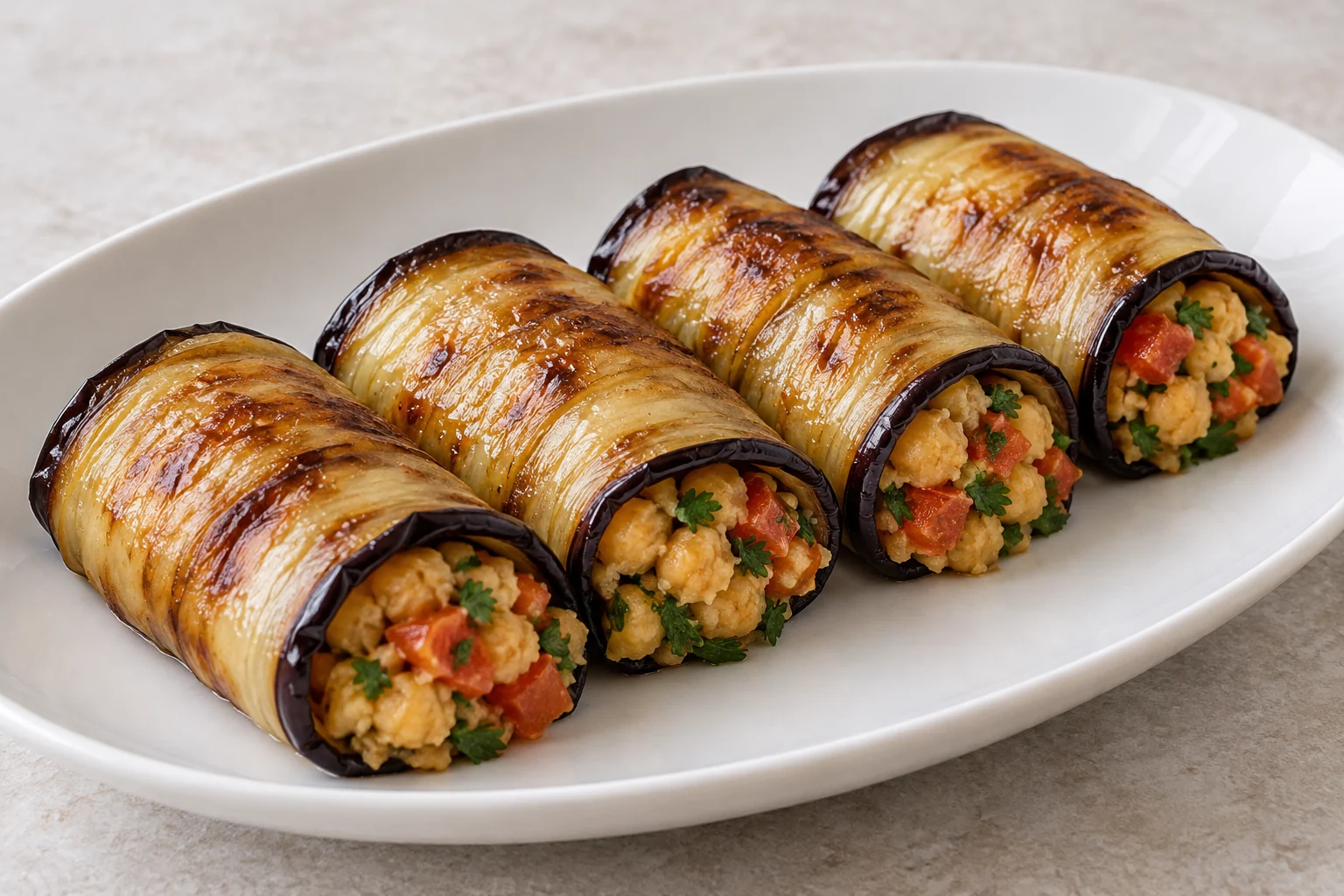
A successful eggplant roll needs two things at once: a soft plank that bends and a filling that is moist without leaking. Roasting the vegetable first and cooking down the tomato keeps those jobs separate. The chickpeas remain coarsely mashed, so the finished rolls have structure without cheese or breadcrumbs.
Eggplant, chickpea & parsley rolls makes 4 servings, with 1 hr 15 min estimated total time. View the standalone recipe page.
Choose planks with usable length
Trim the stem end and slice lengthwise with a sharp knife on a stable board. Aim for eight broad planks around one quarter inch thick. Extremely thin slices tear, while thick slices remain springy and resist rolling. Eggplants differ in shape, so reserve irregular edible ends and dice them for the filling rather than discarding counted food. The six hundred grams refers to the total trimmed edible eggplant, including those pieces. Work with the actual slices instead of assuming every vegetable produces identical rolls.
Brush rather than pour the oil
Lay the planks and diced trimmings in a single layer on parchment-lined trays. Brush the measured roasting oil over the surfaces, dividing it across the whole batch. Eggplant can absorb a puddle of oil quickly; pouring freely makes distribution and nutrition less predictable. Give each slice room so moisture can escape. Turn gently with a wide spatula halfway through roasting. The finished plank should fold without snapping, but it should still be strong enough to lift in one piece.
Reduce tomato before adding chickpeas
The skillet filling should not have a pool of tomato juice underneath it. Cook garlic and cumin briefly, then simmer the diced tomato until its released liquid mostly evaporates. Mash drained chickpeas with a fork so some become a paste that holds the mixture together while others remain small pieces. Fold in the roasted eggplant trimmings, lemon, parsley and pepper. If the mixture slides around like a sauce, continue gentle cooking briefly before trying to roll it into the planks.
Portion filling before assembly
Set out the cooled planks and divide the entire filling into eight similar mounds before rolling. This prevents the first rolls from becoming overstuffed and the last from being nearly empty. Start at the broader end, fold over the filling and roll without pulling tightly on the skin. Put the seam underneath so the weight holds it closed. A small split can face downward in the dish; forcing a stiff undercooked plank around extra filling usually makes the split worse.
Warm through without drying the edges
The final short bake joins the already cooked components and heats the filling. It is not meant to finish raw eggplant, so check flexibility during the first roast. A compact dish keeps the rolls from opening, but do not crush them together. Rest briefly before lifting with a wide spoon. Two rolls make one of four portions, and all edible trimmings remain in the calculation. Refrigerate leftovers promptly and reheat to the stated leftover temperature; the parsley and lemon do not make them shelf stable.
Common questions
Can I use small round eggplants?
They can supply the same edible weight but often cannot supply eight long wrapping planks. Use long, broad eggplants for this assembly method, or treat a layered version as a different presentation with its own portioning.
Why is filling falling out when I serve?
It may be too wet, too coarsely mashed or overfilled. Reduce the tomato first, mash enough chickpeas to create a binder and divide filling evenly before rolling. Let the hot rolls rest briefly before lifting.
Technique & food-safety references
These primary references support the technique, safety and storage guidance. The recipe and cooking explanations are original Recipe Pinboard content.


