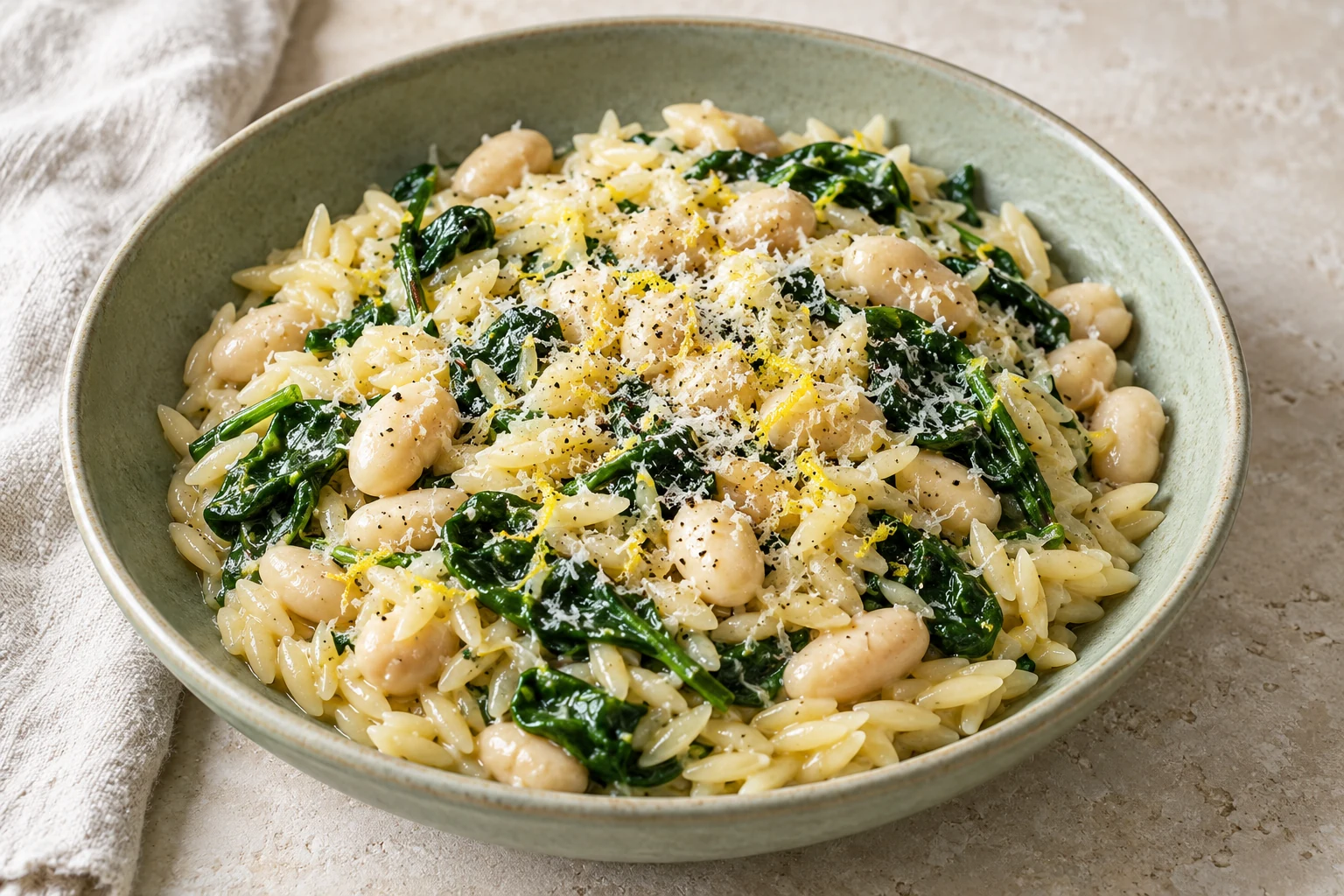
This orzo uses an absorption-style method, so its cooking liquid becomes part of the finished dish rather than being poured away. That makes stirring and small water adjustments more important than in a large pot of boiling pasta. The thirty-five-minute recipe serves four with cannellini beans and spinach, finished off the heat with lemon and most of the Parmesan.
Lemon orzo with spinach & white beans makes 4 servings, with 35 min estimated total time. View the standalone recipe page.
Prepare additions before the orzo needs attention
Dice the onion finely and mince the garlic before heating the oil. Drain and rinse the cannellini beans, weighing the 480 g after draining. Have the washed spinach ready in two manageable portions. Once the orzo is simmering, the bottom needs frequent attention, so opening cans and sorting leaves at that point makes the sequence harder.
Divide the Parmesan into 45 g for the pot and 15 g for the bowls. Keep the lemon juice, zest and pepper together for the off-heat finish. Measure the 700 ml broth and place the extra 100 ml water nearby, but do not pour in the water automatically. It is a reserve for the consistency the pan actually needs.
Soften the onion before adding pasta
Heat the oil in a wide, heavy saucepan over medium heat and cook the onion with salt for five to six minutes. Stir until softened without hard browned pieces. Add garlic for thirty seconds, then stir in the dry orzo for one minute. This brief stage distributes the pasta through the oil and aromatics before liquid enters.
Use a spoon or flexible spatula that can sweep along the bottom and into the pan corners. A wide pan gives you room to distribute beans and spinach later, but it may also lose liquid faster than a narrow pot. Keep that in mind when judging evaporation; the measured water reserve is more useful than blindly following the clock.
Simmer with frequent bottom-to-top stirring
Add the broth, bring to a gentle boil, then reduce to a steady simmer for nine to twelve minutes. Stir often along the bottom so small pieces do not settle into a stuck layer. Scraping only through the visible surface leaves that lower layer untouched. Keep the simmer lively enough to cook the pasta without reducing liquid too aggressively.
Taste a few pieces to assess tenderness. If the pan looks dry while the orzo is still firm, add some of the measured water, stir and let it absorb before deciding whether more is needed. The target is moist pasta with a little movement, not a dry mass or a separate soup of broth around cooked grains.
Warm the beans without breaking them apart
When the orzo is almost tender, fold in the drained beans and cook for two to three minutes until hot. Use broad turns rather than vigorous beating, which can crush the beans and make the mixture heavier. Their heating time follows the main pasta simmer, so do not cook the orzo to complete softness before this step begins.
Add spinach in two batches, stirring each into the hot mixture until wilted, about two minutes total. The leaves initially occupy more space than the finished amount. Waiting for the first addition to collapse makes the second easier to handle. Check the base of the pan again as the leafy volume settles; it still needs enough moisture to remain glossy.
Finish off the heat and serve after a short rest
Remove the pan from the heat before stirring in 45 g Parmesan, the lemon juice, half the zest and the pepper. Fold until the cheese is distributed through the moist pasta. A gentle residual warmth is the intended finishing condition; keeping the burner high can tighten the mixture while you are trying to make it smooth.
Rest for one minute, then reassess. Orzo continues taking up liquid, so loosen with any remaining measured water if needed. Divide equally among four shallow bowls and finish with the remaining Parmesan and zest. Serve immediately while the sauce still moves around the pasta. A lengthy hold will produce a thicker texture than the freshly finished dish.
Common questions
Why does the orzo stick to the bottom?
Small pasta settles during an absorption-style simmer. Stir frequently across the whole bottom and into the corners, and use the measured water gradually if liquid is disappearing before the pasta is tender.
Why does the dish thicken after I turn off the heat?
The orzo continues absorbing moisture during the short rest. Recheck after one minute and loosen with any remaining measured water before plating, rather than adding all the reserve at the start.
Technique & food-safety references
These primary references support the technique, safety and storage guidance. The recipe and cooking explanations are original Recipe Pinboard content.