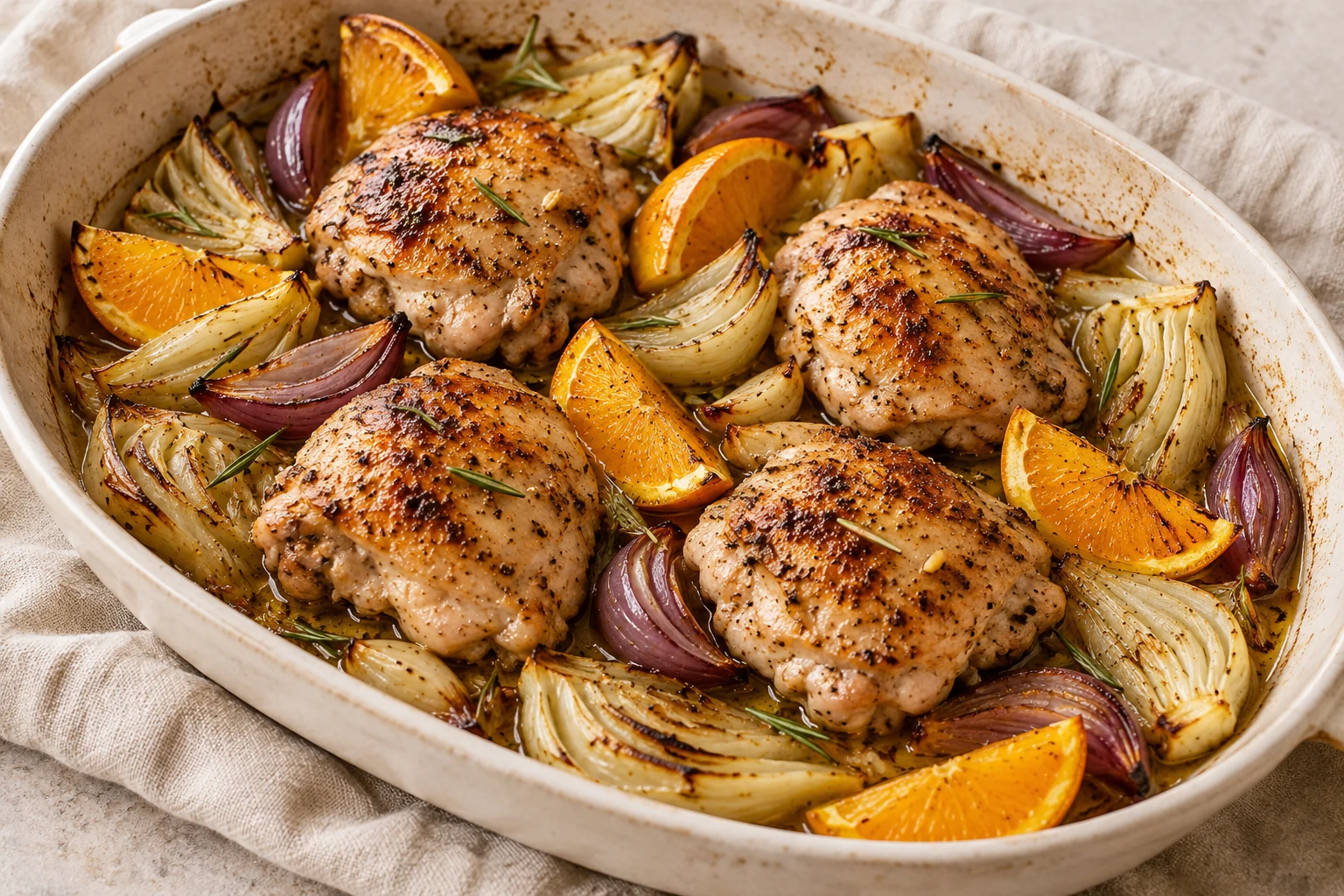
The fennel and onion begin roasting before the chicken joins them. That head start is the organizing idea behind this seventy-minute tray dinner: dense vegetable wedges need time, while the four boneless thighs need enough space and a temperature check of their own. Orange enters as both measured juice and wedges, with rosemary in the rub and scattered over the dish.
Orange & fennel roast chicken makes 4 servings, with 1 hr 10 min estimated total time. View the standalone recipe page.
Trim and cut vegetables to the stated thickness
Weigh 600 g trimmed fennel and cut it into 1.5 cm-thick wedges, leaving a little core attached to hold the layers together. Removing every trace of core can make the wedges fall into loose strips. Cut the red onion into wedges too, separating obvious clumps enough that oil and oven heat can reach their surfaces.
Use a large shallow roasting dish around 33 × 23 cm. Toss the vegetables with the first 14 g oil, 2 g salt and half the pepper, then spread them loosely. A deep pile in a smaller dish changes the balance toward trapped moisture. Begin their fifteen-minute roast in the fully heated 425°F/220°C oven while you prepare the other ingredients.
Prepare two different orange components
Scrub the oranges before cutting. Cut one into eight wedges and juice the other to obtain the measured 60 ml. Fruit varies in juiciness, so use the measured quantity rather than automatically pouring every drop into the dish. More liquid would change how much the vegetables roast versus simmer during the second stage.
Separate the rosemary leaves into the chopped portion for the chicken and the whole portion for scattering. Prepare the garlic while your board is still dedicated to produce. These small organizational steps let you handle the raw chicken last, then clean the work area without needing to return to the same board for herbs or fruit.
Coat the thighs and arrange them without overlap
Pat the four similarly sized boneless, skinless thighs dry without rinsing them. Rub with the remaining oil, salt and pepper, plus garlic and chopped rosemary. Keep raw-chicken utensils and surfaces separate from food that is ready to eat. The four large thigh pieces are the portion structure; cutting them into small chunks would change the roast.
Stir the partially roasted vegetables, pour the measured juice around them and add the orange wedges. Place the chicken on top, smooth side up, without overlap, then scatter the remaining rosemary leaves. Let the thighs rest in their natural shape rather than rolling them into unusually thick bundles. Their exposed upper surfaces should have room to color.
Check the chicken and vegetables independently
Roast for twenty-five to thirty-five minutes. Insert a food thermometer into the thickest part of every thigh and verify at least 165°F/74°C. Check the actual center rather than a thin edge or a pocket between folds. Similar starting weights help, but they do not eliminate differences in thickness or position within the dish.
Probe the fennel separately for tenderness and look for browned edges. If the chicken is ready first, move it to a clean plate and return the vegetables to the oven for five minutes as directed. Do not keep cooked thighs in the oven solely because one thick fennel wedge is lagging. Conversely, tender vegetables do not establish that the chicken has reached its endpoint.
Rest and distribute citrus juices fairly
Rest the cooked chicken for five minutes before serving. Divide the vegetables, orange wedges and pan juices among four plates, with one thigh on each. Stir the dish juices gently before spooning them out so the first portion does not receive only oil and the last only concentrated orange liquid. Watch for hot steam when lifting from the dish.
Each serving gets a share of roasted orange, whose warm flesh can be squeezed over the chicken if desired. The peel does not have to be eaten. Keep the four-way division in mind as you plate the fennel and onion, since wedges differ in apparent size after roasting. This is a chicken-and-vegetable dinner without an additional starch specified.
Common questions
Why is the fennel still firm when the chicken is cooked?
The wedges may be thick or crowded. Preserve the fifteen-minute vegetable head start and the 1.5 cm cut. If necessary, remove cooked chicken to a clean plate and roast the vegetables for the additional five minutes.
Can I pour in extra orange juice for more sauce?
Keep to the measured 60 ml for this method. Additional juice changes the liquid level and can make the vegetables simmer more than roast. Divide the existing pan juices at serving.
Technique & food-safety references
These primary references support the technique, safety and storage guidance. The recipe and cooking explanations are original Recipe Pinboard content.