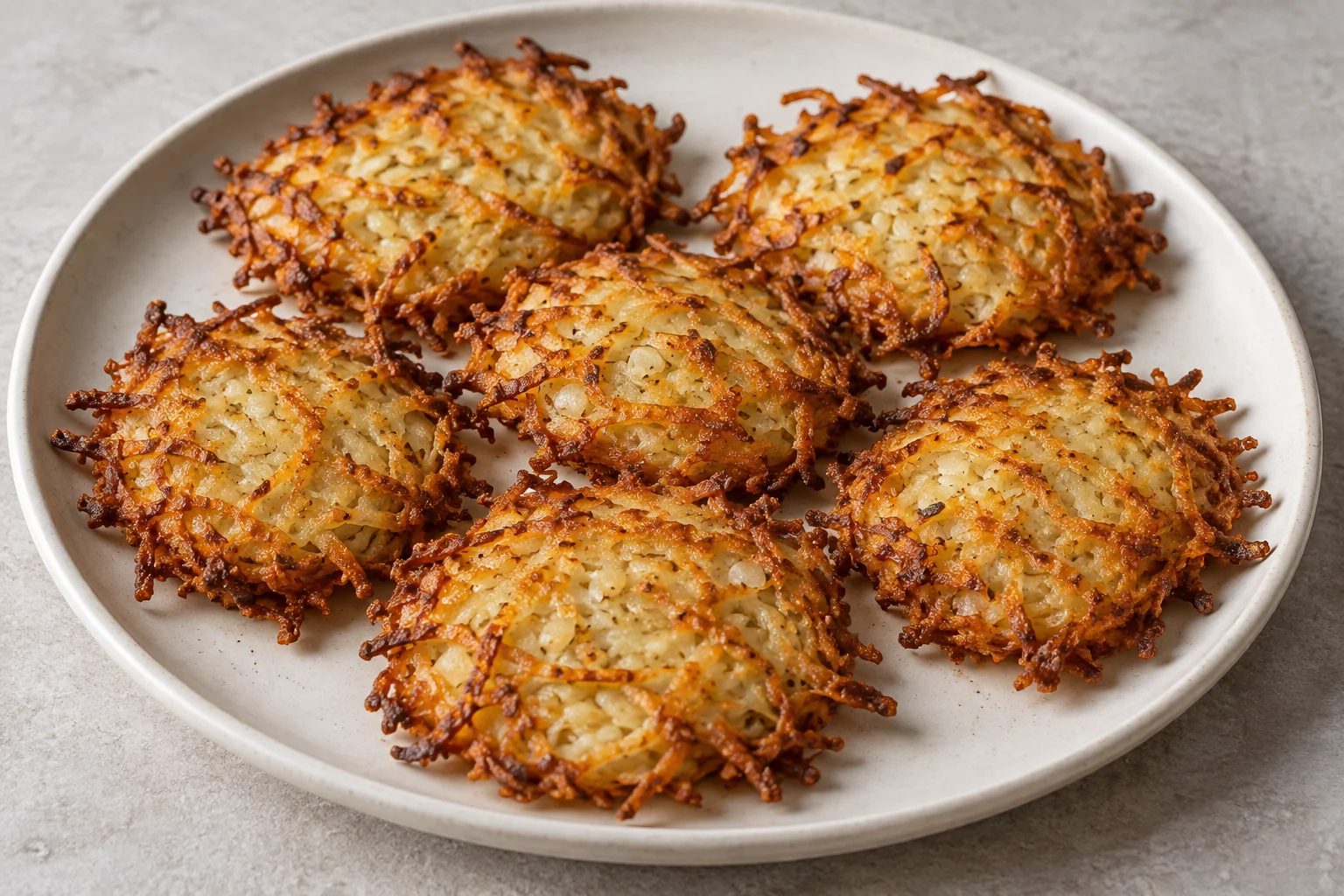
An oven-baked latke needs a thin shape, a dry shredded mixture and contact with a lightly oiled hot surface. It will not behave exactly like a pancake submerged in frying oil. The goal here is a golden underside and lacy edges with a tender center. The recipe makes twelve small latkes, with three counted as one portion.
Oven-baked potato & onion latkes makes 4 servings, with 1 hr 5 min estimated total time. View the standalone recipe page.
Grate evenly and squeeze in manageable batches
Use the coarse holes of a grater so the potatoes retain visible shreds. Very fine grating makes a wetter mixture and a different texture. Grate the onion as well, then gather both vegetables in a clean sturdy towel. Squeeze over a bowl in small batches if the full bundle is difficult to grip. Removing liquid is the main preparation step that prevents steaming. Do not rinse the grated potato after squeezing: that would add water back and wash away starch needed to help the mixture hold together.
Return the settled starch, not the liquid
Let the squeezed liquid sit undisturbed for five minutes. A pale starch layer settles at the bottom while watery liquid remains above it. Carefully pour off the top and scrape the starch into the shreds. This recovers some binding material without returning all the moisture. Add the egg and flour only after that step so you can mix them evenly. The nutrition estimate conservatively includes the original potato and onion masses, since the exact nutrients discarded with the liquid have not been measured for this recipe.
Flatten every mound to the same thickness
Divide the mixture into twelve equal piles before pressing them flat. A thick domed center stays soft long after the edge browns, so keep each latke no more than about 8 mm thick. Spread stray shreds outward rather than piling them on top; those strands form the lacy edge. Leave space between latkes. If your tray is too small, use two trays and allow for rotating their positions, rather than crowding all twelve together. Crowding restricts evaporation and encourages the pancakes to steam into each other.
Wait for a set underside before turning
Use parchment rated for the oven temperature and the measured oil on both the tray and tops. At the first check, slide a thin spatula gently under one edge. If the pancake tears and sticks, give it a little longer to set instead of forcing a flip. Turn with one deliberate motion and avoid pressing repeatedly afterward. The second side needs time to brown as well. Check a center reaches 160°F (71°C) because the mixture includes egg; exterior color alone does not establish that the middle is cooked.
Serve promptly and reheat on an open tray
Freshly baked latkes lose crispness when stacked tightly because steam becomes trapped between them. Serve in a loose layer when possible. Cool leftovers only briefly, then refrigerate promptly in shallow containers. Use within three to four days and reheat to 165°F (74°C). An oven tray can restore some edge crispness better than a covered microwave container, although the reheated texture will differ from fresh. Applesauce or sour cream can be served separately, but neither is included in the recipe’s ingredients, image or nutritional estimate.
Common questions
Why are my latkes falling apart?
They may have been flipped before the underside set, left too wet, or shaped with thick loose centers. Squeeze thoroughly, mix the binder through every shred and flatten consistently. Let the first side form a crust before trying to lift it.
Can I call these gluten-free?
The published recipe contains all-purpose wheat flour and is not tagged gluten-free. Replacing it requires a separate texture and ingredient review. The presence of mostly potatoes does not make the complete recipe free of gluten.
Technique & food-safety references
These primary references support the technique, safety and storage guidance. The recipe and cooking explanations are original Recipe Pinboard content.