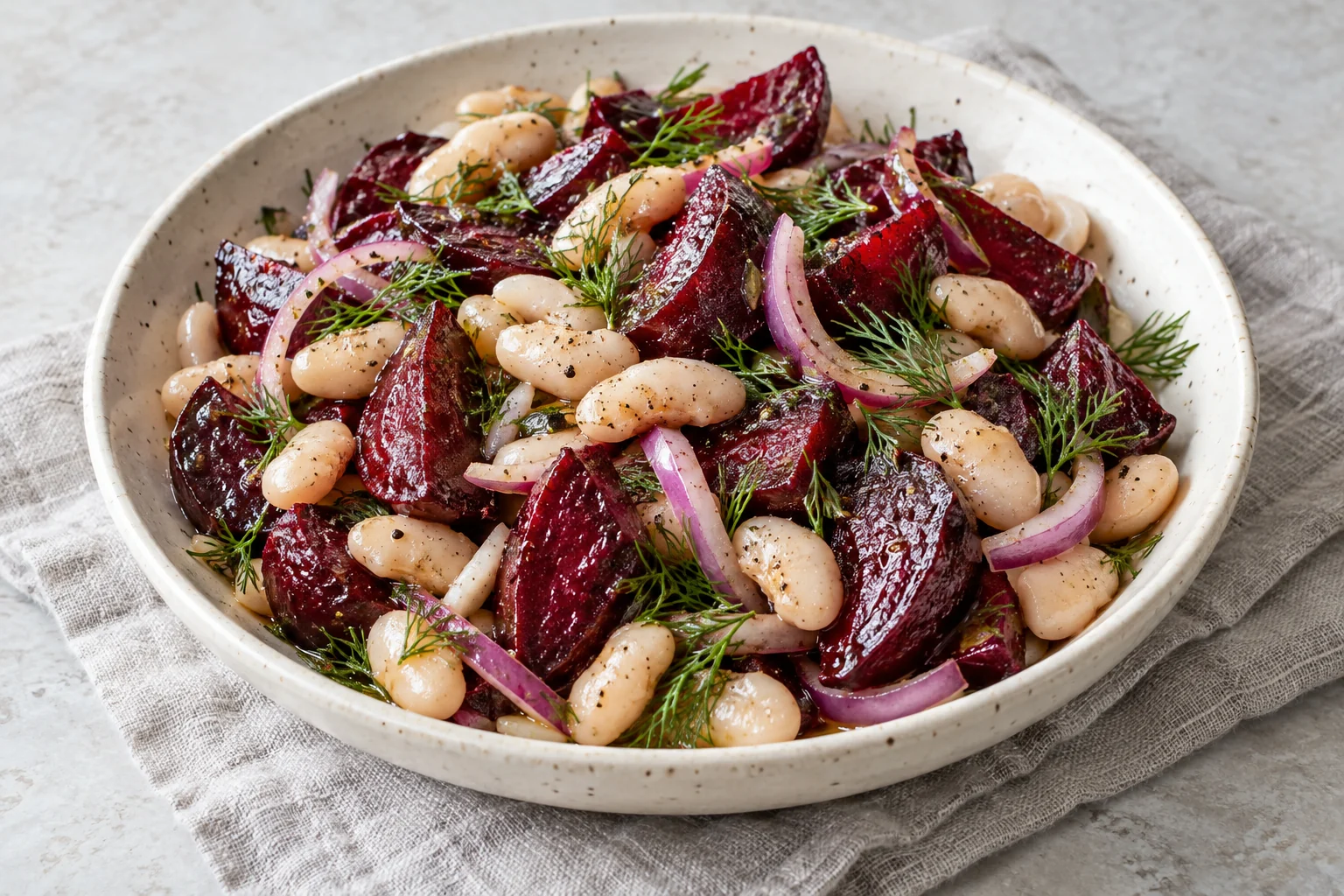
The success of this salad rests on contrasts: tender beet wedges, intact white beans, fine onion strands and a light lemon dressing. Roasting takes most of the 75-minute planning window, leaving about 20 minutes of active work. It makes four equal portions and can be served slightly warm after the required ten-minute beet cooling stage.
Roasted beet, white bean & dill salad makes 4 servings, with 1 hr 15 min estimated total time. View the standalone recipe page.
Weigh the prepared ingredients rather than the packaging
The beet quantity is 600 g after peeling and trimming. Cut wedges about 2 cm thick so the centers cook at a similar rate; an assortment of thin tips and large solid chunks will finish unevenly. A stable cut face on the board makes this dense vegetable easier to portion carefully and consistently.
The cannellini bean amount is 480 g drained weight, not the weight of beans plus canning liquid. Rinse and drain thoroughly. Excess water from the beans can dilute a dressing that contains only 15 g oil after the roasting allocation. Slice the red onion into very thin half-moons and remove tough stems from the dill.
Use the covered stage to soften the beets
Heat the oven to 400°F (200°C). Coat the wedges with 15 g oil and 1.5 g salt, spread them in a single layer on a rimmed sheet, and cover tightly with foil. The first 25 minutes are covered. This is a deliberate part of the method, rather than an optional protection against color.
Open the foil cautiously with the escaping steam directed away from your face and hands. Turn the wedges, then roast uncovered for another 15–25 minutes. Check their thickest parts with a small knife; it should enter with little resistance. Surface color alone cannot tell you whether a dense wedge is tender at its center.
Let the onion sit in the dressing while roasting continues
Whisk the remaining 15 g oil with 30 g lemon juice, 5 g Dijon mustard, the remaining 1.5 g salt and the pepper. Add the thin onion and leave for ten minutes. This step fits inside the roasting window, so there is no reason to postpone all dressing preparation until the beets leave the oven.
The dressing is intentionally light and lemon-forward. Mustard helps it come together, but it does not turn into a thick sauce. Whisking thoroughly before adding the onion distributes seasoning more evenly than pouring the components separately over the finished salad. Leave the beans out until final assembly so their skins are not repeatedly stirred.
Cool briefly, then fold rather than mash
Transfer cooked beets to a wide shallow dish for ten minutes. Spreading them out gives the cooling stage a chance to work; a deep heap holds more heat. The salad may still be slightly warm afterward. You do not need to wait for the wedges to become refrigerator-cold before following the recipe's mixing step.
Add the drained beans, cooled wedges and chopped dill to the dressing. Use a broad spoon or flexible spatula to lift from underneath and turn the mixture gently. Some beans naturally become pink from beet juice. Trying to keep every bean white by repeatedly rearranging the bowl is more likely to break them than improve the salad.
Make four balanced portions and chill what remains
Distribute beets and beans evenly across four bowls, bringing up dressing from the bottom so no portion receives only dry pieces. Check that the onion strands and dill are spread through the mixture. The stated dish stands on these ingredients; adding cheese or a bed of leaves changes what is included in each serving.
Refrigerate saved portions promptly in shallow containers at 40°F (4°C) or colder and use within three to four days. Do not leave the salad out to cool completely. Discard portions left unrefrigerated beyond two hours, or one hour above 90°F (32°C). The lemon dressing does not remove those time limits.
Common questions
Why are the beet centers hard after roasting?
The largest wedges may be thicker than 2 cm, or the covered stage may not have trapped steam effectively. Continue roasting until a knife enters the thickest part easily; do not use the outside color as the only test.
Can I use beans straight from the can without draining?
Not for this measured dressing. The recipe uses rinsed, thoroughly drained cannellini beans, weighed after draining. Including the canning liquid changes both the amount of beans and the consistency of the salad.
Technique & food-safety references
These primary references support the technique, safety and storage guidance. The recipe and cooking explanations are original Recipe Pinboard content.