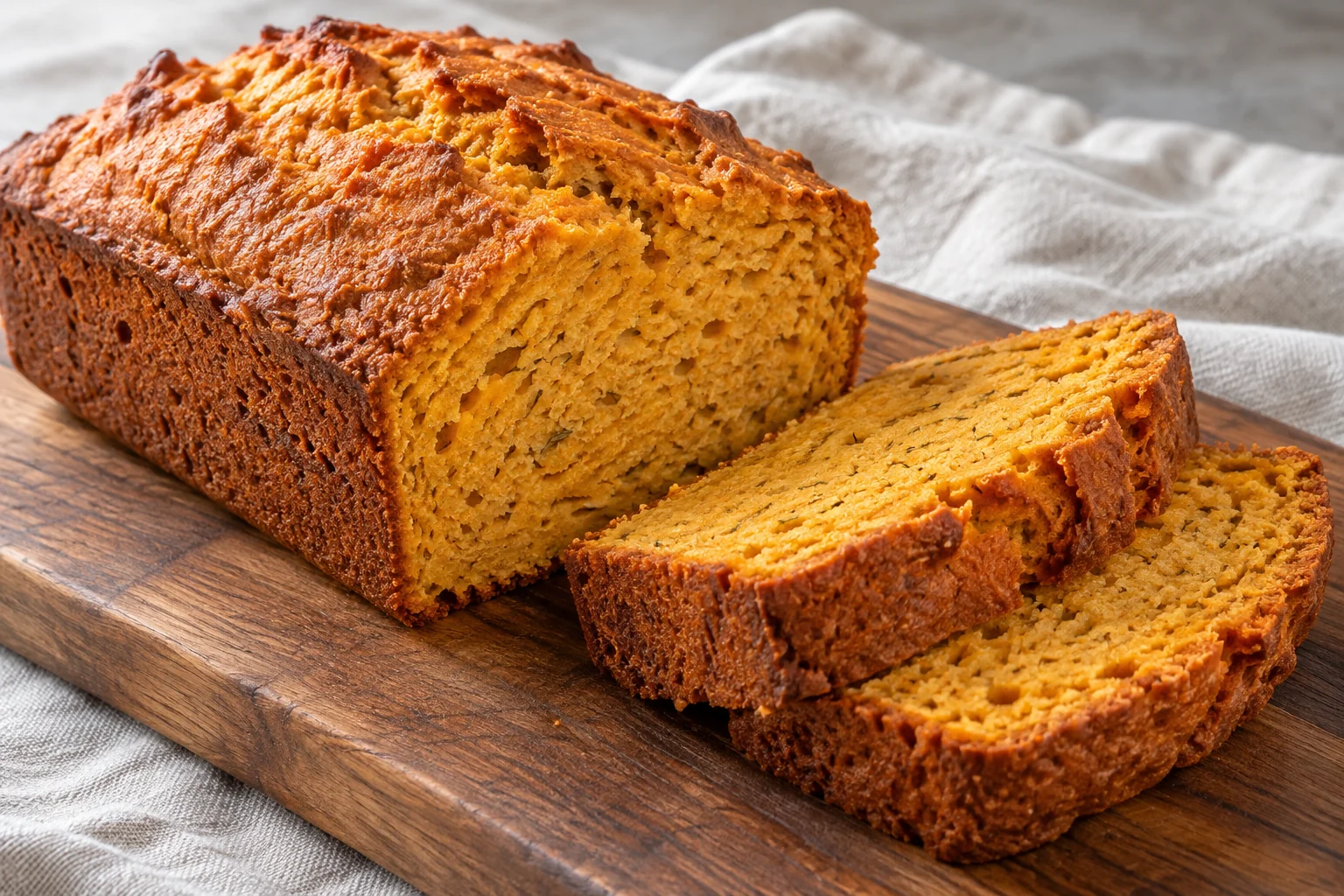
This is a savory baking-powder loaf, with neither yeast fermentation nor a sweet cake glaze. Sweet potato gives the crumb its orange color and moisture, while eggs and flour help the slices hold together. The most useful controls are the cooked potato texture, restrained mixing and a patient cooling period. None can be judged from crust color alone.
Sweet potato & rosemary quick bread makes 10 servings, with 2 hr 30 min estimated total time. View the standalone recipe page.
Weigh the potato before steaming
Start with the stated peeled edible mass and small evenly sized cubes. Steaming softens the potato without immersing it in a large volume of water. Drain surface droplets, then mash the entire amount; do not measure a loosely packed cup of mash and assume it matches the canonical weight. Small differences in potato variety and moisture remain possible. A smooth mash is desirable because large firm pieces interrupt the crumb and make a skewer test harder to interpret near the center.
Cool the mash before adding eggs
The fifteen-minute cooling period is part of the recipe timeline. Spread the mash in a bowl so heat can escape and stir it once or twice. It should no longer be steaming strongly when eggs and yogurt are added. Mixing eggs into very hot potato risks partially setting them before the batter is assembled. Whisk the wet ingredients together until the oil is distributed; isolated oily streaks will not disappear reliably once the flour has already been folded in.
Mix the leavening through the flour
Baking powder needs to be evenly dispersed through the dry ingredients. Crush the dried rosemary so it contributes small flecks instead of long woody needles, then mix it with flour, powder and salt. Fold the dry mixture into the wet mixture only until dry flour disappears. The batter is thick enough to spread into the lined pan rather than pour like cream. Do not knead it, beat it smooth for several minutes or add extra flour to make a bread dough.
Check the center rather than the top
Use the stated loaf-pan dimensions so the batter depth is reasonably predictable. A much smaller pan gives a deeper center that needs longer to cook; a wider pan makes a shallower loaf. Near the end of baking, insert a thin skewer into the central crumb. Wet batter means more time is needed, even if the crust is already brown. A loose foil tent can protect the top. A few moist crumbs are different from a coating of uncooked paste.
Let the crumb settle before slicing
After ten minutes in the pan, use the parchment to lift the loaf onto a rack. Air beneath the base allows steam to escape instead of condensing against the pan. The additional thirty-minute cooling period makes the loaf easier to cut cleanly; slicing immediately can compress the moist center. Cut ten equal slices for the stated portion basis. This bread contains wheat, egg and milk yogurt, and its vegetarian screen does not remove any of those ingredients or their label considerations.
Common questions
Why is there a gummy band in the loaf?
Possible causes include a wet mash, excessive mixing, an underbaked center or cutting while very hot. Check those separately before changing the flour ratio. Use the center crumb and cooling cues together rather than relying only on the external crust.
Can I use pumpkin puree instead?
Pumpkin has a different moisture and nutrient profile. A direct swap is a separate variation requiring its own amount, timing and calculation; the published loaf uses weighed sweet potato.
Technique & food-safety references
These primary references support the technique, safety and storage guidance. The recipe and cooking explanations are original Recipe Pinboard content.


