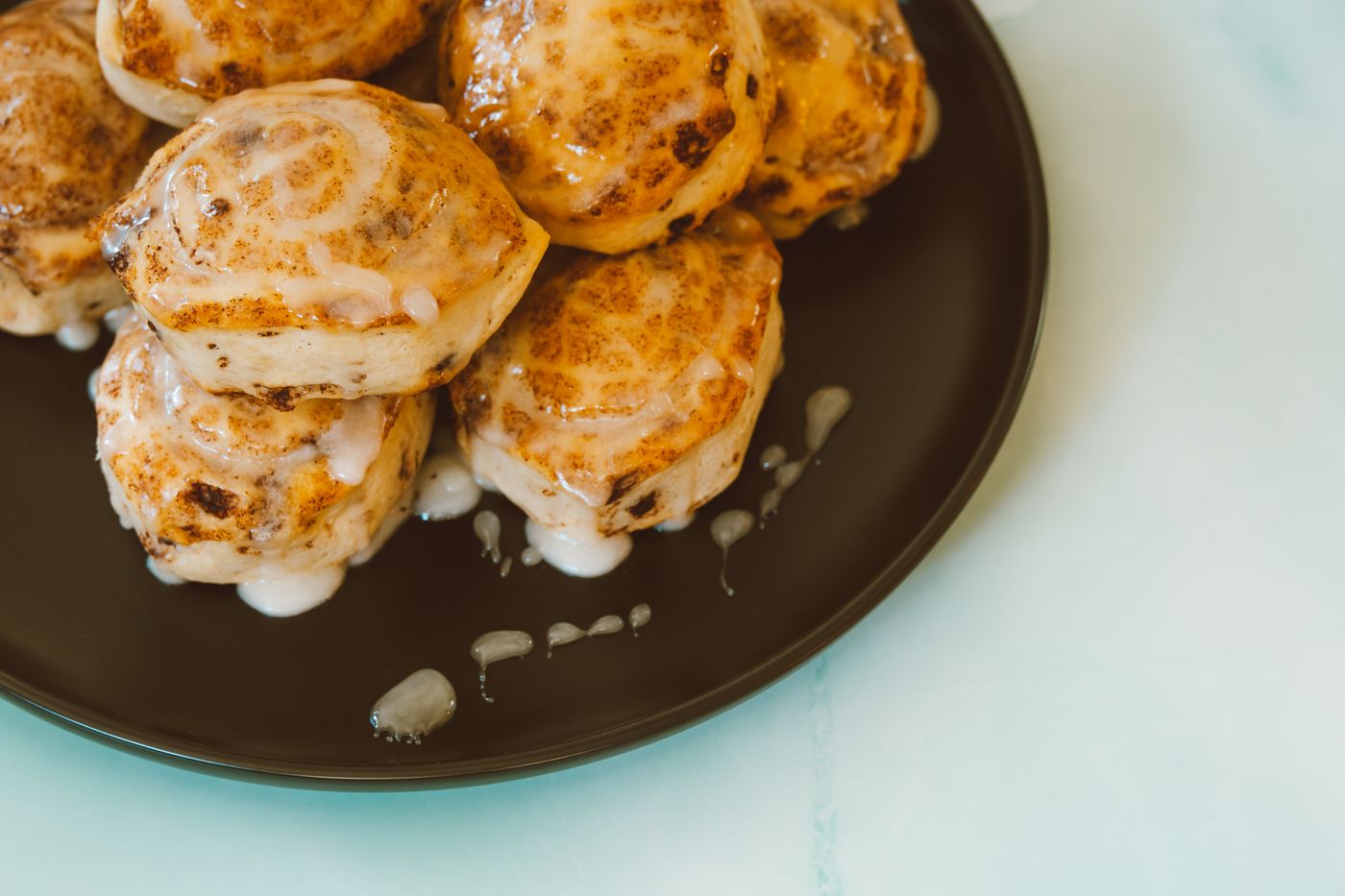
These vanilla-iced cinnamon rolls make twelve portions in a 9-by-13-inch dish. Their approximate 150-minute schedule includes two rises, baking and a short cooling period, so room temperature can move the finish time. The dough uses 500 g all-purpose flour, instant yeast, warm milk, an egg and melted butter. Success depends on keeping that dough soft enough to expand and shaping a log that gives every roll a similar share of filling.
Vanilla-iced cinnamon rolls makes 12 servings, with 2 hr 30 min estimated total time. View the standalone recipe page.
Separate the dough, filling and icing ingredients
Mix the flour with 7 g instant yeast, 60 g granulated sugar and ½ tsp salt. Add 240 ml milk warmed to about 100°F (38°C), the egg and 60 g melted butter. The milk should be comfortably warm rather than scalding. Melted butter should not be so hot that it heats the egg sharply when the wet ingredients meet.
Keep the other butter portions distinct: 60 g softened butter belongs inside the spiral, while 10 g greases the dish. The 150 g powdered sugar, 1 tsp vanilla and 2–3 tbsp icing milk are for the finish. Organizing these now prevents the common mistake of putting all the butter or both sugars into the dough.
Knead until workable, then allow the first rise
Knead for the listed 8–10 minutes until the dough becomes smooth and cohesive. A soft dough may feel slightly tacky without being an unmanageable paste. Give kneading time to develop structure rather than immediately adding flour to eliminate every trace of stickiness. Extra flour would change the fixed recipe and can make the finished rolls heavier.
Cover and let rise in a warm place for about 60 minutes, watching for the dough to double. Treat the clock as a planning estimate. A cool kitchen can need longer, while excessive heat is not a useful shortcut. King Arthur’s yeast-baking guidance likewise emphasizes the specified appearance of risen dough over a guaranteed number of minutes.
Roll a rectangle and divide the log evenly
Roll the risen dough into a 30-by-40 cm rectangle with reasonably square corners and even thickness. Spread the softened filling butter across it and distribute the mixture of 100 g brown sugar and 2 tbsp cinnamon. Break up brown-sugar lumps first so one roll does not contain a concentrated pocket while another has very little filling.
Roll from the long edge, keeping the cylinder even without pulling it drum-tight. Mark twelve equal portions before cutting with a sharp knife. Support the log rather than pressing hard enough to flatten the spirals. Lightly grease the dish with its reserved 10 g butter and arrange the rolls so each has room to expand into its neighbors.
Proof again and bake the centers through
Cover for the second rise, approximately 30 minutes, while the oven reaches 375°F (190°C). Look for visibly fuller rolls rather than baking simply because the timer sounded. An under-risen batch can bake up close-textured, and more icing will not change the interior. Once ready, bake for 22–28 minutes until golden and baked through in the central rolls.
Check the middle of the dish as well as the outside edges, which color sooner. A sticky cinnamon seam can remain moist, but the surrounding bread should not look like raw dough. Do not taste unbaked dough to assess it: both uncooked flour and egg need cooking. If the surface colors too quickly, shield it loosely with foil while the centers finish.
Cool briefly, ice and store thoughtfully
Let the rolls cool for the specified 15 minutes. Whisk powdered sugar and vanilla with the lower end of the icing-milk range, then use more of the measured milk as needed for a thick drizzle. Add it gradually; restoring an overly thin icing would require extra sugar beyond the recipe. Spread over warm rolls so it softens slightly but does not disappear.
For advance planning, reserve icing until close to serving whenever practical. Keep leftover milk-iced rolls covered in the refrigerator as a conservative storage choice and warm individual portions gently; expect the icing to soften. Freeze cooled uniced rolls for a longer pause. Neither refrigeration nor freezing reverses bread that was dried out by excessive baking.
Common questions
Why did the centers push upward while baking?
A very tight log or tightly packed rolls can encourage the centers to rise above the edges. Keep rolling pressure gentle and divide the dough evenly. Some upward movement is normal, but shaping should leave the spiral room to expand.
Can I replace the vanilla icing with cream-cheese frosting?
That would be a separate variation requiring additional ingredients and different storage considerations. This recipe uses powdered sugar, milk and vanilla only. Follow the listed finish for the stated ingredient amounts, and do not assume a cream-cheese frosting is included.
Technique & food-safety references
These primary references support the technique, safety and storage guidance. The recipe and cooking explanations are original Recipe Pinboard content.