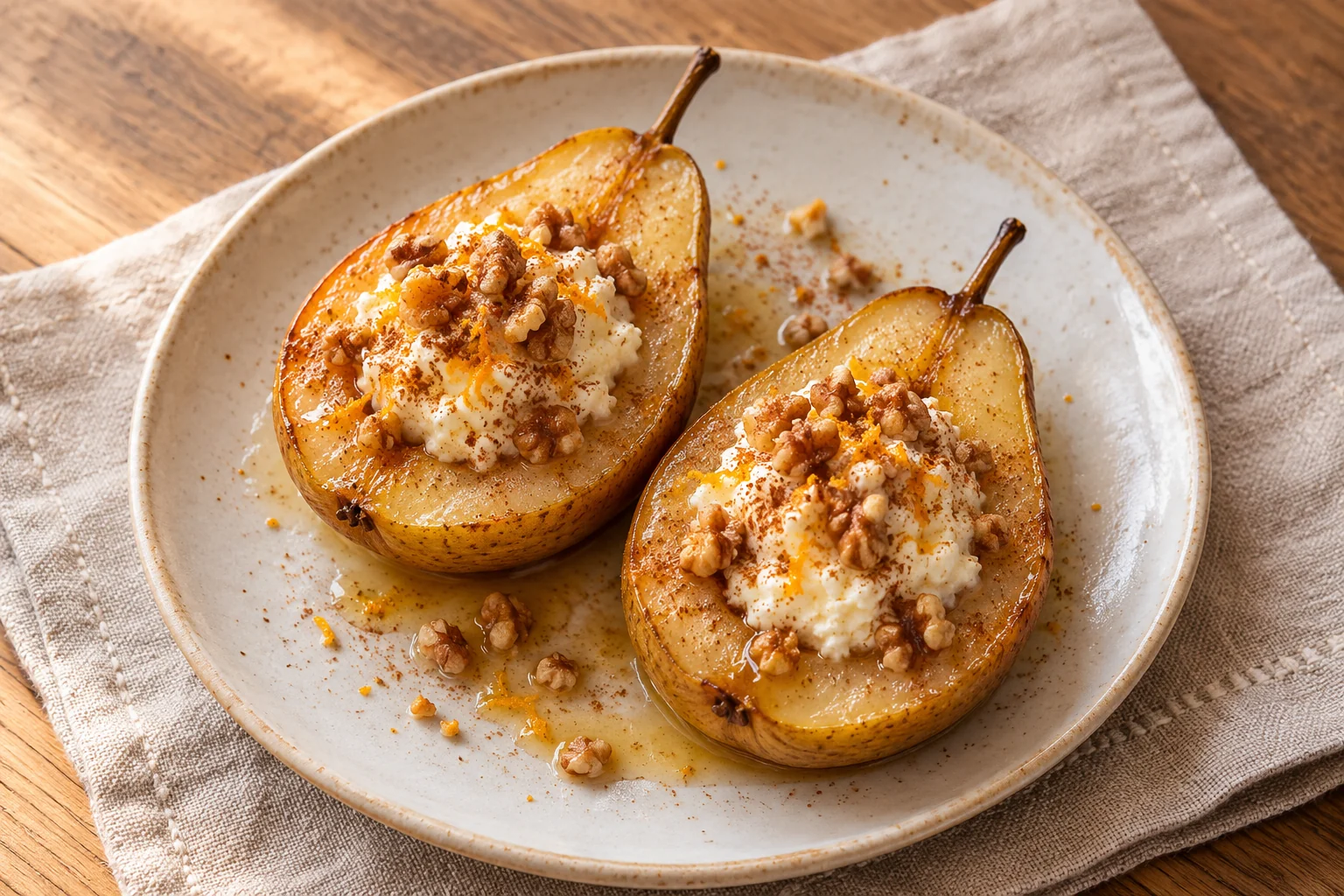
The pears receive most of their oven time before the ricotta is added. That order lets the fruit become tender without asking the dairy filling to withstand the full roast. The sixty-five-minute recipe makes eight pear halves, or four servings of two halves each, with orange-scented ricotta and toasted walnuts. Fruit ripeness can shift the timing, so tenderness matters more than a fixed countdown.
Baked pears with orange ricotta & walnuts makes 4 servings, with 1 hr 5 min estimated total time. View the standalone recipe page.
Choose pears that can hold a cavity
Use four medium pears that are ripe but still firm, around 800 g total. Fruit that is already collapsing under light pressure will be difficult to hollow and move after baking. Firmer cooking varieties can be useful, but the important check for this recipe is texture at preparation, not simply the color of the skin.
Wash, halve lengthwise and scoop out the cores and seeds with a teaspoon. Remove only enough to clear the hard center and create a place for filling. If a half rocks on its rounded underside, trim a very thin slice to make it sit steadily. Do not cut so deeply that the cavity opens through the bottom.
Brush the glaze and keep water underneath
Heat the oven to 375°F/190°C and arrange all eight halves cut-side up in a baking dish. Mix melted butter with 25 g honey and half the cinnamon, then brush over the exposed surfaces. Distribute it across the batch rather than leaving thick puddles in the first few cavities and nearly bare fruit at the end.
Pour the 60 g water into the bottom of the dish, avoiding the glazed surfaces. This keeps the glaze where you brushed it while providing a little moisture around the pears. The amount is measured; the recipe does not call for submerging the fruit or adding enough liquid to turn the dish into a poaching bath.
Bake until the thick flesh yields easily
Bake for twenty-five to thirty-five minutes and test a thick section with a small knife. It should slide in with little resistance. Pears that began especially firm may need longer, while smaller or softer halves may reach tenderness sooner. Check the fruit itself instead of waiting for every cut surface to achieve exactly the same color.
If some halves are still firm, continue the fruit stage before filling them. Ricotta is added near the end to warm, so an undercooked pear cannot be assumed to catch up during that brief final period. Keep the halves upright when checking or turning the dish; their glazed surfaces can be slippery and the hot pan liquid can spill.
Toast walnuts and mix the orange ricotta
While the pears bake, toast the roughly chopped walnuts in a dry skillet over medium-low heat for three to four minutes, stirring. Tip them onto a plate after toasting so they stop cooking against the hot skillet. Small walnut fragments can scorch before large pieces look dark, which makes watching and moving the nuts more useful than color alone.
Stir the ricotta with orange zest, salt and the remaining 15 g honey. Use finely grated colored zest rather than pieces of bitter white pith. The filling should be evenly flavored while retaining ricotta's soft texture; it does not need vigorous whipping or extra liquid. Keep it cool until the pears are tender enough to receive it.
Warm the filling and portion after resting
Divide the ricotta mixture among the eight cavities, roughly 30 g per half with the small amount of added flavoring shared across them. Return the dish to the oven for seven to eight minutes to warm the filling. This is a short finishing bake, not a request to brown the ricotta into a firm cheese crust.
Rest for five minutes, then scatter with walnuts and the remaining cinnamon. Spoon a little pan juice around the pears and serve two halves per person. Refrigerate leftovers in a covered shallow container within two hours, or one hour above 90°F/32°C. Keep any spare toasted walnuts separate if you want to preserve more of their crisp texture.
Common questions
Why are the pears hard after the stated baking time?
Their initial firmness, size or variety may require longer. Continue the first bake until a small knife enters the thick flesh with little resistance, then add ricotta for the short final warming stage.
Should the ricotta be baked from the beginning?
No. The pears need their own tenderizing bake first. Add the ricotta only after the fruit is tender, then warm it for the specified seven to eight minutes.
Technique & food-safety references
These primary references support the technique, safety and storage guidance. The recipe and cooking explanations are original Recipe Pinboard content.