Desserts · ALWAYS FREE
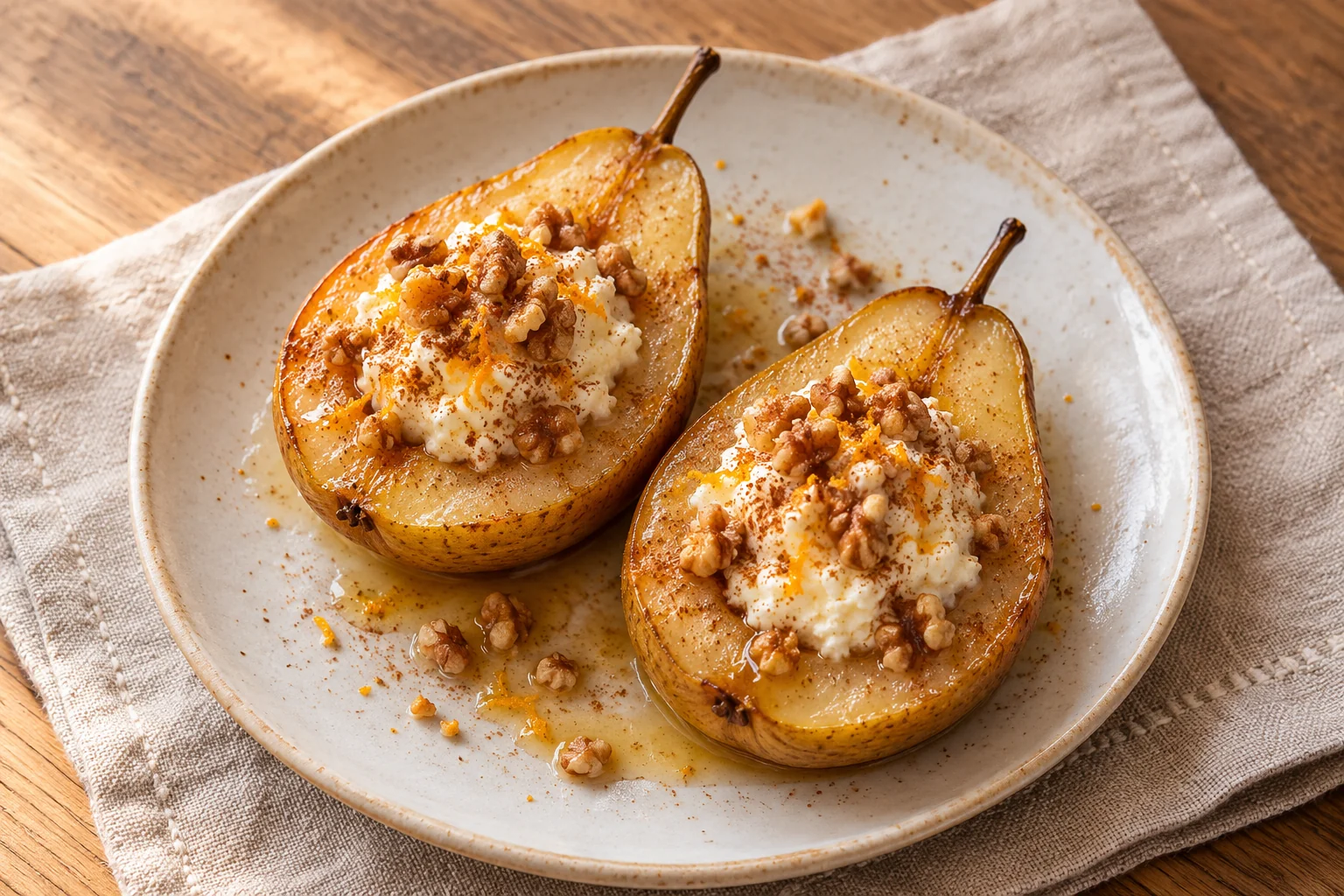
Baked pears with orange ricotta & walnuts
Tender pear halves cradle orange-scented ricotta, toasted walnuts and a light honey-cinnamon glaze.
Ingredients
Volumes are approximate. For baking, use a scale; Metric keeps the specified gram weights.
Let’s make it
- Heat the oven to 375°F (190°C). Wash the pears, halve lengthwise and scoop out the cores and seeds with a teaspoon. Trim a very thin slice from each rounded underside if needed so the halves sit steadily.
- Arrange the 8 pear halves cut-side up in a baking dish. Mix the melted butter with 0.882 oz honey and half the cinnamon; brush over the cut surfaces. Pour the 2.12 oz water into the bottom of the dish, without washing off the glaze.
- Bake for 25–35 minutes, until a small knife slips into the thickest flesh with little resistance. Firm pears can take longer; use tenderness rather than the clock. Meanwhile, toast the walnuts in a dry skillet over medium-low heat for 3–4 minutes, stirring, then transfer to a plate.
- Stir the ricotta with the orange zest, salt and remaining 0.529 oz honey. Divide among the 8 pear cavities, about 1.06 oz filling each. Return to the oven for 7–8 minutes to warm the filling.
- Rest for 5 minutes. Scatter over the toasted walnuts and remaining cinnamon, and spoon a little of the pan juices around the pears. Serve 2 halves per person. Refrigerate leftovers in a covered shallow container within 2 hours, or 1 hour if the room or outdoor temperature exceeds 90°F (32°C).
Estimated nutrition
Per serving · 1 of 4- Calories
- 320 kcal
- Protein
- 6.7 g
- Total carbohydrate
- 40.2 g
- Total fat
- 16.9 g
- Total sugars
- 25.3 g
Calculated from the listed ingredients and yield. Brands, draining, cooking and portioning can change the result. Not a laboratory analysis.
Calculation notes & sources
Estimated from listed ingredient amounts and identified food-composition profiles, divided by the stated number of servings. Not laboratory analysis or kitchen testing. The ingredient-sum method uses raw or cooked food profiles matching the ingredient state. Moisture gain/loss does not change the stated serving count. No general cooking/fermentation nutrient-retention factors are applied. Unless a discard/absorption blocker is listed, all measured pan fats and sauces are assumed consumed. Actual amounts left in pans, on utensils or during cooking can reduce intake. Optional additions are excluded when noted. Calories are kcal. Protein, total carbohydrate, total fat and total sugar are grams. Total carbohydrate includes fiber; these are not net carbs. No %DV or FDA-compliance claim. Null means unavailable, never zero. Sodium and fiber are omitted because retention, brands, rinsing and missing source rows make them less reliable here. Whole-fruit input is converted to edible flesh-and-skin mass using the CoFID 85% standard edible fraction; cores are not counted.
View the ingredient calculations · Source 1 · Source 2 · Source 3Times are estimates. Images illustrate the dish; check ingredients and portions for your needs.
Use a food thermometer for meat, fish, and egg dishes. Refrigerate perishable food within 2 hours, or 1 hour above 90°F (32°C). Reheat leftovers to 165°F (74°C). Safe cooking temperatures · USDA leftover guidance