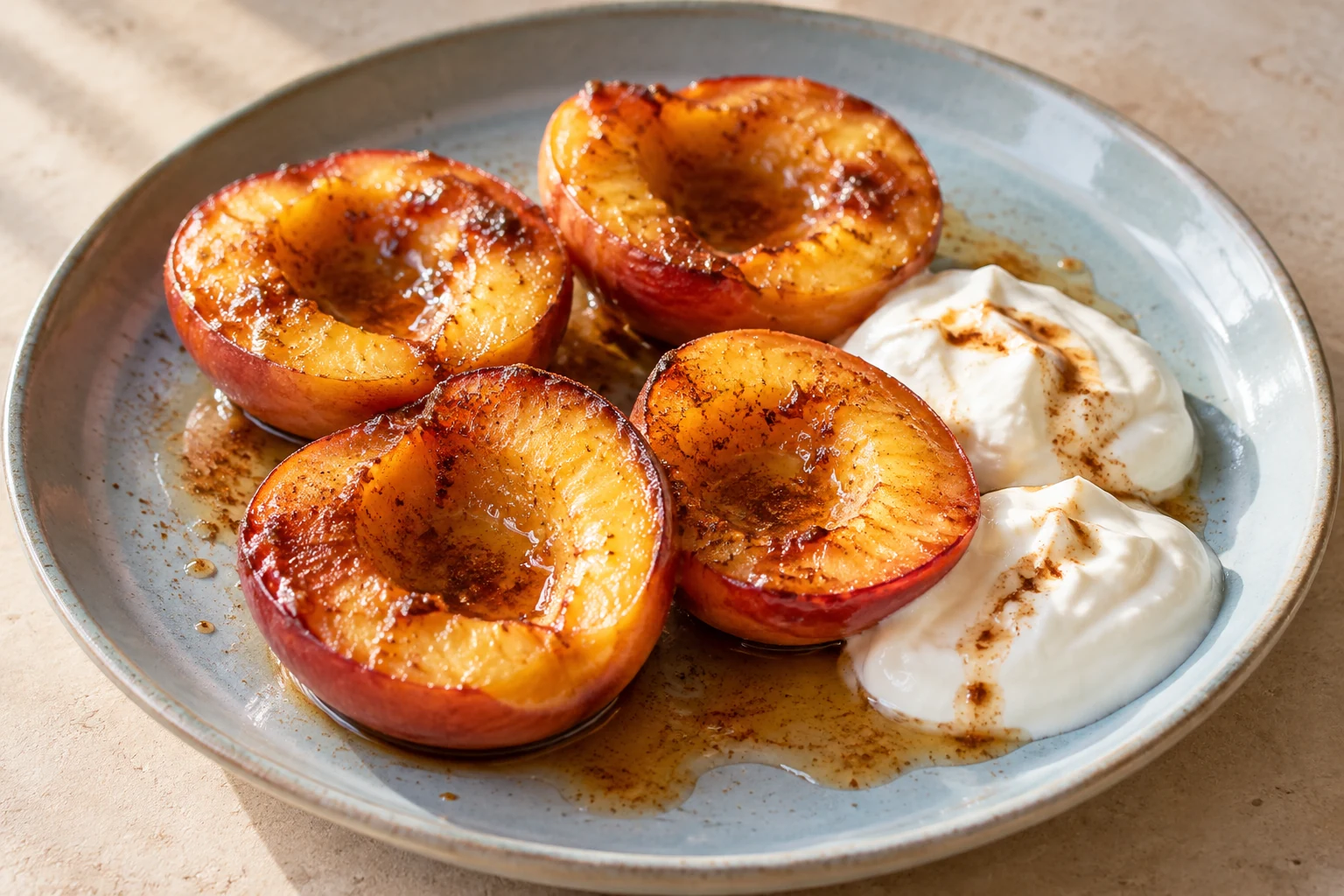
Roasting peaches is a small balancing act: soften the fruit enough for a spoon without cooking it into a collapsed puddle. This version keeps four peaches in halves, brushes them with honey and butter, and serves them with plain Greek yogurt. Fruit firmness matters more than a dramatic brown finish. The 15–20-minute oven window is a guide to tenderness, not a promise that every peach ripens alike.
Honey roasted peaches makes 4 servings, with 30 min estimated total time. View the standalone recipe page.
Choose fruit for roasting rather than pureeing
The ingredient list specifies ripe but firm peaches. Look for fruit you can halve and lift without crushing, while avoiding hard, unripe peaches that offer little give. Very soft fruit may taste good raw but can lose its shape before the coating and surrounding juices have warmed through.
Wash the peaches under running water before cutting, then dry them. Cut around the pit and separate the halves carefully. Remove any remaining hard pit fragments from the cavities. Keep the halves intact; smaller pieces would expose more flesh and would not follow the same roasting behavior.
Arrange the halves to catch the coating
Set the eight peach halves cut-side up in a baking dish, with room to see their edges. The natural hollows collect some honey mixture and juice. Choose a dish in which they sit comfortably rather than being wedged upright or piled against one another.
Leave the skins on, consistent with the card, and use them as support when moving the fruit. A little tilt is harmless, but a half leaning on its side lets the honey run straight into the pan. Reposition it gently before brushing rather than trying to correct it when hot.
Mix a small, even coating
Combine two tablespoons of honey, one tablespoon of melted butter, the half teaspoon of vanilla and quarter teaspoon of cinnamon before brushing. Stir again if the mixture separates while you work. Cinnamon should be distributed rather than left as dry clumps on a few peaches.
Brush all the cut surfaces with the measured mixture, working around the cavity as well as through it. More honey is not needed to make the fruit roast properly. Pools on the bare baking dish can darken faster than the moist fruit, so aim for coverage of the peaches rather than flooding the dish.
Use a tenderness check at 400°F
Start inspecting the fruit near fifteen minutes. A thin knife or skewer should enter the flesh with little resistance, but the half should still hold together when nudged. Check a firmer-looking peach as well as a softer one if the batch varies in ripeness.
Do not prolong roasting just to force every surface to become deeply browned. The useful finish is tender fruit with its shape intact. Juices may be thin or more syrupy depending on the peaches; they are meant to be spooned over the serving, not cooked down into a separate caramel.
Let the fruit settle before adding yogurt
Give the peaches the specified five-minute cooling period. Move them with a broad spoon or spatula, supporting the softened flesh rather than pinching it with tongs. Divide two halves into each of four servings, then add the cup of Greek yogurt across the portions and spoon over pan juices.
Keep unused yogurt refrigerated and store leftover peaches separately from it. Refrigerate the fruit promptly in shallow covered containers, within two hours or one hour above 90°F, and use within three to four days. If reheating leftovers, bring them to 165°F before adding cold yogurt; expect the fruit to soften further.
Common questions
Why did my peaches collapse?
They may have started too soft or roasted beyond tenderness. Use ripe but firm fruit and begin checking at fifteen minutes instead of waiting for a dark brown surface.
Should I reduce the pan juices until thick?
The recipe does not require a reduction. Spoon the juices over the peaches and yogurt as they are; their consistency depends on the fruit and the amount of liquid released.
Technique & food-safety references
These primary references support the technique, safety and storage guidance. The recipe and cooking explanations are original Recipe Pinboard content.